
This was a very satisfying British and WestPal list addition, especially as I had dipped the same species at Snettisham in Norfolk already this year. Checking national bird news on Thursday evening (7th) I found a vagrant Nearctic wader present on the Hampshire Solent for the previous three days had been confirmed as one of the required conversions on my dwindling wish list of more regularly occurring British passage scarcities.
The adult bird in question had been cited as either Semipalmated or Western Sandpiper that are closely related and very similar. I had observed the first of those twice previously – at nearby Keyhaven Marsh (Sep 2013) and Slimbridge WWT, Glos (Oct 2015 see here) – but the second only on my January 2018 visit to Florida. Now it seemed the great and good of Hants birding society had settled opinion in favour of the species I needed nationally, and I at once resolved to go for it in the morning.
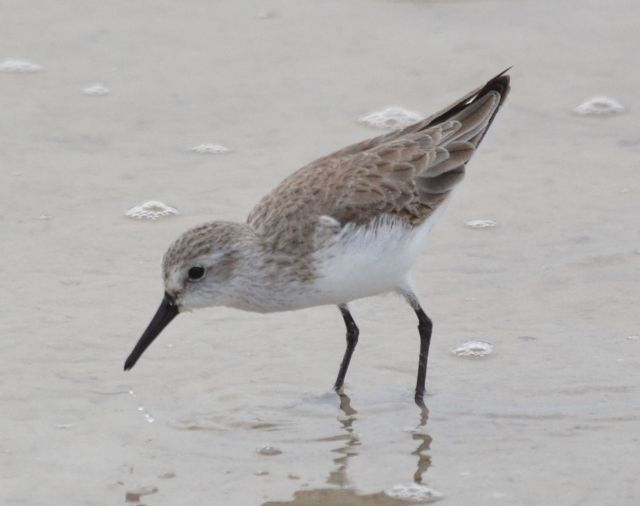
Notes attached to an entry on Hants Going Birding explained the local birders’ decision as being “based on posture, position of the legs, body shape, jizz when walking around, and thin-tipped bill shape.” The previous archive picture of my own (below, left) and outsourced image (right) possibly support all that, and having experienced Western at close range previously I felt reasonably confident of being able to recognise it again.
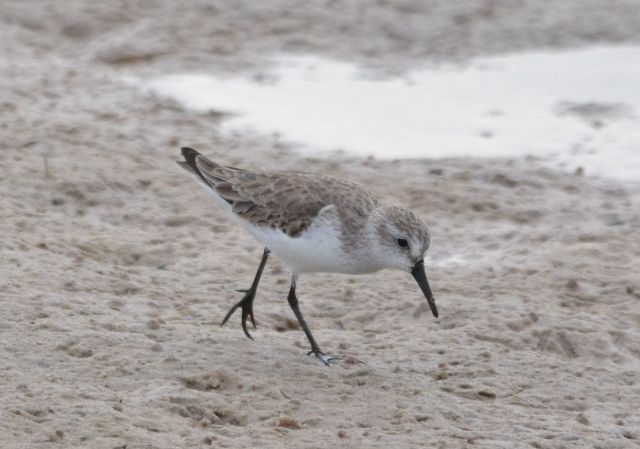
Western Sandpiper (2018) 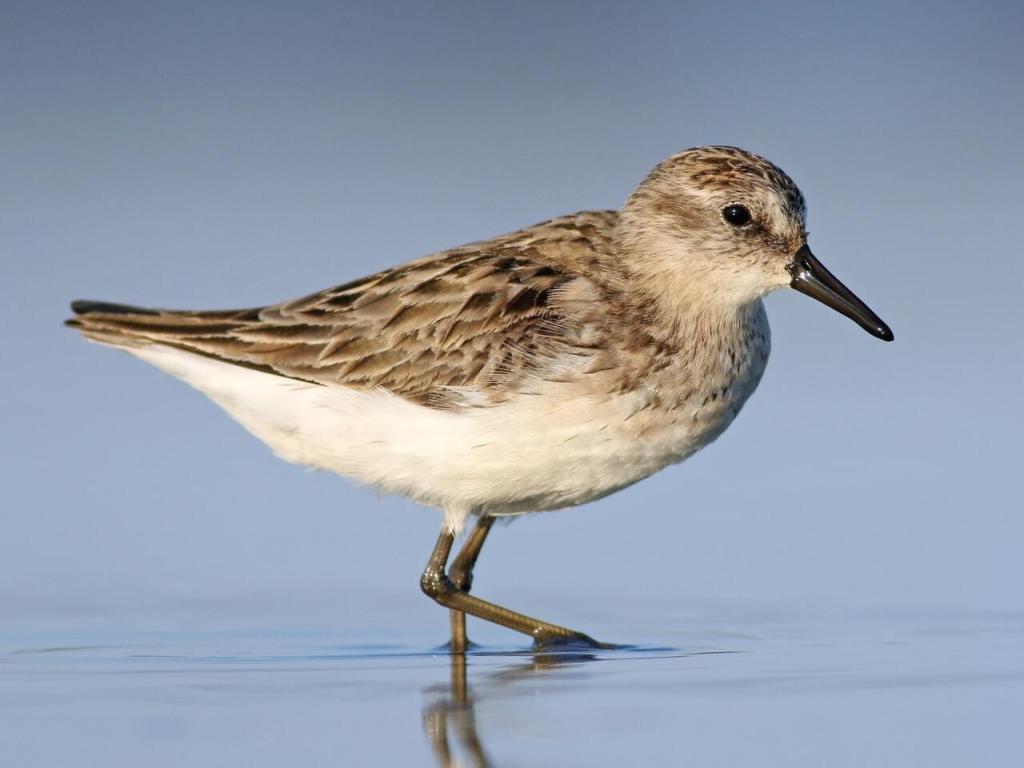
Semipalmated Sandpiper © rights of owner reserved
My quest was being reported each day after 10am and so I opted to arrive on site around an hour earlier. In the event parking without causing obstruction was easy at the junction of Maiden and Normandy Lanes to the south of Lymington, where there are several roadside car spaces. Walking out from there onto the sea wall, small groups of birders were at once visible scanning Normandy Lagoon (SZ 332938). On joining them the scarcity had not been viewed yet so it was a matter of waiting for carrier flocks to fly in with the incoming tide.
Time passed and more birders congregated in two main groups at different points on the sea wall as roosting wader numbers built up. Just before 10:50am a nearby pager owner announced the day’s first news on RBA, so the bird must have been seen by the other group. I headed over straight away but on joining them only two of their number were confident of the sighting. Some discussion then ensued as people confused two Little Stint, an adult and a juvenile, with what we all sought. And so the excitement subsided and a need for patience set in once more.
Nobody was locating the object of our intent in the nearest wader roost, but maybe it was amongst other large congregations too far away to be picked out. Another hour passed then a pair of Peregrine entered proceedings, putting up all the waders around the lagoon. After the latter re-settled a clearly knowledgeable birder standing right next to me began to issue very good directions concerning a bird on the nearest island … and there was the Western Sandpiper that to my mind immediately stood out.
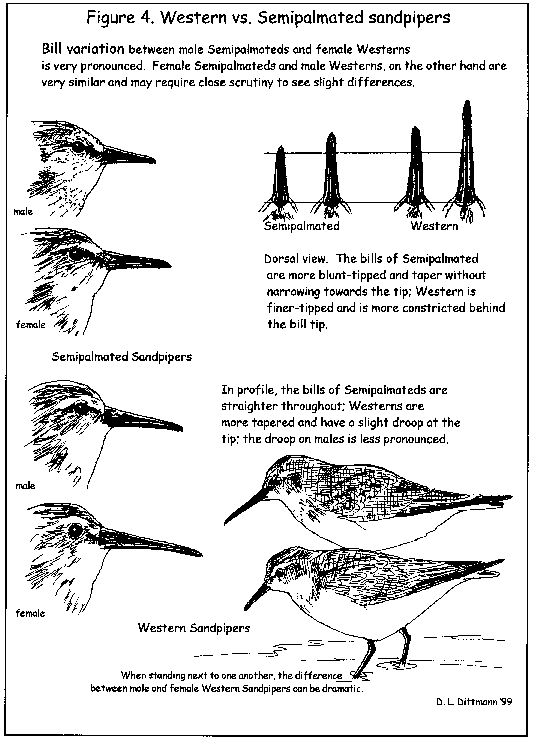
For me the most telling features were this bird’s dainty jizz, strikingly black slim legs and bill, and fine-tipped bill shape. All that was quite distinctive as it moved around amongst numbers of larger Dunlin and Ringed Plover in the middle distance, while the short bills and rounded shape by comparison of the two Little Stints people had kept calling earlier were equally plain to see. This outsourced graphic (below) presents more detail on separating Western from Semipalmated Sandpiper, with emphasis on bill characteristics.
More in line with my own experience today, the Helm guide to confusion species advises observers to think of Western Sandpiper as a miniature Dunlin. The two species are similar in shape and share other characteristics, most notably the down-curved bill. WS is a Tundra breeder in eastern Russia and Alaska, winters on both the US eastern and Pacific coasts, and is one of the rarest visitors to Europe in its group. 2021 has been a record year for the species, with the bird at Snettisham and another on the south coast of Ireland in July and at least two elsewhere on the continent.
This has been a very good national birding year for me personally with 10 list additions so far of which six are lifers. Those are White-throated Sparrow, River Warbler, Blyth’s Reed Warbler, Pacific Golden Plover, Black-browed Albatross and White-tailed Lapwing. The British list additions are Whiskered Tern, Great Reed Warbler, Black Stork and today’s bird that is number 370 on my British and 510 on my Western Palearctic lists. Still not having been to either Scotland or the Scillies, if I wait patiently and scan the daily bird news these things keep turning up within manageable range. So what remains for me to record nationally keeps getting whittled down … onward then!
 Ramblings and Scribblings