Having a year ago presented a one-off study herein of the quite beguiling fruiting cycle of the Magpie Inkcap mushroom, I have sought in the present autumn fungi season to locate and compare that of the related Shaggy Inkcap. And today on a fungus foray to Cowleaze Wood (SU727956) in the Oxon Chilterns we came across a six-strong group of the latter that allowed me to record pictorially the entire sequence.
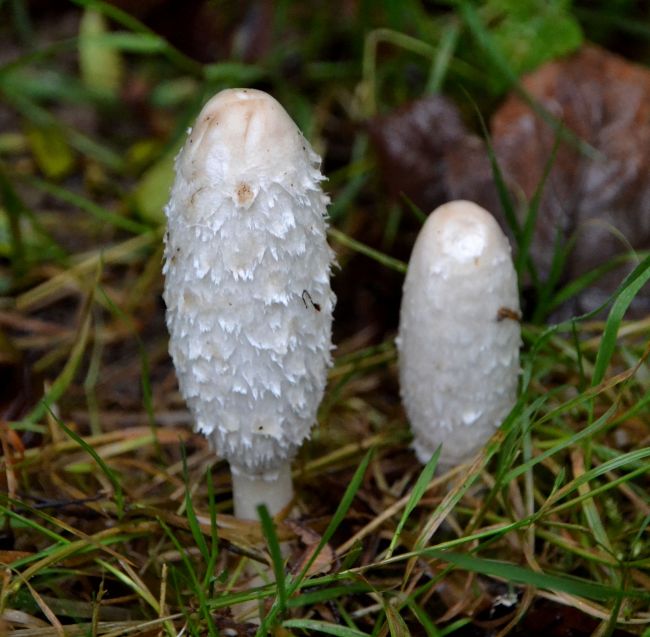
The distinctive and shapely Shaggy Inkcap (Coprinus comatus – pictured above), also known as “Lawyer’s Wig” and “Shaggy Mane”, is described as widespread and common in the British Isles; whereas my understanding is the Magpie equivalent (Coprinopsis picacaea) is less frequent and restricted to Beech woods. But I had observed far more Magpies than Shaggies prior to today. The latter is said to be found in a wider range of habitats, such as meadows, woods not just of Beech, parks, gardens and roadside verges. My researches also suggest Magpie Inkcaps mostly occur singly or at least are well spaced, while Shaggies are more likely to be found in groups such as that encountered today.
The name derives from the notably scaled surface of the white cylindrical cap that adorns a tall smooth white stem. Not having observed this mushroom in the field before today I had wondered whether its fruiting body evolves in the same four part, four day sequence as the Magpies (see here) by which I became so fascinated last season. Now, together in one cluster was all the evidence I was seeking.



Shaggy Inkcaps
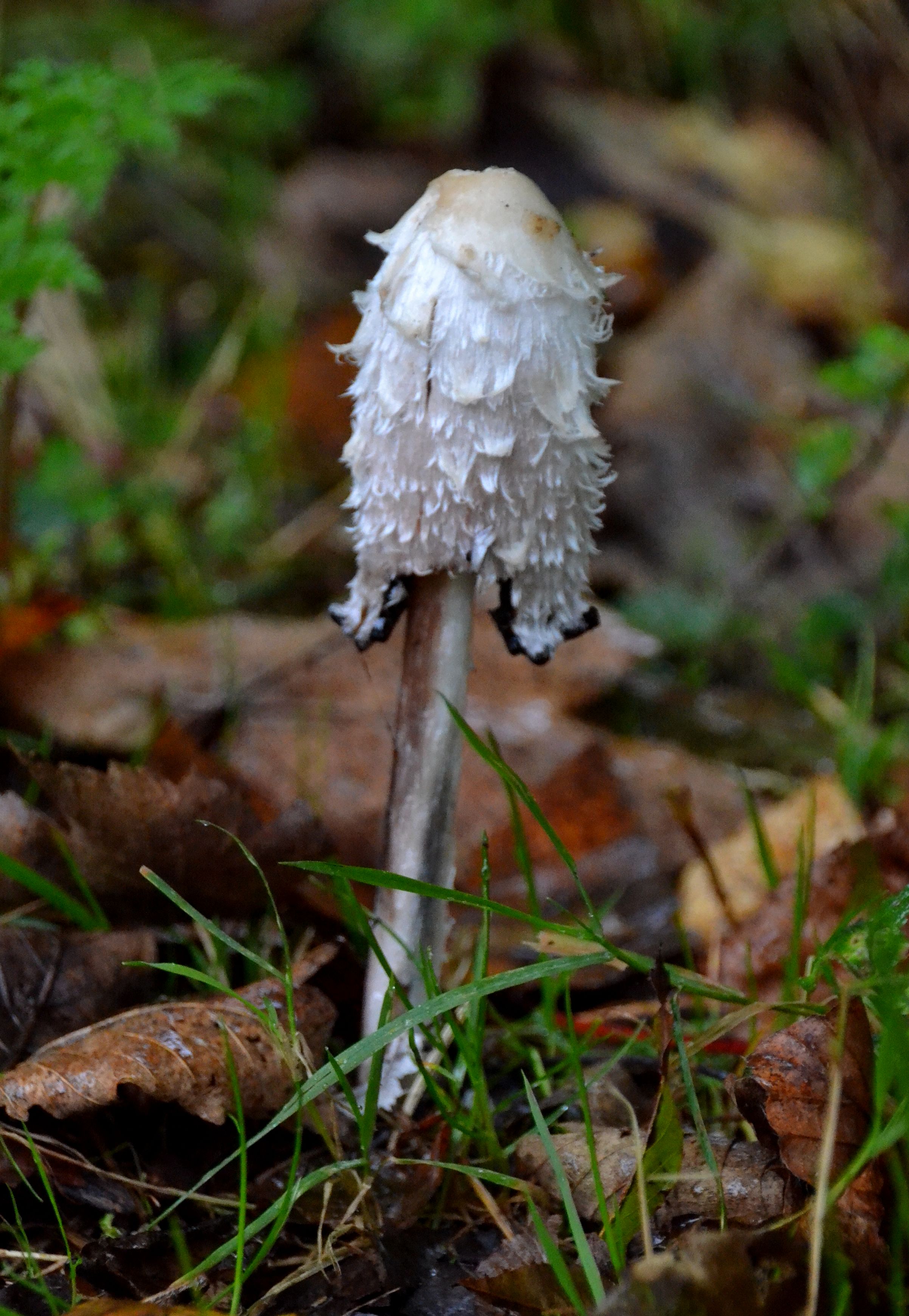
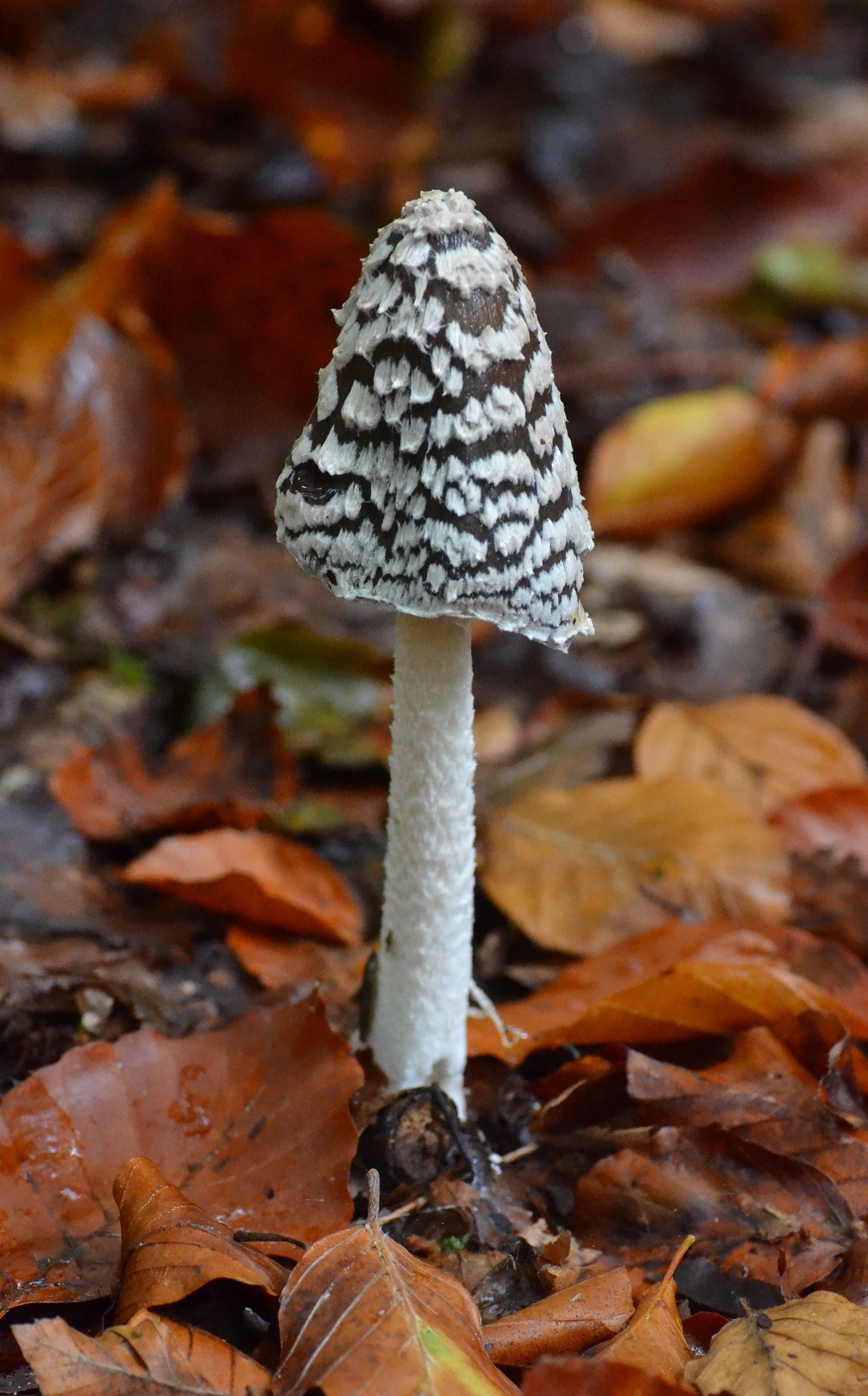
In the above sequence the left hand image is an egg-shaped emergent specimen that once lifted by the stalk will resemble the fruit in this post’s lead picture. The centre left item (above) is beginning to assume the bell shape of the next stage form (centre right), that eventually dissolves from the rim upwards (right) before the stalk collapses and the fruiting sequence and spore dispersal are over for another season. Below is the equivalent sequence in some Magpie Inkcaps found this autumn in Oxfordshire Beech woods at Highmoor Common (days 1, 2 and 4) and Stonesfield (day 3).



Magpie Inkcaps
On first finding the specimen in the left hand picture above I wondered if it might be a Shaggy, but soon realised it’s true identity as through my time on site the dark background of a Magpie increasingly showed through the white scales. Shaggy’s cone colouring may be described as white with off-white / pale tan scales turning grey black, and with a pink tinge. The initially white gills turn pink and then grey to black when they start to ‘melt’ from the edges. The fruiting body secretes a black liquid filled with spores, hence the ’inkcap’ name.
This is a very edible mushroom if picked before the caps start to open, but quite tricky to prepare correctly without dyeing everything around black. But it is also possible to make good ink out of such an outcome by heating the gunge with cloves. Another interesting anecdote I have uncovered is of a Shaggy Inkcap once having lifted a 75 by 60 cm paving slab 4 cm in 48 hours. It has been known for hundreds of these mushrooms to appear on prepared ground such as playing fields if suitably composted, and they are also prone to forming sizeable fairy rings.

It turned out the season’s high target just described was not this day’s only potential for innuendo in Cowleaze Wood, as a second good find was an impressive cluster of Shaggy Parasol (Chlorophyllum rhacodes – pictured above). A smaller relative of the stately Parasol (Macrolepiota procera – below right) that itself is found mainly in open grassland locations, this fairly common woodland mushroom shares the aforementioned Inkcap’s large, legal wig-type scaling whilst lacking the regular Parasol’s snakeskin patterning.

Young Shaggy Parasol 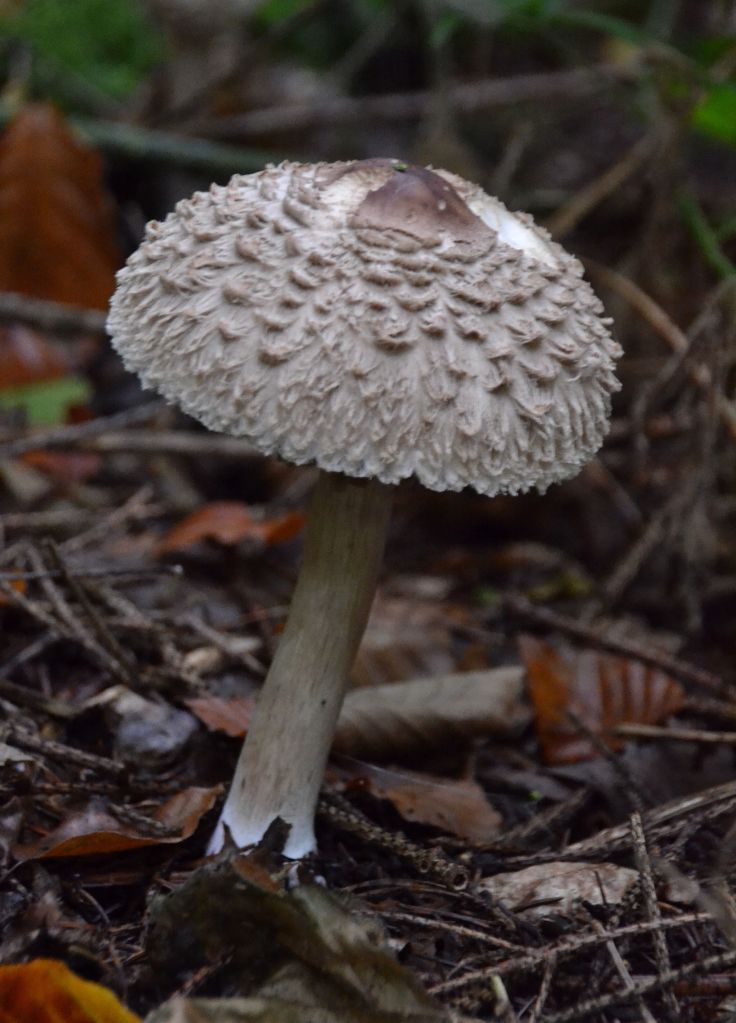
Mature Shaggy Parasol 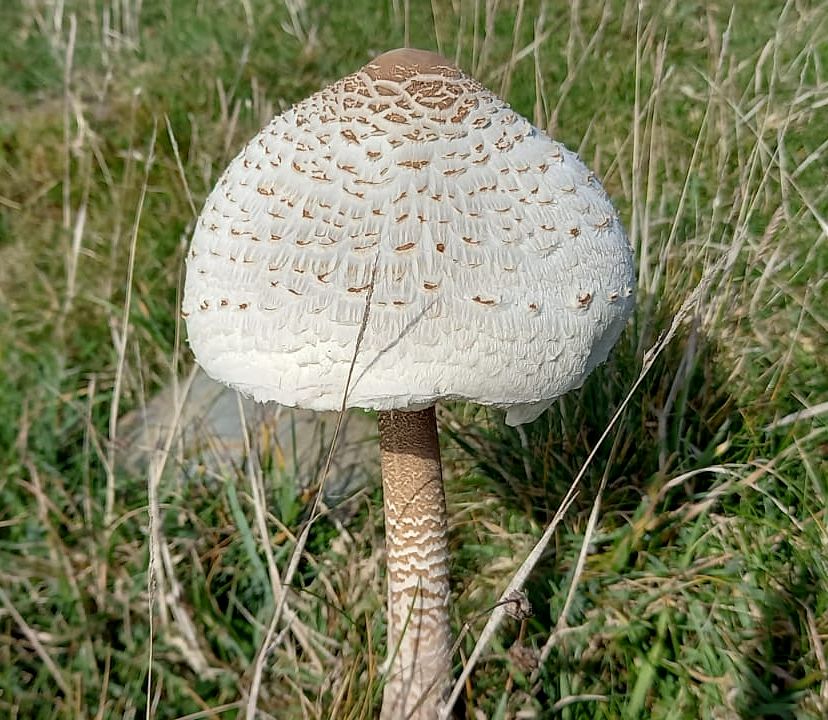
Parasol in north Devon
The Shaggy’s cap is initially bun-shaped (pictured above, left), expanding to turn convex (centre) but only rarely opening out to become flat. When mature, the cap diameter ranges from 5 to 15cm. The 1.8 – 2.4cm diameter stem is white, tinged with red-brown, rising from a large bulbous base.
As a mycology beginner this new wildlife interest of the last two autumns is proving both fascinating and completely occupying, both out in the field and back at home trying to make sense of pictures and puzzling over IDs. Through October and into November fruiting fungi are there to be sought out in all weathers, not just when the sun shines, and they don’t relocate like birds. What is there not to like?
 Ramblings and Scribblings