The subject of this post has this winter shown quite a partiality for eastern English shores. It is an item that has lingered long within the dwindling wish-list of “more regularly occurring” birds I might still seek nationally. And though almost all records are now placed within category E (non-sustaining) of the accepted British list, the recent spate of occurrences has represented a best chance of adding another straggler to my own, non-purist British and life totals.
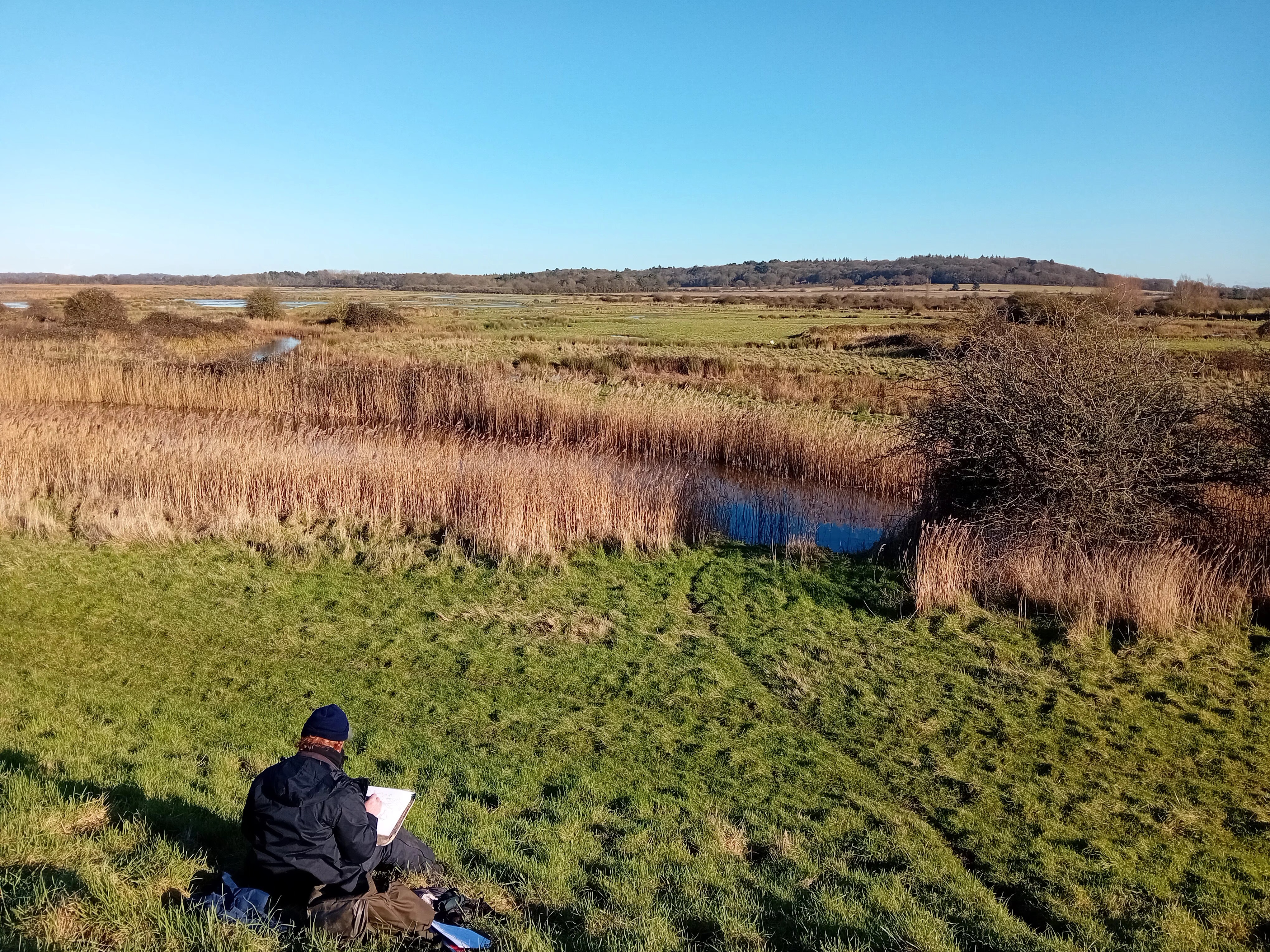
The latest, 24-strong group has been settled at the site featured herein since 21st, having passed through RSPB Titchwell a day earlier. Today was a sunny, crisp, clear winter’s one such as I value most at this time of year, and so I found the desire and energy to hit the road. In the event the connect was straightforward, a 400 metre walk north along an embankment just past the entrance to RSPB Snettisham, and there these appealing little Geese were: out in the middle-distance inland, serenely going about their business in the as attractive habitat of Ken Hill Marshes (TF 652338). Their small size was readily apparent given the feral Greylags they were associating with. Four what are now named Russian White-fronted Geese were also reported from here on this day a little further to the north, but I didn’t seek them out.
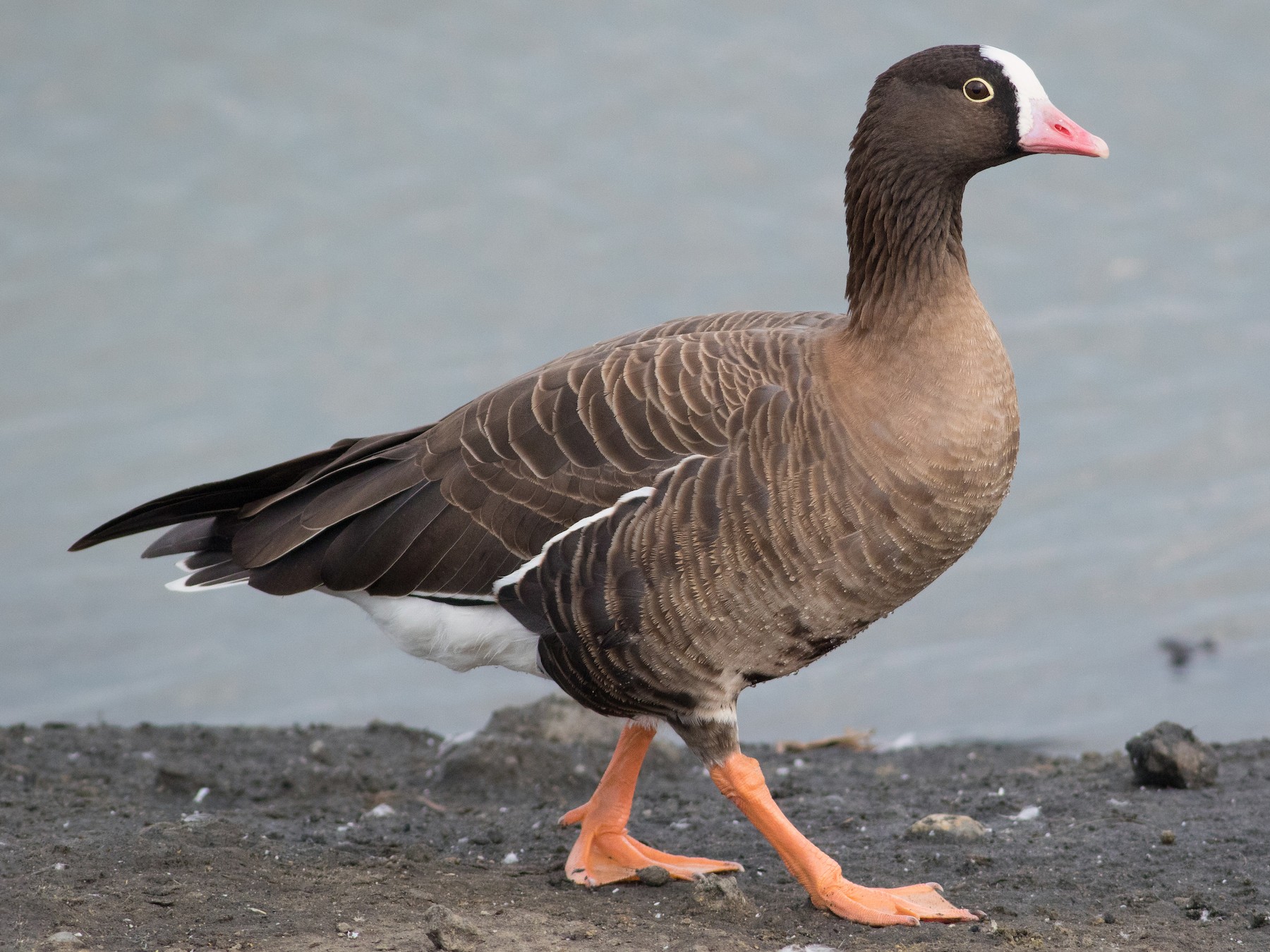
I had previously either been frustrated or dithered in this quest for Lesser White-fronted Goose through much of the current winter. First a family party of seven arrived in Yorkshire at Flamborough Head back on 9th November. The dominant bird of that subsequently itinerant group bears a ring establishing he was released as a juvenile in Swedish Lapland in July 2018, and has since been tracked regularly wintering in Holland. Though it cannot be proven scientifically, his current six companions are unlikely to hail from any other source. In the newer, remarkably large Norfolk group, seven adult birds carry rings from the same re-introduction initiative, whilst five more are first winter birds.
It was thought the Yorkshire LWfGs would over-winter, so given the distance involved I intended to record them over the Christmas holiday period, before my attention was distracted by the Yellow Warbler in Kent. But by then they had moved on, to suddenly re-appear at Spurn for just two days on 13 and 14th January. That group has not returned to Blighty since.
LW-f Goose is classed as endangered on the IUCN Red List, with a worldwide population of around 16,000. The likelihood of observing a genuine vagrant in the British Isles is now slight. When I first started birding in the 1980s they were still expected regularly in very small numbers. But such occurrences have dwindled since then in parallel with the species’ long-term decline due to habitat deterioration, human disturbance and shooting.
The core population breeds in Siberian Russia and over-winters in east Asia. There is also a discernible breeding sub-population of just over100 individuals in Norway. The latter winter at Lake Kerkini in northern Greece and can be connected with on an organized field trip that offers little else in an evolved (for me) sense. It may also be possible to observe them on passage through Hungary and Bulgaria. This year’s mid-winter count of 104 birds is cited as the highest for several years. Another former fragment cluster in Finland became extinct.
Geographically between the two existing populations, a re-introduction scheme in northern Sweden since 1975 has aimed to guard against LW-fG becoming extinct in the Fennoscandia region (see here). This group has maintained numbers of around 15 breeding pairs that usually winter in Germany and Holland. The project’s dynamics are a matter of debate amongst Scandinavian birders, amongst whom some maintain the introduced geese pose a threat to the Norwegian sub-population’s own survival. Others as vigorously oppose such a stance.
All recent British records, if not more plainly escapes from wildfowl collections, are presumed to be from that source. These included, most notably:
- Four birds at North Warren RSPB, Suffolk in 2014 -15 that I failed to connect with
- A juvenile that spent six weeks on Mainland Shetland in 2015
- An individual that ranged quite elusively around Norfolk amongst Brent and Pink-footed flocks through the winter of 2019 /20, without settling in any location for long. I attempted to connect with but dipped it on 10th January (see here)
- A candidate bird at Potter Heigham, Norfolk in April 2019
- An adult at Walpole St Peter, Norfolk in January 2020
- An adult at Oare Marshes, Kent in January 2023
- Another individual of unknown provenance amongst Pink-footed Geese in the Kings Lynn area during the current, 2024/25 winter.
For the RBA gallery of today’s birds see here. And for a detailed species comparison of Greater and Lesser White-fronted Geese see here.
Whilst awaiting any future national occurrence of scientifically proven, wintering individuals from the core Siberian/east Asian, or Norwegian/Kerkini sub-populations, what transpired today must suffice to fulfil my career objective for this species. The only LW-fG I had ever set eyes upon previously was in a pen at WWT Slimbridge, longer ago than I now care to recall.
Footnote: Through to the end of March, 16 more LW-fG from the Swedish scheme were recorded in two groups at a number of north-Norfolk locations. This brought the total number to have wintered in eastern England to 47. The single bird seen around King’s Lynn relocated to Lancashire in early March and looks set to be accepted as a genuine wild vagrant into category A of the British list.
 Ramblings and Scribblings