In recent days two stable and twitchable western Palearctic birds have prompted me to pay some attention to my national list, that still hovers a little way within my career ambition of 400 species. A Lesser Crested Tern from Africa or beyond arrived in Devon’s Exe estuary on 3rd, then three days later a vagrant Scops Owl was discovered at a suburban recreation ground in Swansea. Both items appeared to find their adopted surroundings to their liking, having provided daily observations on the bird information services each day since.
My beloved park home has undergone extensive refurbishment during November, and I have been pre-occupied with related DIY matters of late. But having reached a convenient pausing point in all that whilst feeling a certain degree of pent-up energy, I elected to burn some of it off through a 478-mile round trip to convert these birds for Blighty. I had recorded the Tern once previously in Morocco (2015) and Scops Owl twice in Sardinia (2018) and Turkey (2019).

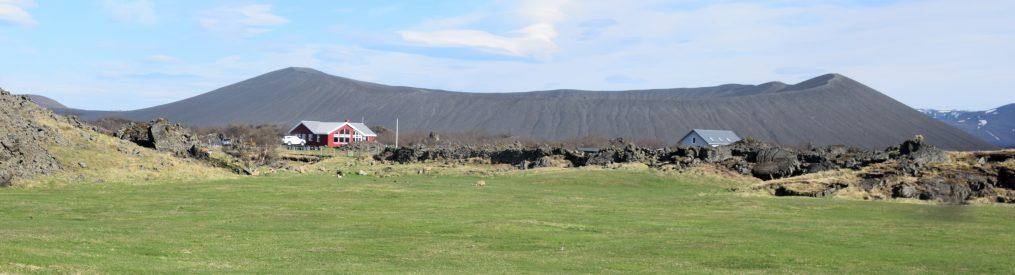
The logical itinerary was to try for the Owl (pictured above) first. Then in the morning the round trip’s shortest leg would get me to the Tern at high tide, in a spot where my second quest had become reliable. The outward journey grew stressful when I lost both Bluetooth connectivity and a stable internet signal along the South Wales M4, then Google Maps guided me through the centre of Swansea in the rush hour and back out via a rather tortuous shortest route, with phone balanced upon knee. How dependent I am for my well being upon such technologies I reflected once again. But when I arrived on site at Dunvant Park (SA2 7QU – 51.6197,-4.0221) shortly after 5pm the Owl had yet to be seen.
I joined a group of around 20 hopeful observers, amongst whom was Adam (see here) as arranged. The gathering was very well marshaled by local birders and everyone behaved sensibly. The initial strategy was to all keep together in one place and hope the bird would come to us, while those equipped with thermal imagers scanned for it, rather than walking around randomly. But after an hour by 6pm the lead marshal suggested we split into smaller groups and keep in touch. Fortunately I joined the one that took the driest path and soon put up the foraging Scops Owl on the ground amongst trees.
By now the initial numbers of birders had probably doubled. It had been agreed that when located the bird would be lit up for no more than 30 seconds then given sufficient time and space to continue feeding before being disturbed again. The lead marshall shone a torch just below the Owl as it perched in a small tree so everyone saw it well as in this post’s lead picture, then a proportion of observers including myself dispersed. All this had certainly been a quite different kind of and unusual birding experience. I had expected to be searching up in tall tree tops, but this particular Scops Owl kept lower down.
The diminutive Eurasian Scops Owl breeds from southern Europe eastwards to southern Siberia and the western Himalayas. Europe forms approximately 57% of that total range, holding between 226,000 and 380,000 pairs. The species inhabits open woodland, parks and gardens, often nesting in suitable holes in trees or walls; and normally winters in sub-Saharan Africa. At 19 – 21cm in length it is slightly smaller than the familiar, British resident Little Owl. Largely nocturnal it feeds mainly on insects, worms and other invertebrates. The Swansea bird is the 44th accepted British record, and 13th so far this century.
My thanks are due to Mark Hipkin for marshaling the twitch so expertly and responsibly, without which I would certainly not have made this connection. Also to Jim Hutchins, the Standlake Birder (see here) for kindly granting me permission to illustrate this post with his own best record that shows exactly how I too observed this bird.
Friday morning (12th) in Devon offered refreshingly cool and sunny conditions, and the 137-mile run from my overnight stay in Port Talbot to the Exe estuary was congestion free. From the parking area at RSPB Exminster Marshes (50.67618, -3.46883 – SX 963873) I walked south for about a kilometre along the Exeter Canal towpath to Turf Lock (50.66489, -3-46760 – SX 964859) that gives access to the waterway from the estuary. Beyond is a hotel / pub and a flat spit of land from where my quest had been viewed for most of this week. Here it perched on offshore buoys at high tide, fed on the mud at low tide and often roosted on a pontoon.
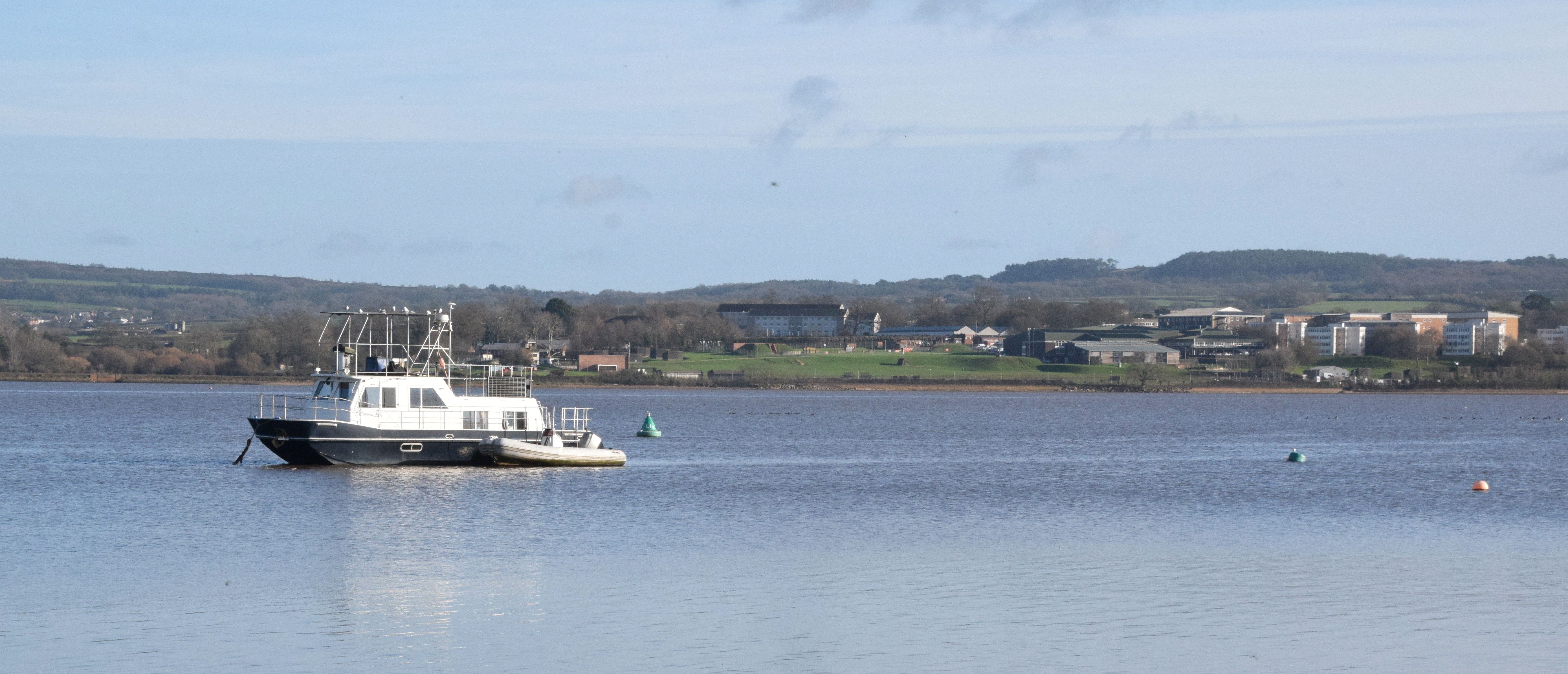
When I arrived at around 11:30 am the Lesser Crested Tern was atop the second green buoy to the right of the boat in the above picture, the visible white dot. And there it contentedly remained, alternately preening, dozing and looking about itself for the next hour. Then it was put up by a passing fast boat and after a fly around re-located to a closer buoy, and I gained some recognizable record shots (below). When after 30 more minutes it was flushed again by a group of paddle boarders, I opted to start the 160 mile journey home. But even as I left the bird had returned to the same buoy.
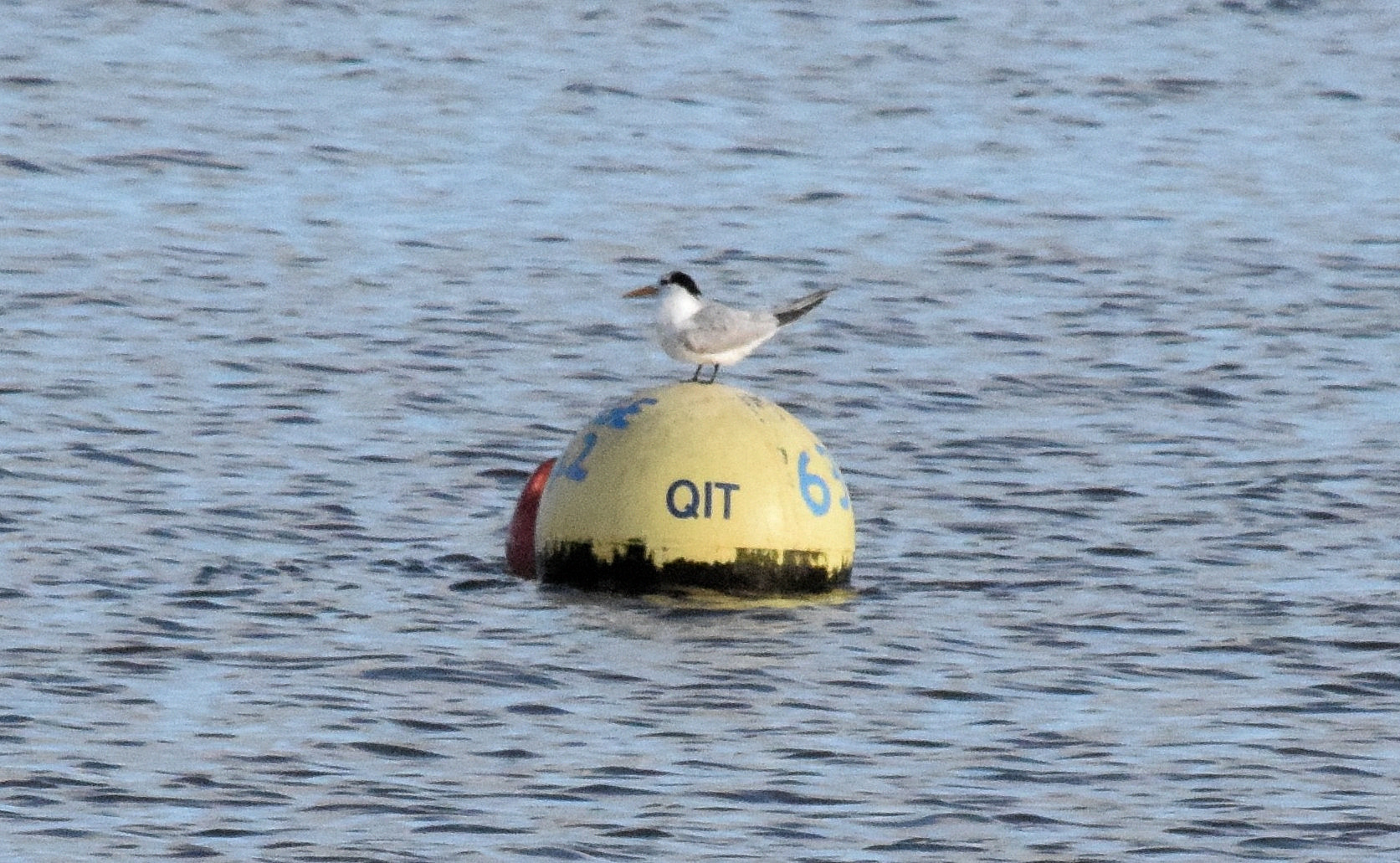
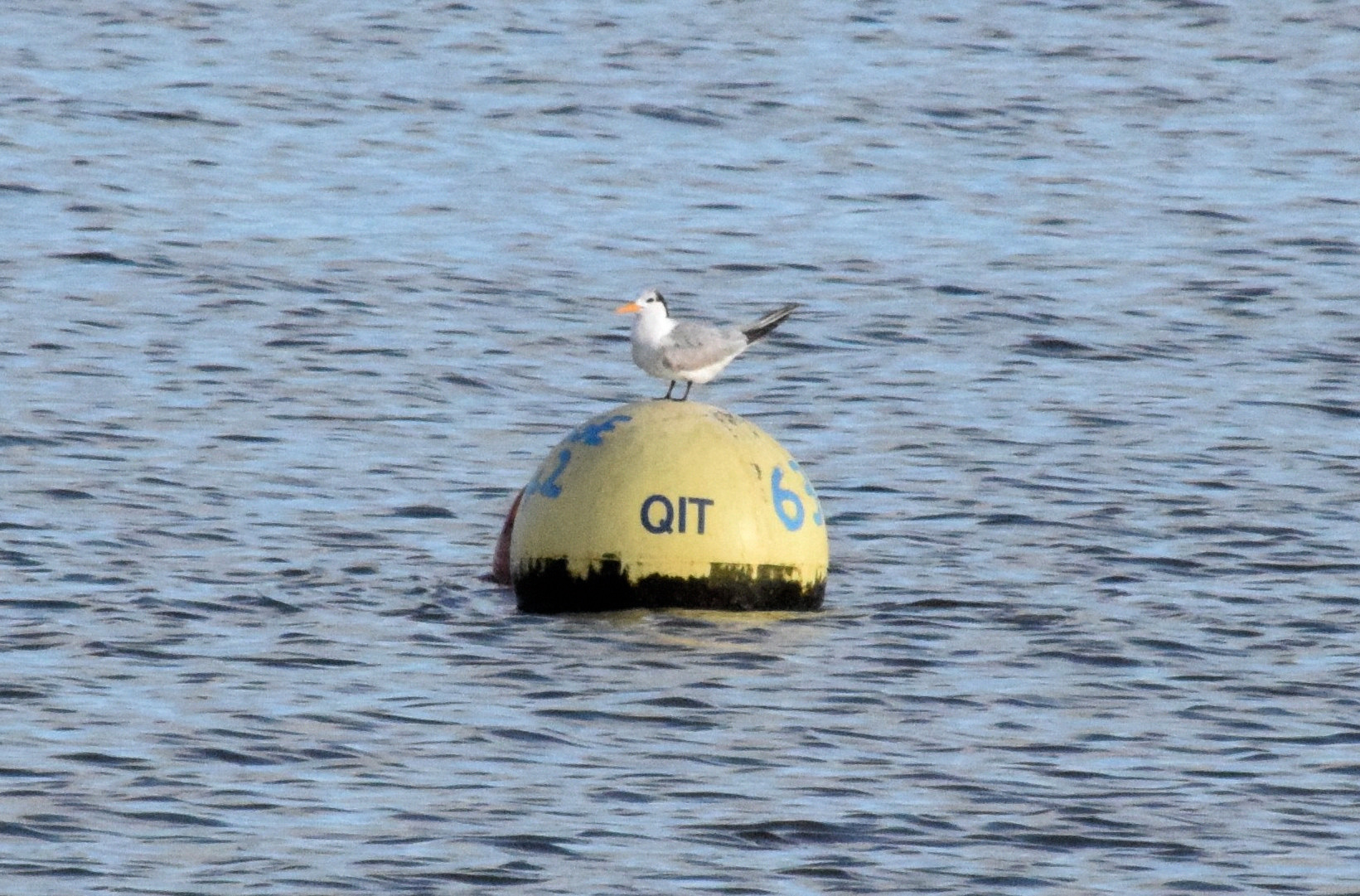
Lesser Crested Tern is one of three similar, orange-billed species that occur in north-west Africa, and also breeds in parts of the Mediterranean, Red Sea, Arabian Gulf and Indian Ocean. The most significant wintering grounds are east African coasts, the Arabian peninsular and the western Indian sub-continent. A very rare vagrant this far north, the Exe estuary bird is only the second British record this century and just the ninth accepted national record, one of which was famously serial over 14 breeding seasons.
My time spent with it was very relaxed in a pleasant, scenic setting – the epitome of winter coastal birding! Walking back to my car I scanned here and there plentiful arrays of wildfowl and waders across the pleasingly lit floods of Exminster Marshes, to complete the hoped for restorative effect of this entire exercise.
NB. My British bird list now stands at 387. I appear to have acted just in time as neither of these birds was seen on 13th or 14th, or indeed in these locations since.
 Ramblings and Scribblings