Scarce Emerald: the last English damsel – 11th August

As of 2015 I had observed every regularly occurring English damselfly but one, the exception being Scarce Emerald. So my top Odonata priority this season has been to complete the full set, and mid-August is the time to do it. One well-known site for the final species is RSPB Bowers Marsh on the Thames estuary in Essex, and with no birding lifers to take precedence this week that was where I headed yesterday.

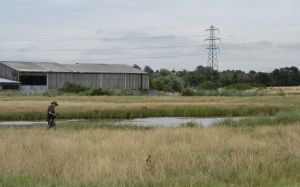
My task was simplified because Adam visited here a week earlier having gained directions from an online contact as to the exact location to find these insects. Arriving late on a lightly overcast morning I met another naturalist, Mike Barnett from Basingstoke, in the car park (TQ755867) and he was on the same mission as myself. Setting off together and after a quick phone call to Adam to verify the correct place to look, we arrived at a small and shallow, reed-filled pool that is prime habitat for our target.

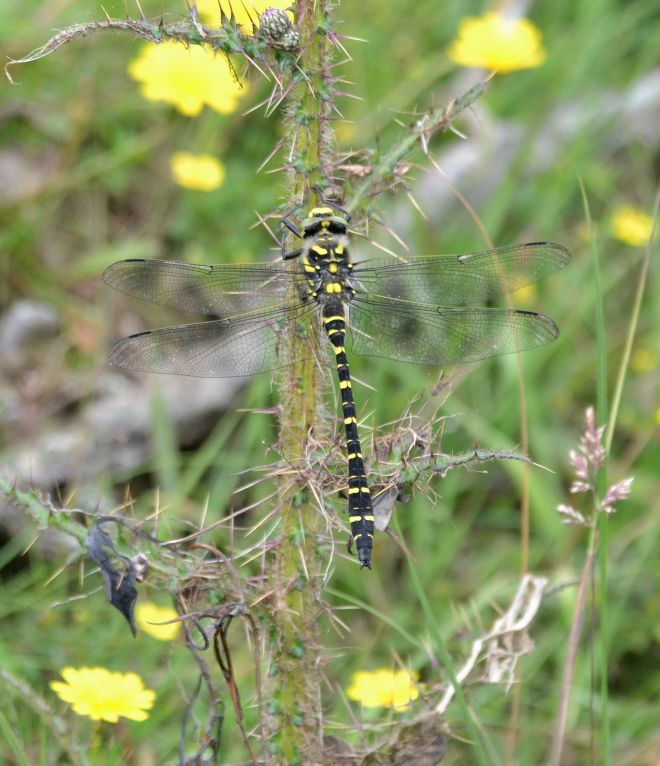
It didn’t take long to find three male Emerald sp damselflies mooching about and perching on stems, usually with wings half open. Two local patch watchers then joined in and assured us these were indeed Scarce Emerald. In the pictures below I have arranged three individuals in what I believe is ascending order of maturity, if that makes sense. The brown-toned left-hand insect is the least mature, while the right-hand one is I hope a fully mature male though I’m not entirely sure of which type.

Having read up on the species again in Brooks and Lewington, I feel confident enough to publish them. That odo bible quotes four diagnostics, since Scarce Emerald is very similar to Common Emerald, and for the key one we are talking anal appendages. The inferior AA’s, or the inner bits of his bits to you and I, are broader and more curved in Scarce than Common, and this is quite apparent in the left-hand picture.

Turned off completely? Well it gets less goolie-ish from now on. Brooks and Lewington lists more “subtle differences” that I believe are apparent in my none too sharp pictures:

  • squarer shape of the pterostigma (black wing tags)
  • less extensive blue colouration on abdominal segment 2, that is absent in the left-hand immature male but shows well in the right-hand image
  • brighter blue colour of the eyes, and aren’t they just!?

A return visit to this site next year could well be in order to remove all doubt. I am used to encountering a lot of colour variation in Emerald damselflies at different stages of their life cycle, and today was no exception. We found no female Scarce Emerald at Bowers Marsh, unfortunately.

bowers marsh.1601

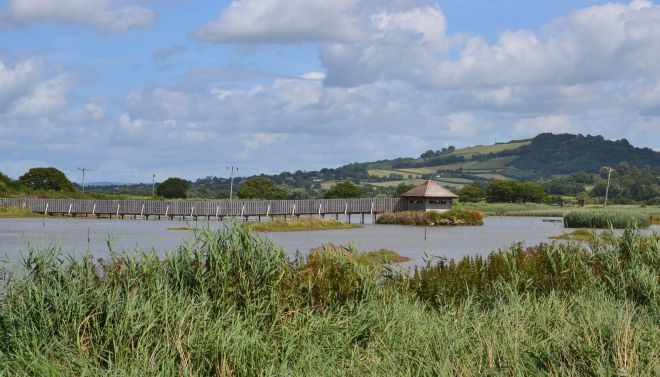
Another part of Bowers Marsh

So now I have observed the complete sets of regularly occurring English dragonflies and damselflies, but still require both sightings and images of some females and immatures. Things will be largely about photography again next season, and believe me I have spent a certain amount of time attempting to improve on past results this summer, mostly without success. Three afternoons watching Brilliant Emerald dragonflies at Warren Heath, Hants was one un-blogged example.

But insect observation cannot be rushed, like zapping in and out on an adrenalin rush to twitch a rare bird. This is where I feel bored birders dabbling with insects in June and July sometimes get it wrong, with respect. A chair, my camera and solitude in wild places is the appeal of odonata for me, and continuous improvement in recording visually the experiences they offer remains the quest.

Least Sandpiper at Seaton Marshes, Devon – 4th Aug

“Accidental small sandpipers” to quote one field guide I use* is a genus that I attach some priority to at this stage of my birding life. Since various of these species occur almost annually in Great Britain, most seasoned birders may have seen each of them perhaps a few times. But given my modest British bird list of now 321 mostly within 150 miles of home, each passage period I aspire to gain one or two more of this group as lifers. Today was such an occasion.

Last week a Baird’s Sandpiper turned up at the populist playground of Minsmere in Suffolk but didn’t stay long enough for me to get there. Western Sandpiper has also been reported a bit further afield recently. Then two days ago a Least Sandpiper was found at Seaton Marshes in east Devon, that at a little over 150 miles was just within my preferred twitching range. I assume the last-named is the rarest of the three species since RBA accords it mega status. When this bird was reported again early Thursday morning on a work-free day, off I set.

For the outward journey I took the scenic route via Ringwood, Dorchester and Bridport to indulge my liking for the Dorset countryside. But as so often the beauty of that county’s scenery was spoiled by the volume of traffic on roads that are not designed to carry it. As a result almost an hour was added to my satnav’s estimated journey time, till at just before 1pm I drew up in a large and welcoming car park at Colyton cemetery (SY251916). From there a path leads down to Black Hole Marsh, one of four areas managed as local nature reserves in the lower Axe valley. Collectively these are known as Seaton Marshes.

DSC_0001

Black Hole Marsh and Island Hide

The bird was being observed from the Island Hide (pictured above). Not having recovered from the journey I asked other people to point it out as soon as I went inside, but at that range it could have been anything. At first a big lens photographer in a prime spot and the head next to him kept blocking my every attempt at picking off the diagnostics. But eventually those obstructions parted in opposite directions and I gained a full frontal view of the Least Sandpiper looking just like the pictures in it’s RBA gallery (see here).

I stayed in the Island Hide for the next hour during which this bird remained faithful to the water’s edge near the start of the boardwalk that leads out to the hide. For much of the time the rare visitor, a summer plumaged adult was associating with a Dunlin by which it was quite dwarfed, while Common and Wood Sandpiper were also in the vicinity. I believe this site has a reputation for attracting good passage waders. But the comparison species I would really liked to have seen here would have been Little Stint.

As its name suggests Least Sandpiper is the smallest of the stint species. It has a squat body, rather short greenish legs and long toes. The dark bill is down-curved, tapering to a fine point. To quote the Helm guide to confusion species the key diagnostics that separate this bird from Little Stint are the leg colour and a very short primary projection. This was mostly fairly plain to decipher during my time in the hide, as other birders came and went and I got into the best viewing position. But to my mind the stand-out feature was the subtly attractive breast pattern that had stood out in the RBA photographs, as it did now in my scope.

All the while I hoped the Least Sand would relocate closer so that I might capture some half decent images. Eventually it was flushed by other birds and landed on a grassy area beside the board walk. Most people inside then moved out to attempt to photograph the rarity through slats in the wooden screen structure. At this point I was joined by Oxonbirder Dave Lowe who was “on the way” (as we say locally) home from a business meeting in Tiverton. He pointed out the Least Sand again quite close to the screen and I happened to be in a good spot to get two lucky shots (above) as the bird crossed the grass back to the water’s edge. It being some time since I have returned from a British birding twitch with publishable pictures, I’m quite pleased with those two. What a little beauty!

Mission accomplished, Dave and myself both left after 3pm to make our way homeward. Not wanting to brave the Dorset lanes again then Poole’s outskirts in the rush hour, I chose the fast M5 / M4 motorway route which in the event was largely congestion free. With the warm glow of having acquired such a rare and attractive lifer, and the bonus of reasonable pictures, all was well in my world at least for one more day.

* Six (that is 50%) of the group I refer to here are now on my British list. The others are Semipalmated Sandpiper, White-rumped Sandpiper, Long-billed Dowitcher, Short-billed Dowitcher and Pectoral Sandpiper. Still to be added are Long-toed Stint, Western Sandpiper, Red-necked Stint, Baird’s Sandpiper, Stilt Sandpiper and Sharp-tailed Sandpiper. If the taxonomy here is inaccurate, the pocket field guide referred to at the beginning of this post is Bruun, Delin and Svensson’s excellent Hamlyn Guide that I keep in the car as a small, light alternative to Collins. This publication is also very dear to me having been carried in the field throughout my early birding years. The borrowed term “accidental small sandpipers” is merely a convenient way of denoting the above group of scarce or rare passage waders.

Goldenring dragons and a special damsel at Latchmore Brook, New Forest, Hants – 17 & 20th July

This was a season’s first visit to the English Odonata mecca of the New Forest. My quest was to acquire better images of Common Goldenring, in my view the most magnificent home dragonfly. My issue with this species is that in the past I have mostly captured them against over-busy backgrounds. Where insect picture taking is concerned my desire is always to cut out the clutter as much as possible.

A year ago (see here) I identified this site as one where that aim might be attainable if a little time is devoted to the task. On Sunday the weather forecast was for sustained sunshine after a cloudy start and hence it was game on, or so I thought. Upon arriving on site around 11am conditions were still steadfastly overcast, and thus largely it remained for the next five hours. But it still didn’t take long to come across Goldenrings as I walked east from Ogdens Forestry Commission car park at SU182124.

common goldenring.1602 latchmore brook

Common Goldenring (male)

This individual, a male (pictured above) was the first one encountered, and soon it settled against a colour co-ordinated if still cluttered backdrop. Goldenrings, of which there are eight variants across Europe, follow a fairly predictable routine of patrolling the same patch up and down and over again. After re-finding one spot that on the previous visit had struck me as being especially photogenic but which somehow didn’t grab me now, I retraced my steps and came across another Goldenring doing exactly what I have described above.

Feeling a little weary in spirit, I sat and watched this second male for some time, noting the locations where habitually he would come to rest. Insect watching should be about relaxing in remote places in communion with complex and fascinating joys of nature with the capacity to cleanse the system, just the dragonflies or butterflies and myself. Instead it more often involves the frustration of waiting for the sun to come out, then too limited intervals in which to record the renewing experience for posterity. Eventually my Goldenring perched perfectly right in front of me (below left). This was more like it.

The twig in the right hand picture (above) was another favoured stopping place, and so it went on. This is the first time in 2016 that I have converted an objective on the limited insect agenda set for this season, and that’s all due to poor weather. Better or any pictures of Hairy Hawker, Downy Emerald, Common Clubtail, and teneral or female Blue Chaser will all now have to wait until 2017; not to mention White Admiral butterflies.

Another speciality at Latchmore Brook is Scarce Blue-tailed Damselfly that I observed for the first time in this place a year ago (see also here). The lowland mire in which they occur, to the immediate north of the brook, was in excellent health today with a fascinating array of bog plants of which I have no knowledge. In mid-afternoon I returned to the car for a power nap then changed into wellies to seek out this species for a second time. The best part of an hour was then spent waiting for an approaching patch of blue sky to cover the key position.

As soon as the sun broke through, SBTD took to the wing, but these are very tricky little insects to capture. They have a finer more delicate appearance than regular Blue-tailed Damselfy and a knack of vanishing from view as imperceptibly as they appear in the first place. But once the three or four individuals encountered here settled the diagnostics of a blue tail band covering part of segment 8 and all of 9, and with a convex upper edge, were plain to behold (pictured above).

I have long since realised that much of the better odonata photography published on-line must be obtained by wading in. But usually I am far too squeamish about treading habitat to get really close to some insects. This particular bog is churned up by free ranging cattle and ponies anyway, and so I felt less guilt at doing what after all odo royalty does. The results were a little better than last year and I resolved to try again.

That opportunity wasn’t long in coming round since following a conversation with Adam we decided to go down together a few days later. He needed SBTD for his odonata life list and I would be able to take him to the right spot to find them. Avoiding the year’s hottest day we opted for Wednesday that in the event wasn’t much cooler. This time we found just one male (pictured above) that struck up some nice poses against reasonably subtle backgrounds. In retrospect Sunday’s capture of a female wasn’t that bad but these are better since they do not involve brown bog water and over-reflection.

In the afternoon we trekked across country, and for some of the way off-piste across Hampton Ridge and through the eastern edge of Pitts Wood Inclosure to Ashley Hole, and then back again. After a very wet summer up until this week lots of superb lowland mire habitat was encountered along our route with many odo-rich pools. But observing these beautiful insects is doomed to become repetitive in this country. If only there were more species to experience, though at least one rather special damselfly has been done justice now.

Collared Pratincole at Ham Wall RSPB, Somerset – 13th July

On my only completely free day of this week I wished, naturally enough to hit the road and go somewhere. And given a recent burst of enthusiasm for high summer butterflies I now rather fancied doing some dragonflies. So the presence since Sunday of a potential British bird list addition on the Somerset Levels offered a dual purpose day out: an Odonata-friendly location with insurance against poor weather.

Having left a bright and sunny Oxford I arrived at Ashcott corner car park (ST449397), between the Avalon Marshes reserves of Ham Wall and Shapwick Heath, with the grey stuff seemingly filling the length and breadth of the levels. This location has produced a number of lifers over the years: most recently Dusky Warbler (see here); and previously Hudsonian Godwit (here), Pied-billed Grebe (Feb 2013) and European Roller (Jun 1989).

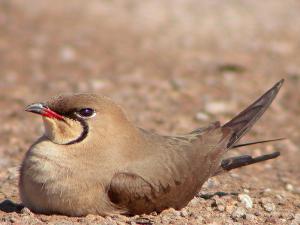
To quote RBA: “The Somerset Levels are fast becoming a top rarity venue as well as Britain’s best rare herons and egrets breeding site”. Today’s attraction was a Collared Pratincole, renowned as a wader that feeds aerially. This is a bird I self-found and viewed well in Portugal (May 2014) and had also observed in la Camargue, France and Coto Donana, Spain two years earlier. A southern European breeder that winters in sub-Saharan Africa, it is the most widely distributed of the world’s eight Pratincoles and also one of the largest.

collared pratincole.01

Collared Pratincole  © rights of owner reserved

When I reached the second viewing platform at Ham Wall, from where the bird was being reported, rain began to fall. Most of the birders gathered there moved to shelter under trees a short distance back along the path. Then one called the Collared Pratincole and showed it to me in his scope, after which I quickly located the bird myself. It was sitting on the ground in the middle distance amongst Mallard and Lapwing, and I was able to put other birders on to what they acknowledged was a better view. The image (above) is outsourced but today’s bird was in more or less the same pose, if against a green backdrop.

At some time after 12pm fair weather set in from the west and the Pratincole took to the air. I then watched it for around 20 minutes or so hawking for insects over much of the landscape in the pictures below.  It had an elegant jizz suggesting a large Swift with the grace of a Tern. Though a very fast flier the white rump and long forked tail stood out clearly. But the name “collared” is misleading since the feature referred to is not a collar and is also present in other Pratincole species. Hence this one is also referred to as Common Pratincole or merely “Pratincole” in  different sources. For the RBA image gallery of the Ham Wall bird see here.

So I have now observed both of the Palearctic Pratincoles in Great Britain. But this was a hugely more satisfying experience than the very brief flight view obtained of a Black-winged Pratincole at the Ouse Washes, Cambs in August 2014. The word satisfying did not apply to my dragonfly watching efforts today. I spent the afternoon a little to the north of the RSPB “home for nature” at Somerset Wildlife Trust’s excellent Westhay Moor NNR (ST455436). A pleasant enough few hours were passed there but no better or even decent odo pictures were gained, and so nothing in the insect line will be blogged.

Purple Emperor at Oakley and Finemere Woods, Bucks – 5 & 7th July

My quest for better pictures of White Admiral found me back at the regular local location of Bernwood Forest, Bucks on Tuesday. With an overcast start to the day and a late shift awaiting in the shop at 3pm there wasn’t time to go “out of area” and so I arrived mid-morning at Oakley Wood Forestry Commision car park (SP612118) to tread a familiar route.

For my first hour on site conditions remained steadfastly grey with only fluttering Ringlet in the long grass and occasional Large Skipper to break the monotony. After one circuit to the central crossroads and back I reasoned that if I left the sun would be bound to come out, so I decided to sit in the car and wait. As things transpired that was only for a few minutes before fairer weather took over.

Then I walked part of the woods that in past experience is good for White Admiral. Four Silver-washed Fritillary were active at one spot though not close enough to photograph, and I also encountered Broad-bodied Chaser and Hairy Hawker dragonflies. Arriving back at the main track a group of dog walkers were gathered around something on the path and they beckoned me over. I get recognised in this place. This had to be a Purple Emperor and so it was.

The butterfly before long objected to being videoed with a phone and flew off. When the group dispersed I set off down the track to relocate it. At first it was very flighty moving restlessly back up the track ahead of me. Incredibly so I thought the next dog walkers through didn’t even notice as this wonder of nature flew past them at waist height. I gestured to point it out but concluding they probably thought I was a bit mad I let them be.

The Purple Emperor came to rest close to where it had first came down from the trees. Then it began the familiar routine either of probing the hard surface of the track for whatever it is they extract, or just sitting still looking magnificent. It allowed a very close approach now. Pristine was not the word as it glistened before me in all its freshness.

Eventually a Dalmation appeared at my elbow that I took by the collar to prevent the insect being put up. The owners were the couple I had passed further down the track. They had apparently thought I was some kind of dog poo vigilante but all was now explained and they were very appreciative of being shown such a beautiful butterfly. Having submitted the record to BC I believe this is the first Oakley Wood sighting of the season.

Today (7th) I met up with Ewan at another BBOWT reserve in the north of the Bernwood Forest complex, Finemere Wood (SP721215). The first thing I encountered after going through the entrance gate some time after 11am was another male Purple Emperor flopping around above the surface of the track, before disappearing from view. I then had to inform Ewan of this who had been on site for an hour already without seeing one. We split up to search different parts of the wood, and soon I got a call to say he had relocated the Emperor. Phew, tranquillity could now resume!

When I returned to the entrance gate this butterfly was still posing nicely for a small group of observers that had gathered. It was in a muddier and more grassy location than the Oakley Wood individual and so offered a little different composition (pictured above). These pictures demonstrate how this large butterfly’s appearance depends on how the light catches it, with often only one top wing in the male appearing to be purple.

Broad-billed Sandpiper at Goldcliff Lagoons, Gwent – 19th June

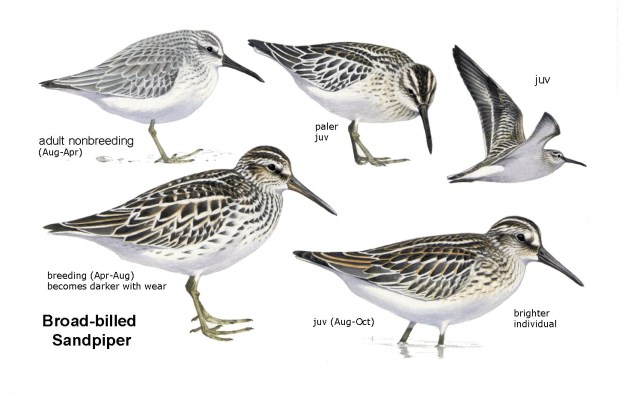
It didn’t take long to find some more vagrant wader action. Broad-billed Sandpiper is a lifer I have wanted for some time but there has always been some reason not to go. So when one turned up this weekend well within my preferred twitching range I finally took the opportunity.

This is a Scandinavian tundra breeder that winters in south and south-east Asia, and passage birds are recorded in Britain every year. Throughout a “day of rest” in the garden at home on Saturday I had noted sightings on RBA from Newport Wetlands NNR on the Severn estuary. I wanted to see this BBS was settled because earlier in the year another or possibly the same individual at the site was very mobile and eluded a number of Oxon birders who went for it.

33BroadbilledSandpiper

© rights of owner reserved

I decided to go if the BBS was still present on Sunday morning, and when the first report appeared on RBA at 7:30 off I set. The bird was in an area of the reserve known as Goldcliff Lagoons, of which there are three. These are accessed about 500 metres east of the Farmers Arms pub in the village of Goldcliff, along part of the Wales coast path signposted “Redwick 5km”. A number of hides and viewing platforms along this track overlook the lagoons.

I had expected to have to pick another wader out of a large flock as at Titchwell on Friday, but in the event things were surprisingly easy. As soon as I joined a group of birders on one platform the Broad-billed Sandpiper was pointed out to me. It looked very distinctive with a white belly and large double supercilium. Then it moved to join a group of six black-bellied Dunlin for comparison. In this company the BBS resembled a large Stint amongst those Dunlin, being noticeably smaller and paler with a different feeding action.

The above images are outsourced © rights of owners reserved

I watched the Goldcliff BBS for around 20 minutes then the birds all flew to another of the lagoons. Being unable to relocate them on the next lagoon and feeling I was unlikely to get better views anyway, I decided to turn around and go back home enjoying the warm glow of this much desired tick. The BBS was found again nearer to the coast line in the afternoon.

IMG_0366

Great Knot on Titchwell freshwater marsh © Andrew Last

Meanwhile up in Norfolk the Great Knot (pictured above) was drawing large crowds and by all accounts showing well. The successful latecomers included Badger and Andy with whom I kept in touch throughout the day. On Saturday that bird had been much more mobile, as I had feared today’s quest would also be. But my luck was in for a second time in three days and I have gained two highly desirable scarce waders as life list additions.

Great Knot at Titchwell, Norfolk and Caspian Terns at Gibraltar Point NNR, Lincs – 17th June

Having reached the familiar state again this week of just needing to go somewhere, the arrival of a rare and attractive Asiatic wader in Norfolk provided a suitable reason to hit the road. With my limited June insect agenda for this year looking like being washed out, I slipped back firmly into birding mode with a lifer and two British list additions to go after around eastern England.

Two days ago only the fifth Great Knot for Britain had been found at Titchwell Marsh RSPB reserve on the north Norfolk coast. Despite its name this north-east Siberian breeder is only slightly bigger than regular Knot, but is quite distinctive in summer plumage. Having checked the species out in my Helm world shorebirds guide I decided it was a must see.

After staying overnight with friends in Suffolk I got to Titchwell at 9:30am. The first sighting had been posted on RBA at 6am and the car park was full. Not a good day for the RSPB then with all these green clad, optics wielding invaders likely to frighten those of the charity’s preferred clientele who might have managed to squeeze their way in. The visitor centre was in any case closed so I trod the path that skirts the “home for nature” and its “bug hotels” out to the action on the beach.

DSC_0010

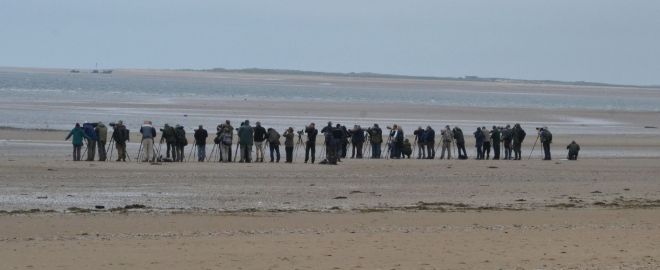
“Something about?”

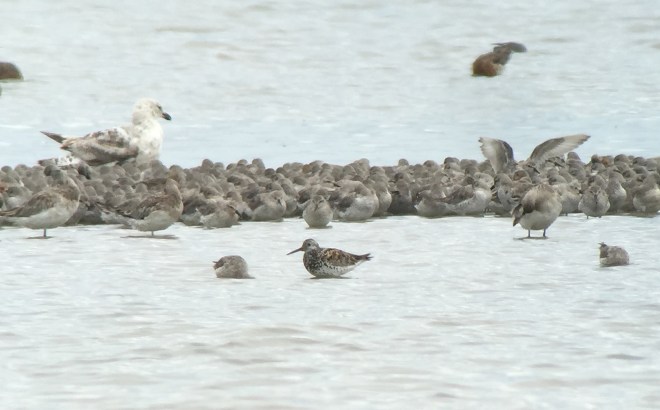
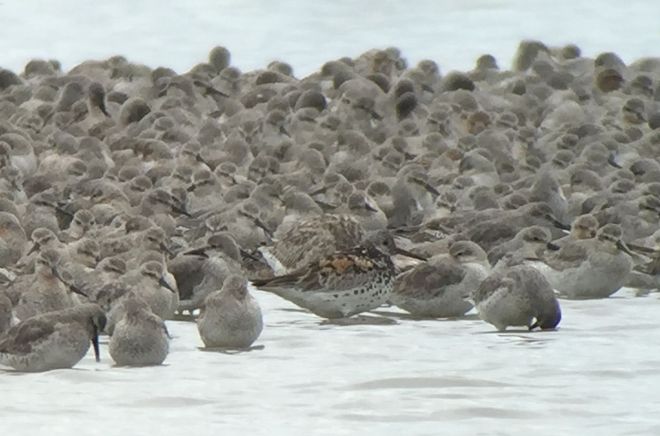
I felt a little concerned at the number of birders walking back, but on reaching the beach there were still plenty scanning the shoreline (pictured above). Before me was what I had expected, a large flock of feeding Knot and other common waders. I decided the vagrant, though an adult in summer plumage was not a bird to self find and so acted dumb until a knowledgeable and helpful birder put me onto it. The Great Knot stood out clearly at distance due to it’s dark breast and belly spotting when seen head on, but was more difficult to identify when lost amongst the throng. This picture (below) shows the plumage detail and longer bill.

IMG_0379

Great Knot (foreground, centre) © Andrew Last

The opportunity to observe summer plumaged red Knot for the first time was also part of the attraction of coming here. Every so often the waders would take flight and relocate, and so the searching would begin all over again. But with more birds in mind today I couldn’t stay for too long and so left a little reluctantly as the crowd dwindled. The entire flock apparently flew east shortly after I moved on late morning. The Great Knot wasn’t seen through the afternoon before being relocated eventually on Scolt Head Island. So my luck had been in.

I now headed for Lincs Wildlife Trust’s Gibraltar Point NNR, an area of sand dunes, salt marshes and fresh water habitats just south of Skegness that often features on RBA. Here two Caspian Tern were viewable from the hides. Being one of my favourite Algarve birds where there is a small wintering population, adding this Baltic breeder to my British list now appealed. The 77 mile drive around three sides of The Wash was arduous to say the least, with low speed limits along much of the route and a lot of farm traffic. Hence I didn’t arrive on site till 2pm.

DSC_0021

View over Tennyson’s Sands from Harvey’s Hide

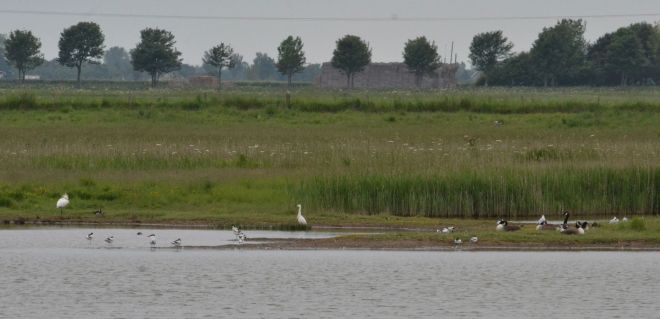
The adult Caspian Tern were pointed out as soon as I entered one of the hides. Both birds seemed to favour standing with their backs to the audience, turning their heads from side to side. But these large terns always stand out at distance due to their big red bills, as the above and below left pictures show. The CT is amongst some Avocet at the left hand end of the group (above), giving a good indication as to just how big the visitors are. This was also very apparent when on occasion the birds took to the air (below right).

My late arrival here ruled out going on for the day’s third target, the long staying Great Reed Warbler near St Neot’s in Cambs. So I stayed at Gibraltar Point for a couple of hours, pleased to be out of the car and birding. There was also a Spoonbill at this site, always a good bird to see in England. Then the tedious 3½ hour journey back to Oxford beckoned and I left at 4pm, pleased to have increased my British bird list to a still very modest 319.

Foul Weather Footnotes

The present unsettled weather pattern has been excellent for re-organising and re-planting my wildlife garden a little later in the season than would normally be ideal. This is the time of year when adult Scarlet Tiger moths (pictured below) begin to fly around my park home. And that is one of those events in the wildlife calendar that gladden my heart.

I now feel relieved at having gone to France in mid-May because the June weather there has by all accounts been as unfriendly to butterflies as at home. But if this grey and wet scenario continues, as seems likely I do foresee certain benefits to counter any boredom. One is that the annual bun fight surrounding Black Hairstreak butterflies at those sites where they occur in Oxon and Bucks may hopefully not happen this year.

Then this rare and precious resource could be left to procreate in peace as they will do whatever the weather, and despite what conservation charities might say in fund raising literature. If Black Hairstreak were a bird, secrecy as to their whereabouts would protect sensitive breeding status. Instead it is open season each year on these butterflies and their habitat, and I for one would like to see that situation alter for the better.

The second potential plus point could be nice areas of surface water locally for the late summer bird migration season. There was an exceptional spring wader passage through God’s own county (Oxon) this year, but I missed some of the highlights through being in France. As a result I am at present some way behind the leading county listers in 2016, not that I view things competitively of course. Experiencing such an exceptional bird as Great Knot this week has served to whet my appetite for the return passage both locally and nationally.

Black Vulture nailed at last in Les Cévennes + Western Bonelli’s Warbler – 18 & 19th May

After two days largely of frustration I took a break from butterflying to devote some time to that noble and dwindling band of birds, “the stragglers” of my southern Europe wish list. Prominent amongst these and not just by its size was Black Vulture that I had failed to locate on all of my visits to the special protection areas of Portugal’s Baixo Alentejo. But they and other large raptors have been re-introduced to the Causses (limestone plateaux) and gorges of the south-west Cévennes. So this trip presented a good opportunity to nail this straggler.

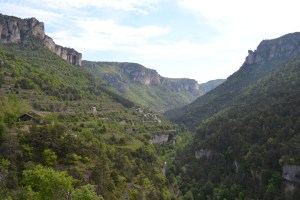
Birding has not been a priority so far this week. But on early reconnoitres while waiting for the day to warm up I have noted several Red-backed Shrike and a few Cirl Bunting by the roadside. This morning involved a quick 50km drive south on the A75 trunk road that was a nice change from negotiating endless hair pin bends into low sun. My destination was the spectacular Gorges de la Jonte (pictured below), where just west of a village Le Truel there is a vulture observatory Belvedere des Vautours.

DSC_0080

Gorges de la Jonte

Griffon Vultures died out in Les Cévennes in the 1940s due to shooting, poisoning of mammals, and compulsory disposal of sheep carcasses. But since 1976 all birds of prey have been protected by law in France, and vulture re-introduction with feeding on private land began in the 1980s. A Griffon colony at Gorges de la Jonte has grown to 443 nesting pairs in 2015. Black or Cinerous Vulture were re-introduced to Les Causses between 1992 and 2004 and now number some 80 individuals and 20 breeding pairs. Since 2012 Lammergeier or Bearded Vulture have completed the scheme, and two breeding pairs of migratory Egyptian Vulture also return to the area each year. So this is potentially the only place in France in which all four species may be seen.

DSC_0075

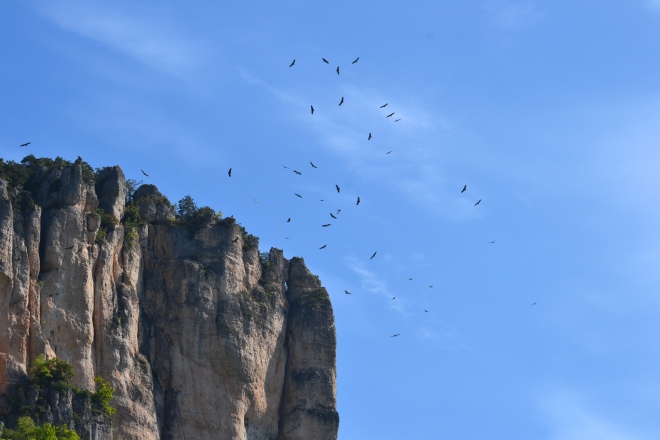
When I drew into the observatory car park, this (pictured above) was the welcoming party. I set up my scope quickly to find almost all the soaring and cliff-top birds were Griffons, but then a darker individual flew in and perched prominently on one crag. I began to pick off the diagnostics then this bird turned its head to reveal a purplish blue beak. This was indeed my Black Vulture for the trip, then Griffons landed on either side of it for comparison before harassing the interloper off its perch.

Seeing this lifer upon my arrival showed that its removal from the straggler ranks here was meant, after so much fruitless searching in Portugal. And although Belvedere des Vautours may be termed a Loch Garten or Rutland Water type location, finding a Black Vulture here still has provenance in my view. There is no certainty of seeing the latter since as tree nesters they do not breed on the cliffs with the Griffons. But individuals do stop by so I had been fortunate to have sighted one so well.

Once this excitement was over I went into the observatory where 6.70 euros gains admission to a museum that educates visitors on all things vautour. When a group of people builds up everyone is invited inside for a very informative audio visual presentation with English subtitles. Afterwards I stayed on the observatory roof for some time watching the Griffons on the cliffs overhead (pictured below), but it could have been a long wait for a Lammergeier or Egyptian to drop in. So around midday I decided to drive north into Le Causse Mejean on the off chance of crossing paths with either of these or Golden Eagle that are also in this area.

DSC_0079

The cliffs at Belvedere des Vautours

Choosing an ascent at random I became distracted by a broad and butterfly friendly looking track that led up a wooded valley from N44° 13.401′ E3° 17.631′. Eventually this took a hairpin and emerged above the tree line. I had brought a recording here of another straggler Western Bonelli’s Warbler that I familiarised myself with at the start of this walk. Now here was that very call coming from cover at one side of the track. I had several views of the bird but it didn’t stay still for long enough to focus on. So that was both my bird trip targets gained in one morning.

I began to regret not having genned up on Western Orphean as well. On the walk back down I did hear Bonelli’s again in two more locations and it’s a call I will not now forget. I must be getting to grips with this Xeno Canto malarky, having identified three new warblers on call in the last five months. The others were Dusky at Ham Wall, Somerset (see here) and Iberian Chiffchaff at Telford, Shropshire; but since the latter wasn’t seen it hasn’t been blogged either.

The following day I started at Gorges de la Jonte again, finding another large concentration of Griffons a little to the east of Belvedere des Vautours at N44° 92.394′ E3° 97.452′. Here there was also a large colony of cliff-nesting Red-billed Chough, that are widespread in the gorges of Les Cevennes. Having got to know this corvid so well on Portugal’s Sagres peninsula in January it was good to have another satisfying experience of them here.

Butterflies in Les Cévennes National Park, France: 15 – 20th May

I have driven many hire cars around more hairpin bends than I could ever count in a lot of scenic southern European uplands in the last five years, but this is right up there with the most spectacular regions of them all. Les Cévennes lies around 200 miles from Provence at the south-eastern edge of France’s Massif Central. This is a huge and largely unspoilt landscape of high granite peaks, limestone plateaux dissected by dramatic gorges, towering inland cliffs and endless forests (pictured below).

DSC_0164So where does a lone lepidopterist begin to look for butterflies in all this vastness? As a week earlier in Provence I arrived here unresearched with a “go out and see” attitude to things. But if Le Luberon dwarfed Les Alpilles then this place is, well massif as they say here. On Sunday I drove out from my base at Marvejols with a vague idea of exploring the Gorges du Tarn route. This follows the D90 road roughly south-west of Florac, the administrative centre of the park.

But winding roads in scenic uplands inevitably means bikers. There are hundreds of them here. Well each to their own, so at a village Molines I turned off the D90 and headed north along the D31 back towards Marvejols to seek peace and solitude. The road climbs one side of a sunny, sheltered valley that looked good butterfly country, so I turned off to the right then walked back down a rough path (pictured below) through stony, wild flower-rich habitat.

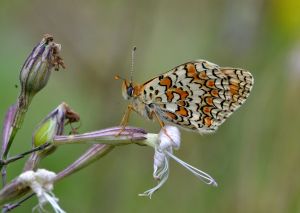
The first butterflies to appear were inevitably Wall Brown, seemingly a default species in this part of France. The first encounter of note was with a cluster of Marsh Fritillary, that were soon followed by two more of that family. Weaver’s Fritillary (pictured left below), a lifer is fairly widespread throughout southern France. To me the clearest diagnostic is the occasional larger dots in the row just above the base of the hind wings. One Glanville Fritillary (right below) was also recorded here.

Thereafter the roll call just kept on growing. Skippers – Dingy, Grizzled and what I took to be Red Underwing – were competing for territory with Common and Small Blues and Brown Argus. Scarce Swallowtail, regular and Pale Clouded Yellow (lifer) would waft past at intervals. Small Heath, Small Copper, Orange Tip, Small and Wood White, Brimstone and Osiris Blue (lifer) made up a total of 19 species at this first, randomly discovered site.

I followed the path downhill almost as far as the village. Then on the way back up again the site’s 20th and stand-out butterfly, a fourth lifer made itself known. Escher’s Blue in appearance (pictured above) lies somewhere between Adonis and Common Blue, being not quite as bright as the former but with a more iridescent purple tint than the latter. Quite a large blue, it is widespread in the Mediterranean region from eastern Spain to Greece, flying in flowery, rocky places such as this from May through to August.

On my uphill walk many more Marsh Fritillary had become active. These are very photogenic butterflies in my experience and I usually capture interesting pictures of them. The following will add some different back-drops to my collection.

I remained here until 2pm then went on to look for further good sites in different habitats, but without success. It had been an excellent start but over the next two days things were much more difficult. I know of no on-line resources for locating butterflies in France, and have found just one published trip report from Limosa Holidays in 2011. Butterflies seemed to be a lower priority than botany and birds for that particular group and they had lousy weather, but the report did suggest more sites in the north-east Cevennes that I investigated on Monday.

Immediately east of Florac and north of the D998 road to Le Pont-de-Montvert is a hilly area called les Bondons. There along a very minor road to a village Chadenet was a sunny corner that produced two more new butterflies. The first of these was a Sooty Copper (pictured below) that I watched for some time returning to the same spot as they are said to do. This one displayed a more purple tone than Collins’ illustration and photographs on the web site butterfliesoffrance.com show. I suppose that like a Purple Emperor in miniature this depends on how light catches the insect.

The second lifer here was an as attractive Chequered Blue that looks like a bigger version of Baton Blue on the top-side but has very bright and distinctive underwing markings. It is quite a localised and sporadic species in southern Europe, that in France occurs in south-eastern areas. This little beauty too kept returning to the same place on a wood pile but without ever settling in a position to photograph well.

Out of Les Bondons flows the River Briançon. From a bridge on the D135 road at N44°22.072′ E3° 37.124′ an often overgrown track runs north to a village Lozerette. Along here one or two big butterflies crossed my path without stopping, then I spotted a very big butterfly indeed. This was a Camberwell Beauty, the first I have ever seen. But it was being harassed by a small Fritillary every time it tried to settle, before gliding majestically and disdainfully away and up into the trees. Nothing else settled here either and I didn’t get any pictures at this site. There were more Chequered Blue here too and a lot of Wood White.

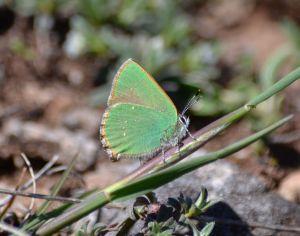
From here I drove on to Le Pont-de-Montvert then north over Mont Lozère, the highest ground in this part of les Cévennes; but without finding more productive sites. On Tuesday morning I started at the granite peak of Lozère, around which lies wet heather moorland. This is said to be good habitat for several species I have yet to see, but at three stops in sample habitat I found only Green Hairstreak. The feeling was growing in me, having begun a day earlier that perhaps I have timed this visit too early for many butterflies read about.
green hairstreak.1604 cevennes

Green Hairstreak

Naturetrek comes here in mid-June, and I next checked out a locality on their agenda. This is a ridge to the south-east of Florac called Corniche des Cévennes, along the top of which a road runs to the town of Le Pompidou. Here there were wonderful wildflower meadows with myriad Orchids and Pasque Flowers but very few butterflies save for Green Hairstreak again. I suppose this sort of habitat is more associated with high summer than May species but it was still disappointing not to see more.

My sense of discomfort was now growing into the fear that I had made a serious error of judgement in coming to les Cévennes. I needed very much to see and photograph some butterflies, and so set the satnav for that superb spot from day one. So why is this location at N44° 23.237′ E3° 31.378′ so butterfly friendly whilst almost everywhere else has been disappointing? Well it’s rocky, flowery habitat in a sunny but sheltered open valley and I just haven’t come across more places like it. Steep, forested and fenced off is more usual here.

Most of the same butterflies were active again, so what was happening second time around?  The Marsh Frits were sitting up to be noticed as ever but I had done them justice three days earlier. Mr and Mrs Escher were getting it on in the late afternoon sunshine (pictured above left), while the tinies continued to battle for bragging rights all around them. There seemed to be more Escher’s Blue here today as if they are still emerging, as they should be at this time.

But the butterfly I most wanted to photograph was Pale Clouded Yellow and one duly obliged (pictured below, left). Further down the track I came across what I identified as two of the brighter, lemon yellow Berger’s Clouded Yellow, one of which went into the can too (below, right). These are the ones that always flew past and kept on going in Provence. I hope I have identified the two smaller CY species correctly, but if not am open to expert guidance. With these results my spirits were restored.

Over the next three days I continued to look for butterflies in different habitats at randomly selected sites, with varying degrees of success. On Wednesday in one of the limestone plateaux of the western Cevennes, le Causse Mejean I followed a good looking track that climbed a wooded valley from N44° 13.401′ E3° 17.631′. Here in overcast conditions I noticed Small Blue-sized butterflies with violet blue top sides going past me. These had to be Osiris Blue that occurs in low density in southern France but whose range extends from Spain to Central Asia. When settled in the cool temperature they were very approachable and so the ID was clinched.

On reviewing my pictures and checking them against butterfliesoffrance.com I realised I had also seen this species on day one at the site by the D31 road north of Molines. By comparison with Small Blue the male Osiris has sharply defined black marginal borders, and both genders have a noticeably different underwing pattern to Small Blue. In the following collage I have included a Small Blue top side image from this trip and an underside picture from my archive.

This site also produced two Fritillary additions to my life list, but I didn’t realise what they were until reviewing my photographs back at home. I had rather hoped that some finds might turn up at this later stage. The left hand butterfly (below) is, I believe a female Weaver’s Fritillary that I confused with Small Pearl-bordered until matching my picture to those on butterfliesoffrance.com. In the same way I had initially thought the male Weaver’s recorded on day one was Pearl-bordered, unlikely as that other setting had seemed. The right hand item (below) is a rather worn Queen of Spain Fritillary.

Thursday morning was lost to the only heavy rain of this week. The afternoon was spent exploring some southern areas of Les Cévennes, drawing blank for butterflies time and again. A very cold wind was blowing now, and chatting to a staff member at the Mont l’Aigoual tourist office I learned it had been an unusually cold spring in the region this year. So here was a possible explanation why so few butterfly species were on the wing in many places searched.
DSC_0124

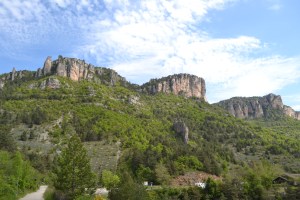
Limestone country of Les Causses

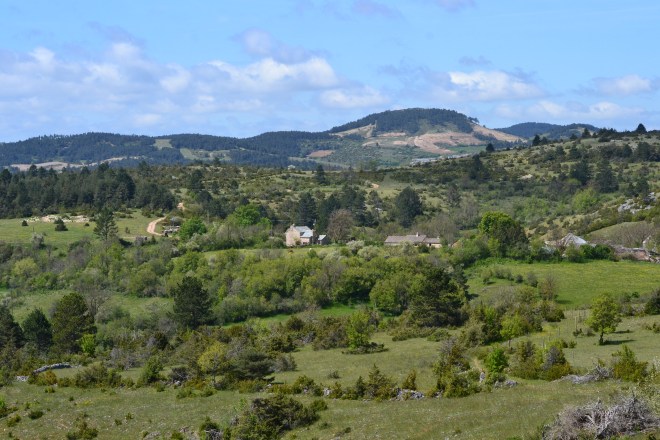
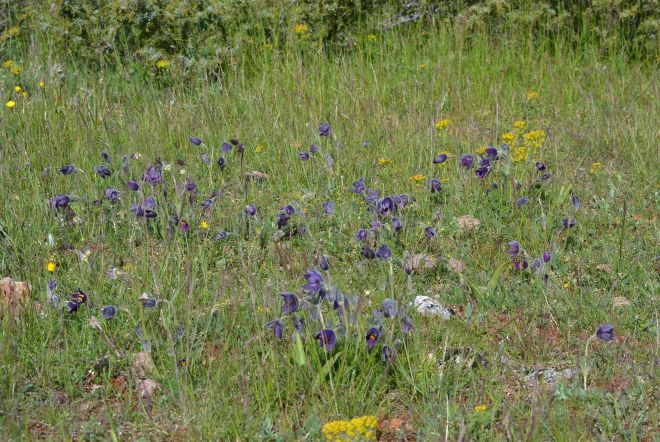
On my final day I didn’t wish to travel too far from base and so explored another north-eastern limestone plateau, Le Causse de Sauveterre. Along a minor road south-west of a village Champerboux I located a promising looking area (pictured above) and walked from N44° 23.838′ E3° 23.527 along a rising track through rocky, grassy land with a rich limestone flora. The profusion of Pasque flowers in particular here was astonishing.
DSC_0022

Pasque flower plot

It was a gloriously sunny day to end the trip. Amongst all this warmth and colour were varying quantities of smaller grassland butterflies seen each May in England: Green Hairstreak, Dingy and Grizzled Skipper, Small Heath, Orange Tip, Brown Argus, Common and Small Blue.  Remarkably to me there were even Wood White here, a species that I associate with woodland at home but have encountered in much more open habitats here. Some Baton Blue (pictured below) were also on the wing.
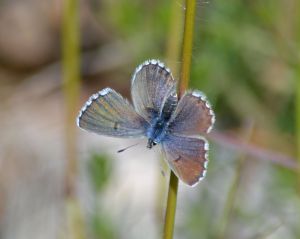
baton blue.1605 cevennes

Baton Blue

In place of Adonis Blue there was another less bright butterfly of similar size and jizz. This lacked both the purplish iridescence of the Escher’s seen earlier in the week, and the diagnostic black lines through the white marginal borders of Adonis, though the black of the border extended inwards along the veins . There were plenty of them here that I identified as Turquoise Blue (pictured below top). This grassland species of upland slopes ranges across southern and eastern Europe as far as the Caucasus. It was my fifth new blue of the trip and the stand out butterfly of the final day. The following grid includes male Adonis Blue (middle row) from Provence and Escher’s Blue (bottom row) from this trip for comparison.

No Cévennes trip report would be complete without some orchids. The national park is renowned for them and there were plenty in the wild flower meadows of this Causse de Sauveterre landscape. Here (pictured below) are some that caught my eye especially, though I do not know their names.

Eventually I left this scenic and uplifting location to see if anything new was flying at the productive site of day one. There were now more Escher’s and Osiris Blue here than previously, and in two spots I found congregations of different blues (below left) possibly extracting moisture or salt from the soil. Amongst these was another lifer Green-underside Blue, a fairly common and widespread species of diverse habitat that flies across much of continental Europe from late April to early July. The top butterfly in the right hand picture is one.

So my first serious excursion into butterflying France was over. Despite appearances the fortnight in Provence then Les Cévennes was by any standards a half-baked experience. I was disappointed to gain only 11 life list additions in  a country with so many species to offer, and the trip just involved too much searching and not enough finding. I left with the impression that an imminent explosion of lepidopteron life and colour awaited anyone who might time their 2016 Cévennes visit a little later than I did. But this was intended as a fact finding exercise and I expect I’ll return at some future time, probably in June and definitely better researched.
Butterflying in Provence: the rocky hills above Les Baux – 12th May

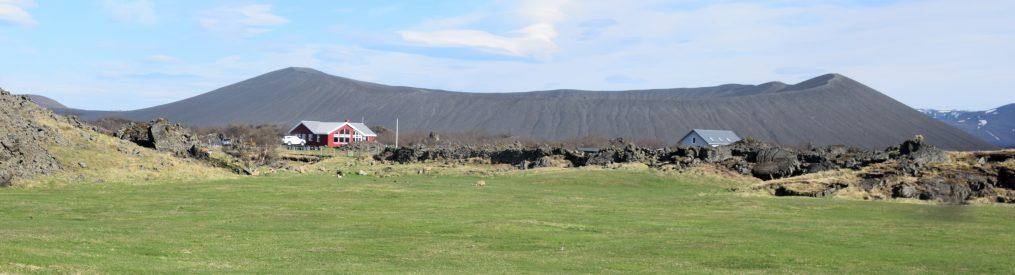
Les Baux de Provence had been a superb place to visit in winter (see here). But today I hurried past the high season tourist trap’s overflowing car parks and jostling coaches disgorging visitors, into the limestone hills just to the north. Here in May 2012, possibly while hoping to see passing raptors, I had first come across Provence Chalkhill Blue and had no idea what these delicate charmers were. My access point then has been blocked off with boulders and deterring signs but the next stopping place was just a little further on.
les baux.1627 from north

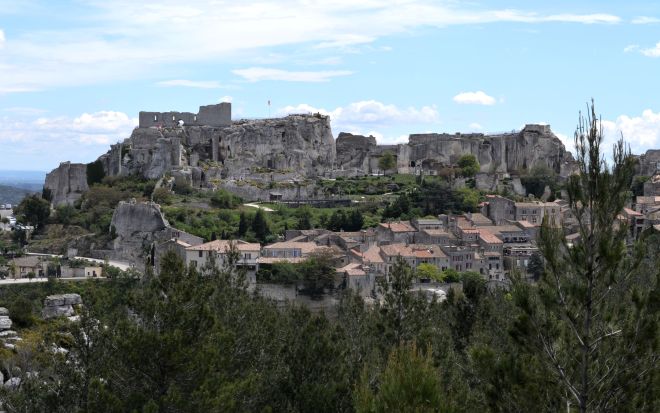
Les Baux de Provence from the north

From here (N43° 45.114′ E4° 47.481) a track penetrated the rocky, wild flower rich landscape that faces the bastion of the fortress village (pictured above) across a steep-sided valley. Butterflies soon began to cross my path as I walked in here. I realised the browns were all Walls of which there were many, and both Swallowtail and Scarce Swallowtail would flop by at intervals then go on their way in the sunshine. It was perfect butterfly weather and habitat.

The Provence Chalkhill Blue here were offering nice open wing poses (below left), revealing a slightly subtler toning compared to their British equivalents. Then the mystery was solved of the tiny blues I had seen a few times already this week, as one little beauty (below right) allowed a close approach. This was at last a life list addition for the trip, or sort of because Baton Blue is one of three very difficult to distinguish species.

I encountered one of these, which I took to be Panoptes Blue in the Algarve hills several times in May 2014. Then an on-line respondent to my trip report offered a tutorial on comparative ID. The confusion species is apparently False Baton Blue whose range is also limited to the Iberian peninsula. But according to Collins Baton Blue is the one found in France, so I’m ticking it and reverting my previous sightings to Panoptes.

I next drove on another 5km following a winding descent that seemed to be popular with the lycra-clad kamikaze brigade, and so required some care. At a point N43° 45.714″ E4° 47.677′ a forest trail led off to one side into a wooded valley that it soon became clear was superb butterfly country. Amongst the first to speed past were the trip’s first Berger’s Clouded Yellow but whenever seen these always did just that. They are very fast fliers and not inclined to settle.

provencal fritillary.1612 les baux

Provençal Fritillary

A short distance along the trail there were both Glanville and Provençal Fritillary, and this week’s first significant showing of Skippers: Grizzled and Mallow. Then a Southern White Admiral glided onto some Euphorbia before posing even more nicely against a green backdrop. The British equivalent is never so co-operative back home in Bernwood Forest, Bucks where in five years I have yet to capture a truly satisfying image of one. These south European stunners (pictured below, left) are possibly my butterfly of this trip, the fresh ones having an almost metallic quality as they soak up sunlight open winged, Several were seen here today.

Further along still I began to see male Provence Orange Tip (pictured above, right) and eventually managed slightly better record shots than two days earlier. I continued for some distance up into the hills enjoying butterflies all along the trail, then the sun went in so there was no repeat experience on the return walk. Now only the ever plentiful Wall Brown remained active, then as the greyness intensified even they were no longer to be seen. Back at the car rain set in and this best butterfly day of the week was over.