Little Bunting at Great Barford, Beds – 8th Mar

Today was the latest of its kind when I just needed to go somewhere, but on this occasion not too far. Upon scanning RBA I elected to experience my third Little Bunting, a wintering bird at a site near Bedford. My first record of this taiga breeder was at close quarters from a hide at a LNR in Cardiff (Feb 2015 – see here). Then earlier this year I stood in line with Oxon’s finest at a feeding station near Chipping Norton in the north of God’s own county to gain what was a county tick for myself as well as quite a few other people.

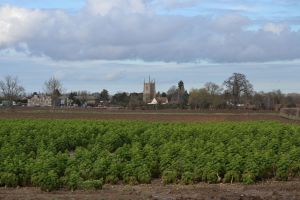
Working a late shift immediately following a sleepless night two days ago had taken their toll. But on struggling out of bed mid-morning I at once felt that a little cleansing of the system would be beneficial. And so I headed for the village of Great Barford, just 60 miles from home and parked beside a church near Barford Bridge (TF134516). Two other birders returning to their own car said the LB was coming to seed a short walk to the south-west, just before a green metal bridge where the Ouse Valley Way crosses that river.

great barford.1701

Great Barford from the riverside site

Upon reaching the described spot at 2:30pm I found a carrier bag containing bird seed on the ground and took the liberty of spreading a small amount on the path ahead of me. I soon realised that hadn’t really been necessary. Numbers of Chaffinch, Reed Bunting and other small passerines were moving about in a thicket to one side of the track (pictured below, right) and coming down to feed on much more seed that had been put down at the edge of a ploughed field. Amongst them before too very long was the Little Bunting.

I was the only person present and spent the next 40 minutes puzzling over various female Reed Buntings. Then a second birder arrived. Whilst appreciating he knew what he was talking about, it had been pleasant enough to be free of plumage topology conversation in the interval and irritating when he put the doubts in as to my own sighting. I now needed to see this bird again to reassure myself and that happened twice more, the first time under this other birder’s direction before he left.

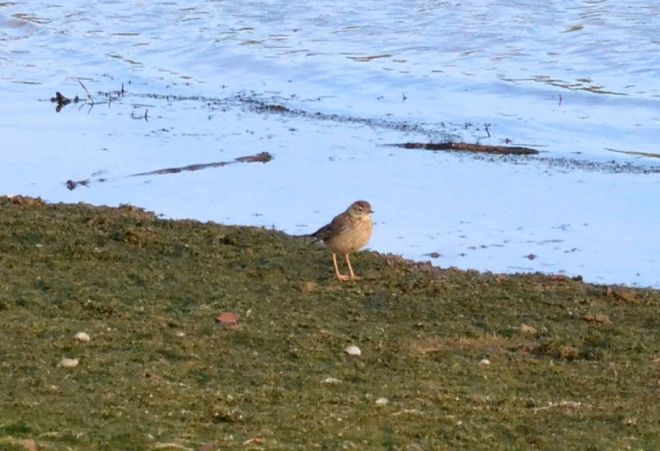
By now two more local birders had arrived and eventually what was needed transpired: a nailed-on, self-identfied repeat sighting. Like so many small (or indeed not so small) birds, when this one appeared it stood out clearly and some diagnostic features were obvious. The head pattern can be variable in tone but this individual’s chestnut facial features were noticeably bright. The other stand out feature for me was very marked streaking of the bird’s flanks. As ever I am not a great one for plumage topography, which is perhaps just as well since the Helm guide to confusion species devotes the best part of a page to it for Little Bunting. Unfortunately I did not manage to get a photograph, but the couple with whom I observed today’s bird sent me this excellent video.

Great Barford Little Bunting – courtesy of Peter and Kathy Blackmore

Though sporadic in it’s appearences during my two hours on site here today’s Little Bunting provided good value. The Cardiff bird had been viewed mostly into bright sunlight and the north-Oxon one was somehow difficult to appreciate in such a large gathering. So of my three records to date this is the one that has told me the most about a regular winter visitor. And though I regard baiting birds with seed as contrived, today’s encounter aptly illustrates how difficult it would be to locate those many scarce passerines that go unseen in the British countryside were it not for feeding stations such as this.

Footnote: Having not got a photograph I returned a day later to try again, but waited three hours from 12 to 3pm even to see this bird. Various local birders came and went in that time and conveyed that this Little Bunting is often elusive. It was first found by a surveyor before Christmas, and after Beds county listers spent a lot of time here without success the county bird recorder authorised the bag of seed to make things easier. So this site is not a permanent feeding station like the one in north Oxon.

In Memoriam: Bluethroat at Willow Tree Fen, Lincs – 15th Feb

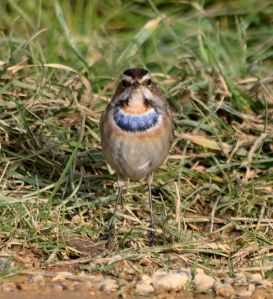
The rather exceptional discovery last Friday of what has become a showy wintering Bluethroat in the Lincolnshire fens was a suitable draw for two reasons. I have encountered the species briefly twice before at Larnaca Salt Lake, Cyprus (Nov 2011) and after much searching Tavira Marsh, Portugal (Jan 2014), but had yet to observe an adult male. So the opportunity to add a first winter male to my British bird list just 110 miles from home was not one to stand up.

The nearest wintering Bluethroat to Great Britain are normally in the south of France and the Iberian peninsula, and are of the southern white spotted sub-species. There is currently some discussion amongst birders online about the origins of today’s bird, that could be of the Scandinavian red-spotted sub-species or other forms occurring further east in Russia. But such taxonomic concerns were of less interest to me than getting what is a regular though declining passage scarcity onto my British list

I headed north in reflective mood after events in the previous two days. At my charity shop on Monday there had been a murder in the street outside. But more particularly, after deciding to go for this bird yesterday I learned of the death of a good (non-birding) friend after a brief hospitalisation with cancer. I felt no inclination for the usual accompaniment as I travelled what has become a familiar route via Northampton and Peterborough. Instead I pondered the transience of all the many phases of our lives and what the remainder of my own might hold.

I arrived at Lincs’ Wildlife Trust’s Willow Tree Fen reserve near Spalding at 12:30pm after taking the best part of 30 minutes to remember where it was. I had been here once before in August 2015 (see here) to see a beautiful Red-footed Falcon, probably my British bird of that year which subsequently was also murdered. There seemed to be a general movement of birders off the reserve, but I was directed to a group along the main track where the Bluethroat was said to be popping in and out of reeds to one side. Many close-up pictures taken at this spot, reflecting various degrees of expensive technology, had appeared on RBA and Bird Guides over the preceding days.

Upon my arrival a minibus carrying school children passed slowly in the opposite direction. Considerate yes but not especially helpful, and a dog was also present. None of the birders waiting here seemed to have seen the Bluethroat yet. Having made a late departure after working an evening shift I now feared the worst. But after just a 20-minute wait, and once the dog had gone, a murmur of: “There it is,” issued from my left. The bird had emerged from the reeds right in front of me. This (below) is what I call a result.

The above images were all captured with my entry level Nikon SLR and 300mm telephoto lens. I would like to dedicate them to the memory of Jeremy Hill, who was a very fine man and will be sadly missed by all who knew him. My thoughts throughout this twitch were with his widow Penny, one of my longest standing friends and their sons Sam (17) and Tim (15).

The Bluethroat spent several minutes moving about and feeding in the grass beside the track, where food must have been put down for it by photographers and/or other people with cameras. Mealworms were mentioned by some birders around me. As in the Algarve three years ago I was struck by the larger size of this Robin-like passerine, and also by the way he constantly flicked his cocked tail. From time to time he just seemed to stand and look back at the line of observers who were all so fascinated by him (pictured below).

bluethroat-1706-willow-tree-fen

Who might this be?

Finally and rather coquettishly he flipped back into the reeds from whence he had come, and immediately I thought of my stomach. After a sandwich break back at the car I decided not to linger further and so headed home. Standing in line watching a bird at such close range always seems a little contrived to me, especially if it has been baited with food. But I am unlikely to get better views of a rather under-represented species in my past records that is now well and truly ticked for blighty (no 335). I believe this is only the second British wintering Bluethroat this century.

Winter is almost over now, and I have negotiated the dark season without a break abroad. That has been a difficult, at times brutal ride, as needs must but also an experience that instils some sense of achievement. Hitting the road to “see a bird” always helps: that is why I do it.

White-billed Diver at Bardney, Lincs – 25th Jan

This is the last European diver, or loon as they are also known that I needed for my birding life list. I usually associate reports of White-billed Diver with northern Scottish coasts. So when a juvenile turned up five days ago at an inland river site south-east of Lincoln, just within my preferred range, it was a must see. Even more so after I viewed these images (here) on RBA.

On Monday at a county twitch in north Oxfordshire I overheard a conversation about this bird and expressed my interest. The next day Ewan called to say he was up for it if I would do the driving and so it was agreed. I was sickening for a cold that I did not want to pass on to my friends at the charity shop, so a birding day out with a hardy soul who though warned was not bothered by my germs was an attractive prospect. And so we set out northward at 9am on a foggy Wednesday morning.

In Europe White-billed Diver breed in arctic coasts of Russia and winter chiefly along the north-west Norwegian coastline. It is a rare winter visitor further south around the North Sea though there are notable annual spring gatherings in Scottish waters off the Isle of Lewis and the coast of north Aberdeenshire. Inland British occurrences are very rare indeed and hence this bird has been nominated the Bird Guides bird of the week.

white-billed_diver_from_the_crossley_id_guide_britain_and_ireland

White-billed Diver: first winter (foreground) and adult breeding © Crossley ID Guide to Britain and Ireland

The day’s first sighting on RBA told of the Lincs WBD drifting north along the River Witham past a tiny village called Southrey (TF138663). We arrived there some time after midday to find a gaggle of birders milling about and wondering in which direction to search along the towpath. The latter half of our journey had been through cold clear sunlight but once we got close to the location it became apparent the whole area was blanketed in freezing fog that would not be burning off any time soon.

At 12:20 a birder checking RBA announced that the diver had been relocated a few miles to the north at Bardney Bridge (TF113693). Cue a mass re-location. Ewan and I were amongst the first to arrive there and about 500 metres north of the said bridge we sighted a very impressive looking bird indeed, keeping company with a Cormorant. White-billed Diver is the largest of its genus that breeds in Europe, even bigger than a Great Northern Diver. The two species are quite similar in appearance but WBD’s distinctive and most impressive feature is a large, straight, up-tilted white bill that in summer turns yellow. Hence this bird is also cited as its north American title Yellow-billed Diver (or Loon) in some sources.

I observed the diver for a short time then attempted to photograph it, at which point I realised there was no SD card in my camera. It happens … well sometimes! And so I rushed back to the car to retrieve the spare I always carry, passing many more birders converging from various points along the River Witham and all enquiring about the WBD. “Keep going, you can’t miss it,” and such like I responded but it appeared that all of them did. I could not have imagined this bird could move on so far in the short time that I was away.
Returning to take my pictures, or so I had thought I stomped on and on to eventually rejoin a confused melee of birders all at a loss to know where the WBD had got to. It seemed that only the first several people on site, including ourselves had managed to connect. Ewan said he had seen the diver turn around and probably head back south, and so we agreed to search in opposite directions. Walking north I quickly encountered people coming back from a lock and barrage beyond which the bird was unlikely to have passed. Then Ewan called to say he had viewed the WBD very briefly as it surfaced back near Bardney Bridge. I conveyed that to those ahead of and behind me and so things continued.

It became clear this powerful swimmer must be travelling for considerable distances under water. The thing was that people walking the towpath all headed for the group of birders they could make out in the fog ahead instead of keeping an eye on the river. And so almost everyone missed the bird. Meeting Ewan again he suggested we went back to Southrey and wait for the WBD to pass. Back there it soon became apparent that lots of other people, most of whom had yet to see the bird all had the same idea. By 2:30 pm we decided to look further south again, but discouraged eventually by the dismal and freezing weather we gave things up and headed home.

In various ways this was a frustrating day, due not least to the local weather conditions and also because out of carelessness I did not capture my own images of an important lifer. But I had seen the WBD well which most birders in the area did not on this occasion. It seems rather bizarre that such a large and stand-out bird could have eluded most of its audience so thoroughly for much of the time, but that is what happened. Most importantly I have now observed all of the European divers in Great Britain.

Rose-coloured Starling at Crawley, Sussex + Oxford Waxwings – 10 & 11th Jan

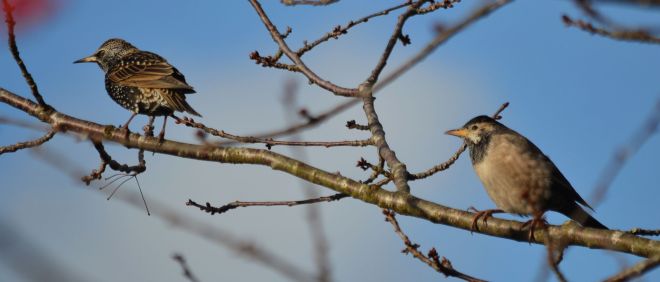
The first-named is a bird I have intended to visit for some time. The now second calendar year juvenile has been gracing a suburb of the Gatwick Airport metropolis since early November. But I wanted to wait until its moult progression more closely resembled the splendid pink and black plumage of an adult (outsourced picture below right).

There are 30 plus British records of Rose-coloured Starling in most years, some of which like this particular youngster over-winter. It is a scarce south-east European and south-west Asian breeder, and the normal wintering grounds are in southern Asia. I had seen a first winter juvenile once before in my home area close to Oxford in January 2010. But that distantly viewed bird had just looked like a very pale common Starling in a large flock. So when Ewan, who had seen the Crawley bird closer to its arrival (pictured below left) said he was going for a second look and invited me along, I jumped at the opportunity.

Arriving in the residential district of Broadfield (TQ255345) late morning we found the RCS at once, its presence being revealed by two other birders. We too were able to walk right up to the low trees it was favouring beyond a garden wall where clearly a large amount of bird food was being put out. Then for the next hour or so we just snapped away with our cameras, while more birders came and went, mostly on time out from their jobs and also doing a check on the juvenile’s progress into adulthood. Now and again local residents would drive by smiling knowingly inside their cars: “birders again”.

rose-coloured-starling-1701-crawley

Rose-coloured Starling (2cy juv) at Crawley today

As the partially moulted bird moved around it became readily apparent just how well things were coming along. My favoured Helm guide to bird identification describes juvenile RCS as pleasant, bland-faced, innocent looking birds with rather loose, fluffy plumage; and I have to agree. The images in this post were captured with my 300mm telephoto lens. It really was that easy, unlike the recent Dusky and Blue Rock Thrushes.

The above sequence shows the frequent bill cleaning behaviour that the bird engaged in. Also in addition to the more developed glossy black plumage, how the beak is turning from yellow to pink and a noticeable crest is forming. I believe the moult should be completed by February when I will be greatly tempted to observe this bird again if it remains. After all I have yet to come across one in southern Europe.

rose-coloured-starling-1705-crawley

Common (left) and Rose-coloured Starlings for comparison

Back home in Oxford, one of the stand-out birding events of the new year has been the much anticipated arrival of Waxwing in the city. 2016/17 has been touted as an irruption winter since the early influx of large numbers of the Scandinavian berry bandits into Scotland and northern England. Now for the last four days a small group of six birds has been active along one arterial road in north Oxford, paying frequent visits to an ornamental berry tree from more lofty surrounding perches, as Waxwings do. I have visited the location in each of the last two days, and these (below) are my better digiscoped records of the occasions. The right hand image illustrates just how thoroughly the berry tree has been stripped of its fruit.

On the subject of local birding, my Oxon county year list for 2016 had I been keeping one would have ended on 173 (plus two heard only). Somewhere in the 170s is usual unless one doesn’t go on holiday in the passage season, is able to drop all other commitments and go after every county bird, and is an excellent networker to get all the tips quickly from other birders. So topping my 2012 and 2013 totals of 181 will have to wait for another year, if I should choose to indulge such a widely denied practice. The 2016 Oxon year rather fizzled out in December, but then two Bean Geese arrived late afternoon on New Year’s Eve, the month long presence of three Cattle Egret has been revealed on a north Oxon pig farm, and more Waxwing are likely as forecast “Arctic blasts” look set to “batter Britain” through January.

All the 3s: Blue Rock Thrush in the Cotswolds – 28th Dec

Another fine reason arose to be out and about in the frosts of mid-winter when news of this bird broke yesterday from the Cotswold town of Stow-on-the-Wold, Glos. I have encountered Blue Rock Thrush often enough abroad. The national bird of Malta where I commenced my southern Europe travels five years ago, I have also observed the species in Cyprus and Morocco, and several times each in the south of France and Portugal. But more parochial British list additions are always welcome and this one represents bird number 333.

12 months ago an incessant Atlantic weather pattern was dampening my spirits prior to a January escape in the BRT’s home territory. Now the elements have contrived to cater for my choice to endure the British winter this time around, by offering up more cold, clear days of the kind I so enjoy. It was a glorious, frosty daybreak at home in Garsington but on the other side of Oxford there was fog that endured throughout the day. The A40 was closed west of Witney due to a 20 vehicle fatal accident, necessitating a detour through that town. Eventually I arrived in Stow some time before 11:30am.

The pay and display car park closest to the bird was full, with green clad optics carriers coming and going. As I walked from there towards the BRT location people coming back the other way were all content and saying: “It’s showing well,” and such like. As with the Derbyshire Dusky Thrush this occurrence demonstrates how a rarity can remain beneath the radar for some time, in this instance a week before someone with a passing interest puts images on social media and news gets out. Then local residents need to brace themselves for an invasion, prepare the charity buckets and sit tight.

blue-rock-thrush-1601-stow

Thar he blows!
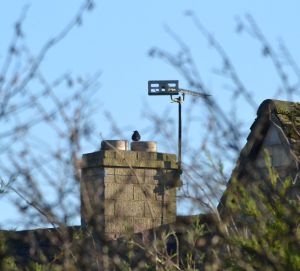
On reaching Fisher Close I found a rather modest gathering who were all clearly on the Blue Rock Thrush that was perched obligingly atop a chimney (pictured above). Voila! Apparently there had been around 200 birders crowded into the small cul-de-sac at first light, which must have been a bit of a shock to any late-waking resident who might not have been forewarned. I myself do not feel the need for dawn starts unless there’s a significant advantage in seeing a bird. But I likewise appreciate that getting there early is a matter of form for many birders.

I only needed to tick this BRT for Blighty and thereafter was content for the twitch to turn into a social occasion. There wasn’t long to wait as I looked to my left and found fellow Oxon birder Adam (Hartley), who I would have been surprised not to see here. We chatted for a while then I looked behind and someone else was smiling and waving. Andy? No the Viking beard couldn’t have grown that much since before Christmas. Here were Wayne and Julie (Bull) and before long we were joined by Keith and Shirley (Clack) who I also somehow expected to meet. As we stood around talking these various friends greeted other birders who they knew from here or there: twitching is like that!

All the while the reason for our being present kept coming and going, perching on roof apexes and taller chimneys. It seemed a rather incongruous location for a Thrush that I have always associated with inland or coastal cliff faces in southern Europe. But this bird was treating the environment of it’s adopted resting place in exactly the same way as I had always observed its kind in the past, as I consider the above images show.

This is only the seventh British record of a shy species that normally is seen at distance in its home range and tends to hide itself when disturbed. Today’s BRT was no exception. It behaved just as all those others I have seen abroad did, appearing at height as a silhouette and surveying all before it. But when light caught this male bird in the right way its deep blue colouration and strikingly long bill could be plain to discern. For some quality images see here.

stow-1601

Definitely not a covert Oxon sortie into Glos … just a social gathering

It remains to reflect upon how I seem to have spent some time in Gloucestershire of late. That neighbouring county has hosted Dusky Warbler and Eastern Black Redstart in December 2016, as well as the Richard’s Pipit and Blue Rock Thrush of this journal’s last two entries. All of those are birds I have yet to record in God’s own county (Oxon) where we currently survive on a diet of Bittern, Harriers, Caspian Gull and Tristis Chiffchaff. Whilst appreciating those are all excellent birds to have in a central, land-locked English county, I as always yearn for something new and different. And so far this winter I have not fared too badly a little further afield.

A Richard’s Pipit at Arlingham, Glos – 26th Dec

Having been pleased to add Blyth’s Pipit to my life list four days ago, I decided also to have a look at this very similar bird. I went to a site by the Severn estuary just to the south-west of Gloucester with a vague idea of assessing how much difference I could detect between the two. But my prime motivation was just being out and about, not too far from home (66 miles) on what was a beautiful, clear mid-winter’s day.

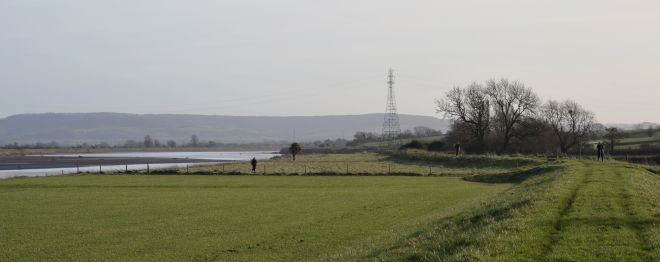
Arriving mid-morning and parking short of some farm buildings (SO709119) I set off along a right of way through a muddy farm yard then onward to a flood defence embankment. Being alone, finding the bird seemed like a challenge and Meadow Pipits began to fly up from either side of the earthwork that I hoped would be a harbinger of something scarcer. Before me stretched a restful landscape of subtle purple, ochre and green hues (pictured below) all in a hazy light. It was low tide. Here and there busy little Stonechat adorned fence posts and wires, while more commonplace Chaffinch and Dunnock went about their own business.

arlingham-1601

The Severn estuary at Arlingham

And so I took a little time to luxuriate in being somewhere new, different and this pleasant. The directions on RBA cited a narrow rough field in which was a mistletoe covered hawthorn. This (below) looked like the spot and there ahead of me were three more birders clearly observing something in the greener area between me and themselves. Scanning to where the right hand person was looking I found a bird of the right shape and jizz. Not such a challenge after all then!

arlingham-1602

The Richard’s Pipit site

The other birders now walked on ahead of me and I followed. As I caught up with them a bird went up out of long grass and over our heads, emitting a rasping chree-up call. This was definitely not a Mipit but indeed my bird for today. The call of Richard’s Pipit is also a key indicator, since upon referral to my favoured Helm guide I find that Blyth’s has several quieter and softer ones. The RP then settled briefly to the landward side of the flood defence, before crossing over and feeding in the short-cropped green area.

Now we crept up on the blind side of the embankment, before peeping over the top and watching the bird moving slowly away. The feeding action at once struck me as being less energetic than last Thursday’s Blyth’s. As I had recalled from my two previous sightings of Richard’s, today’s bird appeared a little darker-toned and the likewise reddish legs seemed of less super model proportions. The record images (below) do not reveal too much, but as always show at least that I am not making this story up. For a good one captured at a later date see here.

I then walked away to put the sighting on RBA and when I re-joined my companions they said the Pipit had moved into longer grass along the river’s edge. It remained out of sight for around 30 minutes before reappearing some distance towards the farm buildings. That was the direction in which I needed to head, and so I began to walk back. The RP was now keeping to the far side of the green area and it could have been a long wait for the bird to come closer for a decent photograph. And so, with things still to do at home I left.

So just how much variation could I detect between these two larger, wintering Pipits? I will not attempt to go into plumage topography since I am not knowledgeable enough to do so and in any case that bores me. But I have to agree with the Helm guide’s assertion that in the absence of obvious diagnostics the two just appear distinctly different in the field. The most important thing of all was that my third Richard’s Pipit had cleansed my weary dark-season soul a little by giving purpose to a quite refreshing morning out.

Blyth’s Pipit at Blagdon Lake, Somerset – 22nd Dec

When this bird was identified last Monday five days after first being found, I at once recognised an exceptional opportunity to gain a difficult lifer. When any British mainland Blyth’s Pipit has appeared on RBA in the past it always seemed like a tricky species even to get sight of never mind distinguish from the very similar Richard’s Pipit, indeed citations are often qualified by the word “probable”. But this individual had been showing well on open ground around a lake shore near Bristol all this week prior to my visit on a fine winter’s day today.

Since the first modern British record of Blyth’s Pipit in 1988, this rare vagrant from eastern Asia has become increasingly regular in late autumn, with a few lingering into winter. But most of these are encountered in the Hebrides and Scillies where I have never been. The majority of large Pipits seen after early October are the Siberian breeder Richard’s Pipit that averages around 120 a year. I have observed the latter twice at Weymouth, Dorset (Jan 2012) and on Portugal’s Sagres peninsula (Jan 2014).

Blagdon Lake (ST508595), at the northern edge of the Mendip Hills, is managed by Bristol Water primarily as a private fishing facility, but bird watching is accommodated for permit holders. Access is currently allowed for visitors wishing to see this rarity. Around 11:30am I arrived at the fishing lodge car park (as instructed on RBA) to find very few cars and fewer birders. The consensus amongst a confused smattering of us was to walk east along the lake’s perimeter road and see what we found. Then birders driving back the other way let us know that vehicle access had been opened up closer to the area that the Pipit favoured.

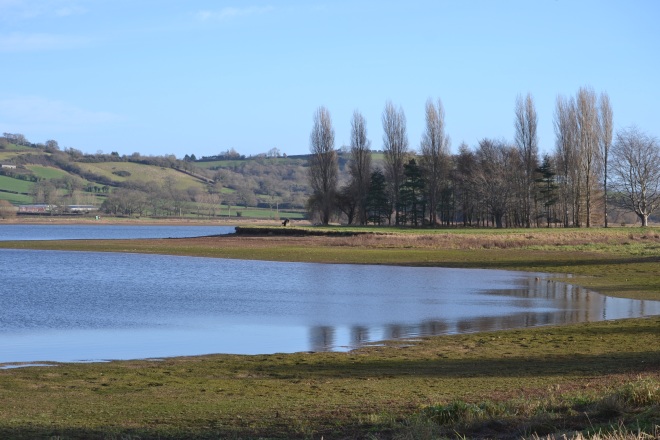
On relocating to a spot known as “Green Lawn” birders were dispersing and I was told the BP had just flown to an area east of the trees (pictured below). There were three locations at the eastern and of the lake that it commuted between in company with several Meadow Pipits. So I walked on and fortunately found myself in company with two very knowledgeable and helpful volunteer wardens who quickly put myself and others onto our quest. With the tick gained that familiar surge of relief known to all birders swept through me and it was then possible to relax and enjoy. And this little number performed very well.

dsc_0027

Blagdon Lake on a perfect winter’s day

The Helm guide to confusion species describes Blyth’s rather aptly as exhibiting few diagnostic features but “a host of minor differences that create the impression of something distinctly different”. Having had the benefit of watching this bird for a few days, the wardens described all those nuances as the first winter Pipit moved ever closer along the shore. I will not go into detail but to me it stood out amongst the Mipits for being much more long-legged with an upright stance. It had an energetic feeding action, often raising or tilting its head to one side when the smallish bill became apparent. Something different indeed! Eventually all the Pipits flew back to Green Lawn where I captured a record shot (below) that shows the bird’s generally buffy hue and long reddish legs.

blyths-pipit-1601-blagdon-lake

Blyth’s Pipit

On this twitch I was struck by the very welcoming outlook of local birders who were helping visitors to get onto the rarity. One of them said this was the biggest gathering so far this week, and save for an inevitable person with a camera trying to get far too close everything was conducted in a good spirit. I also met bird warden Nigel Milbourne who publishes the Blagdon Lake web site (see here), and would like to express here my appreciation for his efforts in putting information out and negotiating visitor access with Bristol Water. Mission accomplished and with the great assistance of these true birding colleagues a rather difficult lifer in the bag.

Dusky Thrush at Beeley, Derbyshire – 6th Dec

When news broke on Sunday of a Siberian breeding Thrush in the Peak District national park it was not to be missed. Collins lists seven Asian Thrushes that occur as stragglers in western Europe through autumn and winter. Like the star passerines that enlivened England’s north-east cost during October they really ought to migrate the other way into south-east Asia, and I myself had yet to see any of them until now.

I believe some of these and other native European Thrushes are known affectionately to some birders as “The Turds” due to their Latin genus name of Turdus. Today’s Dusky Thrush Turdus eunomus is the same shape as a Song Thrush and a little larger than a Redwing with attractive variegated patterning. As if to demonstrate how very many rare migrants must go undetected in usually unwatched areas, this individual had apparently been present in the village of Beeley, just inside the national park boundary for around two weeks. Then a local resident photographed it, word got out and a major twitch ensued.

I had spent a perfect sunny winter’s Sunday scouring local woodlands for Crossbill that is still missing from the 2016 Oxon year list that local form dictates I do not admit to keeping. The result was mild dark season depression. Walking the south Oxon downs hoping to cross paths with a Merlin recently had produced the same effect and the prospect of starting all over again in January really doesn’t enthral me. Drifting lethargically into the new week, upon seeing a lifer’s presence confirmed 137 miles from home I searched online for local accommodation, found a last minute room in a well-rated B&B for £45 and booked it straight away. Having made that decision, with the prospect of hitting the road and a new bird to see, I felt alive again.

After Monday afternoon at the charity shop where I volunteer, I set off northwards at 6:30pm. Yes there is life after 5 o’clock in mid-winter, and propelled along by the best driving at night sound in the world ever (that’s another Slash reference) I soon found myself on the M1 motorway north of Leicester. It was a pleasant and uneventful run and around 9pm I drew up at my B&B in a very frosty Matlock. Checking RBA at breakfast the Dusky Thrush was reported early. I arrived on site at 8:50am to a very well-organised twitch, with coffee, bacon sandwiches and toilet facilities all laid on by Beeley’s Duke’s Barn outdoor activity centre (a registered charity) where I got the last parking space and made a donation.

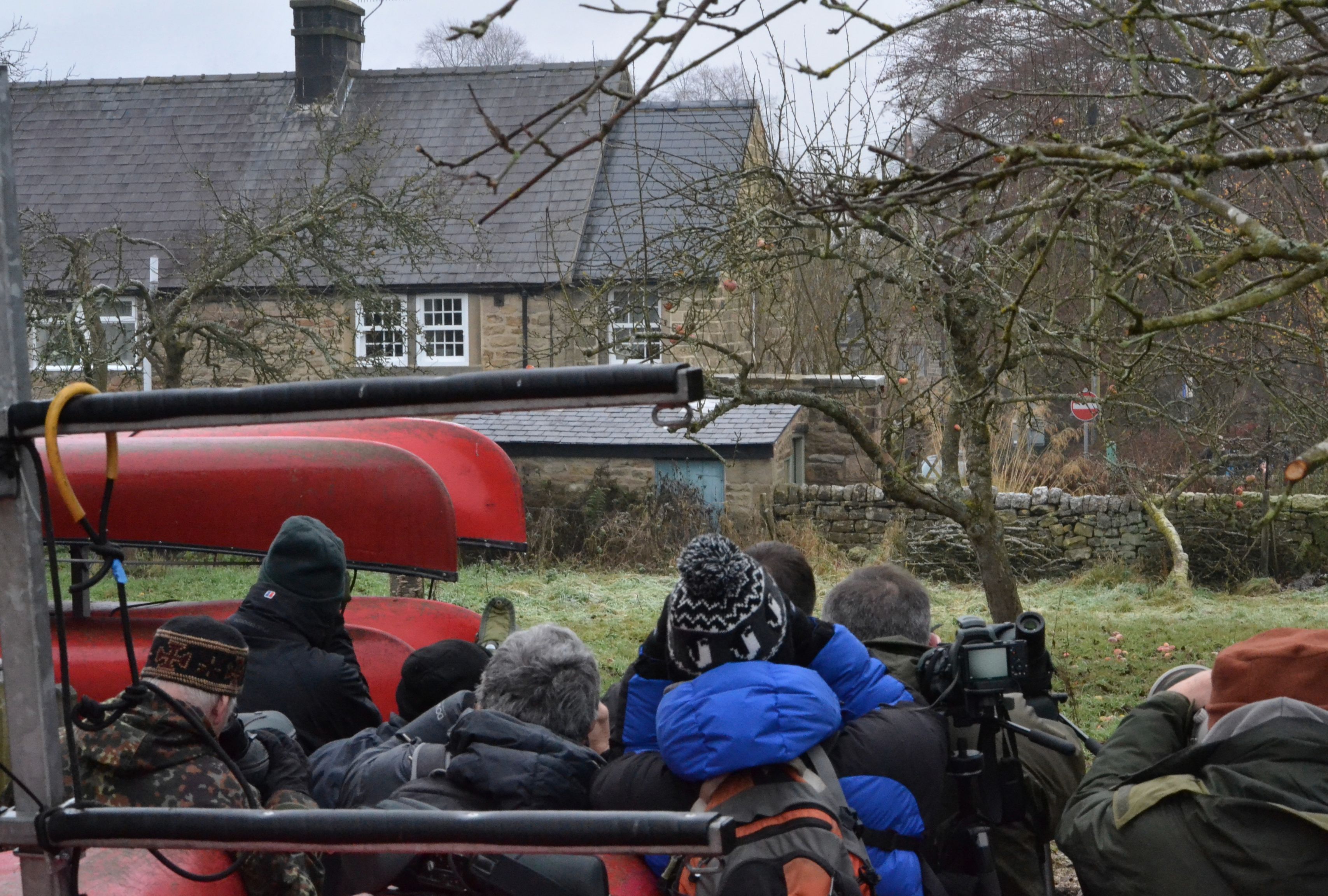
The Dusky Thrush is in the apple tree (centre)

The Dusky Thrush is in the apple tree (centre)

Local birders who were stewarding the event confirmed the instruction on RBA that the bird could be looked for in an orchard from behind one of the centre’s barns. I walked around that building to find a large group of visitors all crammed into a rather cramped and obstructed viewing area. The picture above gives the general impression. This struck me at once as a gathering of seasoned, traditional birders as belied by the near absence of big camera lenses. Proper field etiquette was being observed that included not talking loudly until the bird has been seen, and everyone just watched and waited patiently.

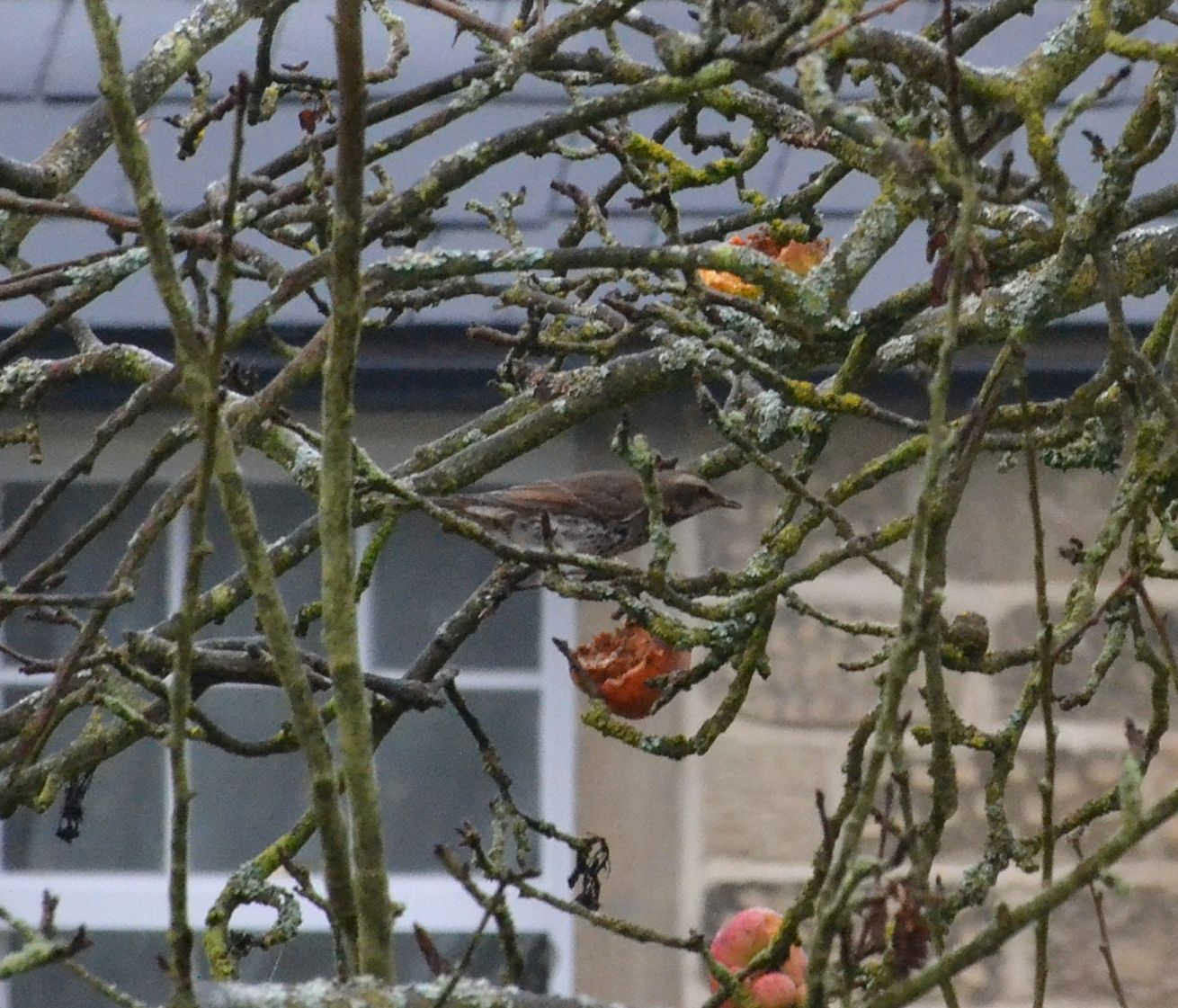
Things didn’t take too long. After 20 minutes the Dusky Thrush, a first-winter probable female was located in dense tree cover at one end of the orchard and a certain amount of jostling and getting in one another’s way ensued. That was inevitable in the circumstances and guess what, I was one of those who could not get on to the bird. But then the DT moved left to feed in one then another apple tree, revealing all it’s subtle plumage detail. To me it resembled a rather pale Redwing with a broad and prominent supercilium. This superb image (here) on RBA shows exactly how I too saw the bird, so it was just as well there were one or two big lenses present after all. For the full RBA gallery of this bird see here.

Dusky Thrush (fem)

Dusky Thrush (fem)

I had stepped up onto a boardwalk behind the watching group and concentrated on watching the Thrush rather than trying to get pictures myself. The above image is the best record I could manage. All this lasted for around 10 minutes then at 9:20 the bird flew off into the village. Much of the crowd now dispersed but I elected to hang around for a while and hope for a better photo opportunity. I began chatting to two nearby birders about our earlier sighting and new arrivals nearby told us to be quiet. Well, I can’t have it both ways! Occasionally over the next hour people would claim obstructed views but the DT did not show well again in that time.

By 10:30, mindful of the need to head back to work early in foggy conditions, I went for a wander around the village. Birders and their cars were now everywhere, possibly to the annoyance of local residents and play group mums. Well that’s poetic justice, but if I’m referring to parents of disabled children using the centre I withdraw the sentiment of course. There was no way the Duke’s Barn car park alone could have contained such an influx as had been instructed on RBA. Everyone was searching for the DT, apparently with little success. The bird was seen a few more times later in the day but I had been party to it’s best showing.

Forster’s Tern on the Stour estuary, Essex – 20th Nov

I have been wondering where new birds to see might come from this winter, and it more or less has to be something new to fire my imagination currently. Then, yesterday as if to illustrate that rarities will always turn up, an Atlantic storm named Angus blew in this thing of beauty.

On getting home late afternoon from a working Saturday, the day’s highlight on RBA was a vagrant north American Forster’s Tern 130 miles from Oxford. This is the first in Britain since 2003, though the species has been a regular winter visitor to Ireland in the 13-year interim. The usual wintering grounds for this marsh dwelling Tern are southern coasts of the USA and Mexico. I decided that if still present in the morning I would probably go for the lifer.

Upon beholding an image (see here) on Sunday morning my mind was made up. What a subtle, understated gem! A first-winter bird it is slightly larger than a Common Tern with a black bill, dull orange legs and most strikingly a black ear covert patch beneath a pale grey crown. It had been observed between 1 and 4pm from Mistley Quay (TM117321) on the Stour estuary, and reports all stated “showing well”.

I arrived in Mistley at just after 2pm to find a long line of parked cars to one side of the town’s landmark 18th century church towers. A man I parked next to advised me to walk past that monument to the quay where the FT had last been seen around 45 minutes previously. There was quite a concentration of birders there (pictured above), as I had expected for what was the day’s top English draw. This being a mega second ever for Essex, county listers were of course out in force. People told me the FT followed a routine of flying west along the estuary then back east, and everyone present expected it to come round again soon.

The quay edge was topped by a steel mesh fence that is a local bone of contention (see here). Having had my fill of such obstructions when observing the Easington Siberian Accentor last month, I walked past restricted access signs under apparent threat of prosecution to where a small group were also seeking a clearer view. Nobody stopped us. Amongst them was fellow Oxon birder Terry Sherlock. I usually expect to run into one or more of the county’s finest on these occasions, and learned that Andy had also been and gone earlier.

It was now a matter of waiting patiently for the Forster’s Tern to do another circuit. Time passed and on checking RBA Terry found the bird had not been reported from further east, while a “no further sign” had been posted from Mistley. It always irritates me when people see fit to do the latter because they cannot be bothered to stick things out. And as someone nearby commented: “At this time of year, when the Tern does come along we won’t have to work out which one it is!”

forsters-tern_02-1601-mistley-quay

Forster’s Tern from Mistley Quay

So we continued to watch and wait. A high tide roost of Black-tailed Godwit just offshore offered a pleasing diversion, while Turnstone, Shelduck and Goldeneye provided further interest out on the estuary. After around an hour on site myself the Forster’s Tern was called approaching from the east, then it proceeded to do what had been described earlier, circling the area before the quay and plunge diving for fish at intervals. The diagnostics from yesterday’s RBA gallery image are just about discernible in my own photo above.

This fly past provided good views for all the assembled birders who then quickly dispersed back to the warmth of their vehicles. As I walked to my car more people were still arriving and also watching the estuary from points further west. This is my own 330th bird in Britain that has provided an attractive and satisfying first addition for my winter national season.

Velvet Scoters at Willen Lake, Bucks – 12th Nov

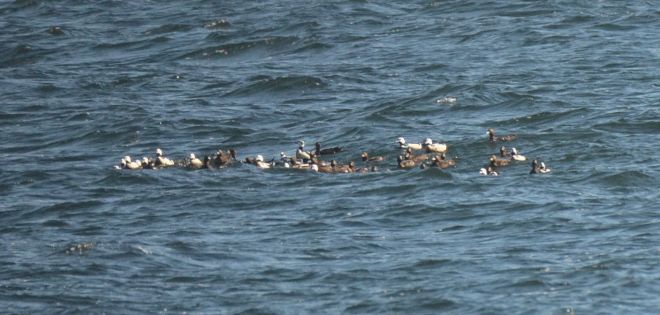
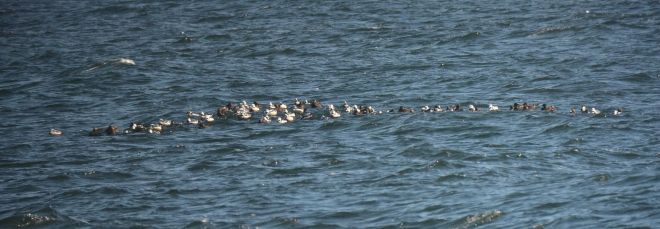
On this damp and grey day of the new dark season the occurrence of some scarce wildfowl in a Milton Keynes public park offered a suitable diversion. Having risen late following successive evening shifts, my attention was caught on RBA by two Velvet Scoter just 40 miles or so from home in neighbouring Bucks. Such a bijou twitchette would fill the remaining hours of daylight nicely and so I jumped at the opportunity.

I have observed this sea duck twice previously, on the Solent near Titchfield Haven, Hants (Mar 2010) and at Oxford’s Farmoor Reservoir (Dec 2013). More than 20 were reported this morning around the south-east English coast in Norfolk, Suffolk, Kent and Sussex, with three more at two inland sites. Essentially marine in winter, these Baltic and tundra breeders are rare inland in Britain, usually turning up during freezing weather. The instructions on RBA said in the SW corner of Willen Lake, viewable from the perimeter path near the pub. What they didn’t make clear is there are two lakes here, a southern one (SP877397) being home to a water sports complex, while the northern one is more naturalised.

I reasoned that the Scoters would more likely be in the less disturbed location, but upon checking out the north lake first the information board showed the pub was by the south one. The busier option it was then but in my first scan around every black silhouette was a Coot. Then I noticed two birders further around the perimeter path and went to join them. They pointed out the area where they had last seen the two first winter male Velvet Scoter, but it was several minutes before we relocated them close to the structure pictured below left.

Mist was rising above the lake’s surface in steady drizzle and the light was deteriorating fast. As so often when meeting birders in the field I seemed to recognise these two but could not place from where. After my companions left, the two Scoters continued to drift right, diving all the while and getting closer and closer. These sooty brown ducks have a stocky, rather large-headed profile with a thick lower neck and long wedge-shaped bill. Their pale cheek patches always stood out but the white secondaries remained hidden. I was only going to capture little blurs in the conditions, but as always these images (below) show how the birds were seen.

In an hour or so on site this was the best of my three Velvet Scoter experiences to date, and the afternoon was duly filled with a satisfying encounter. After October’s five British list additions my national birding had gone rather flat, though as darkness set in some good early winter birds have swelled my Oxon year list: White-fronted Goose, Scaup, Whooper Swan and Hen Harrier. Most recently Pink-footed Goose was a county list addition and I have now bettered 2015’s total. If there were new national or county birds to go and see every day I would never lack for motivation, but life and birding unfortunately ain’t like that!

velvet-scoter-1603-willen-lake

Misty Velvet Scoter (bottom right). The other one has dived to its left