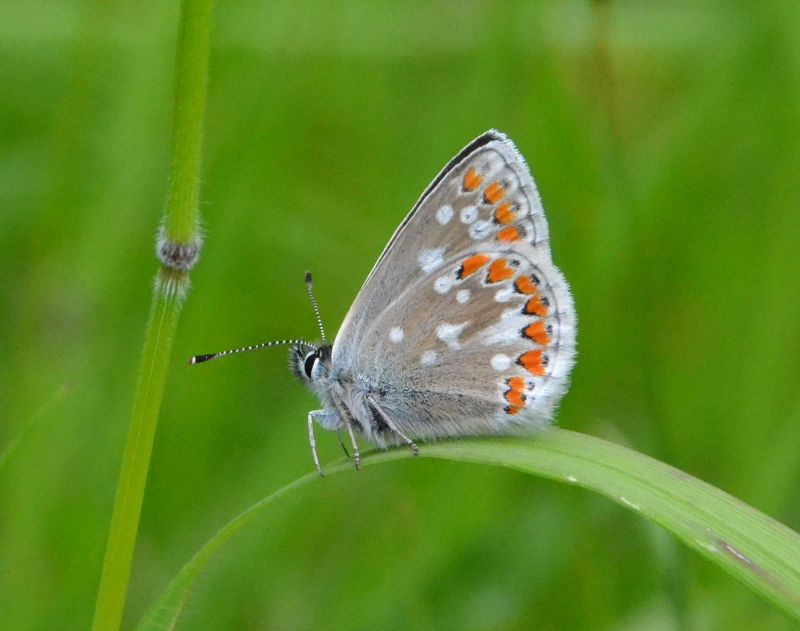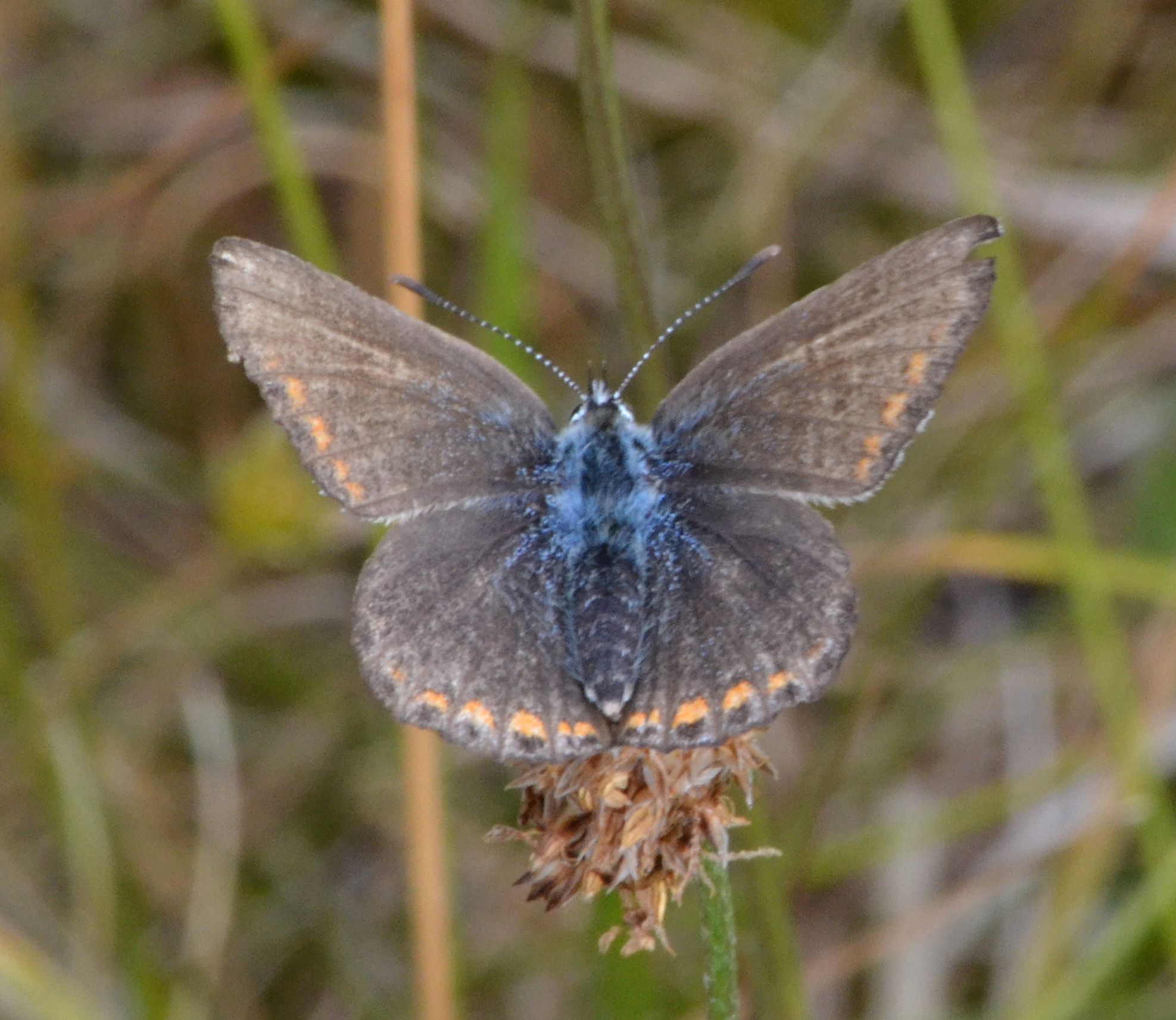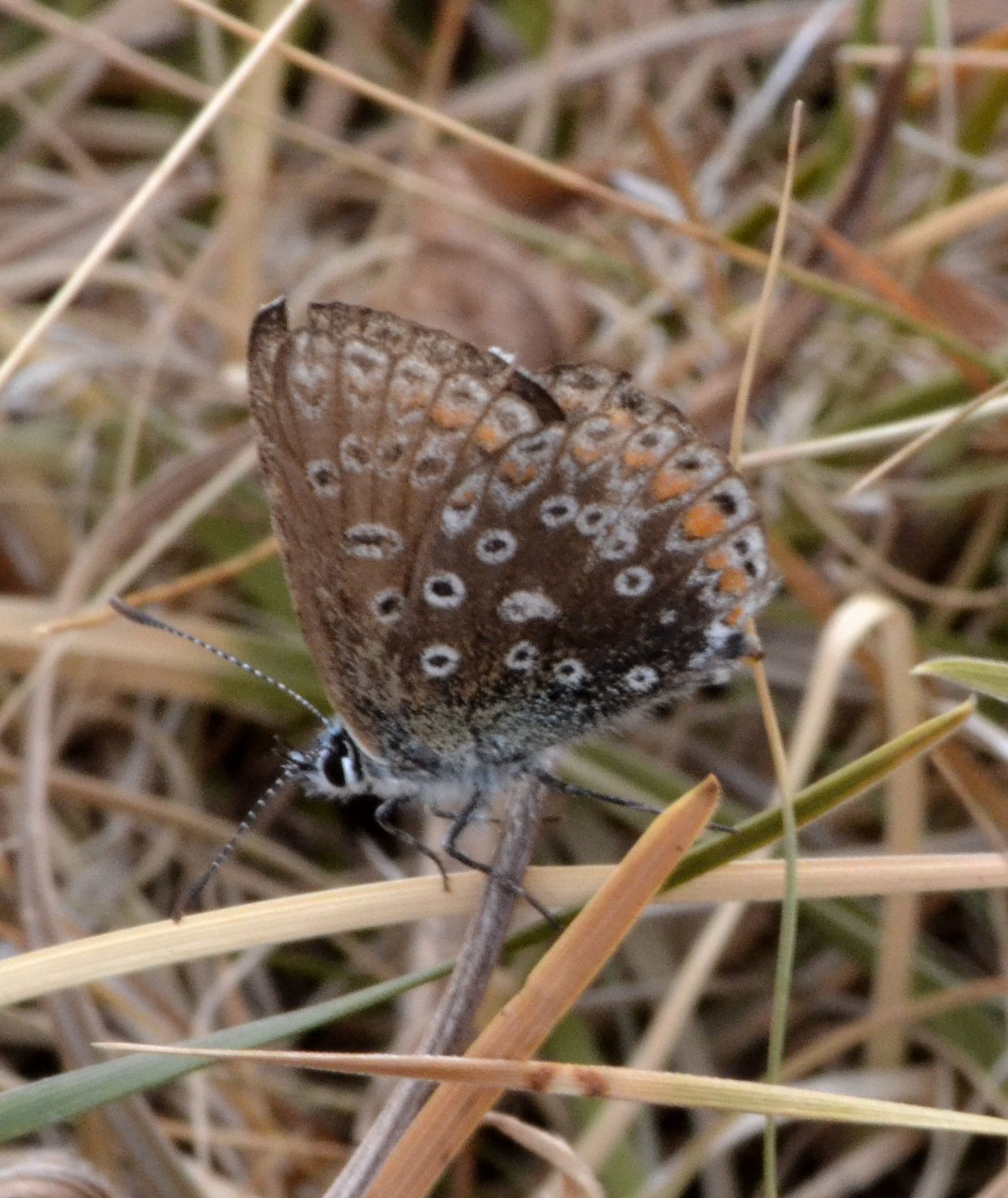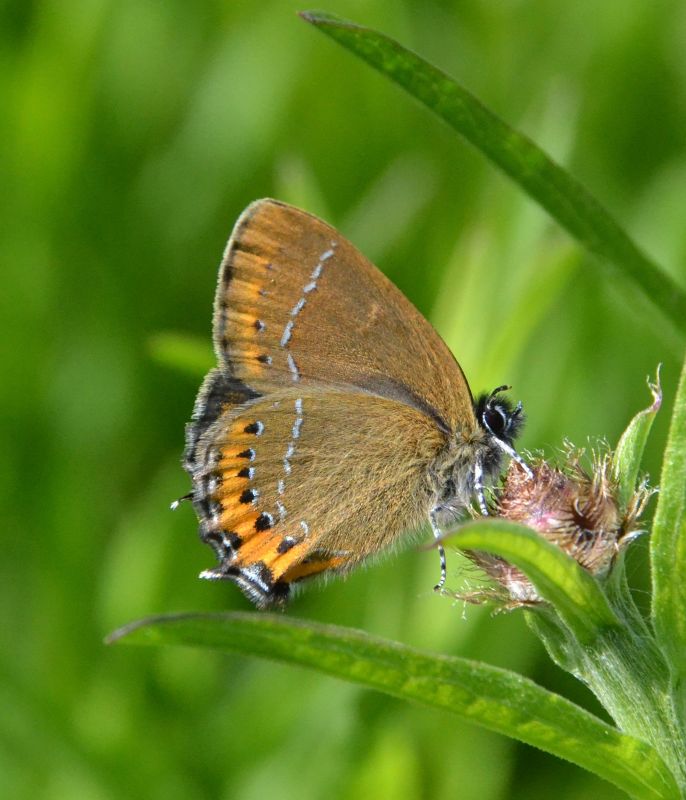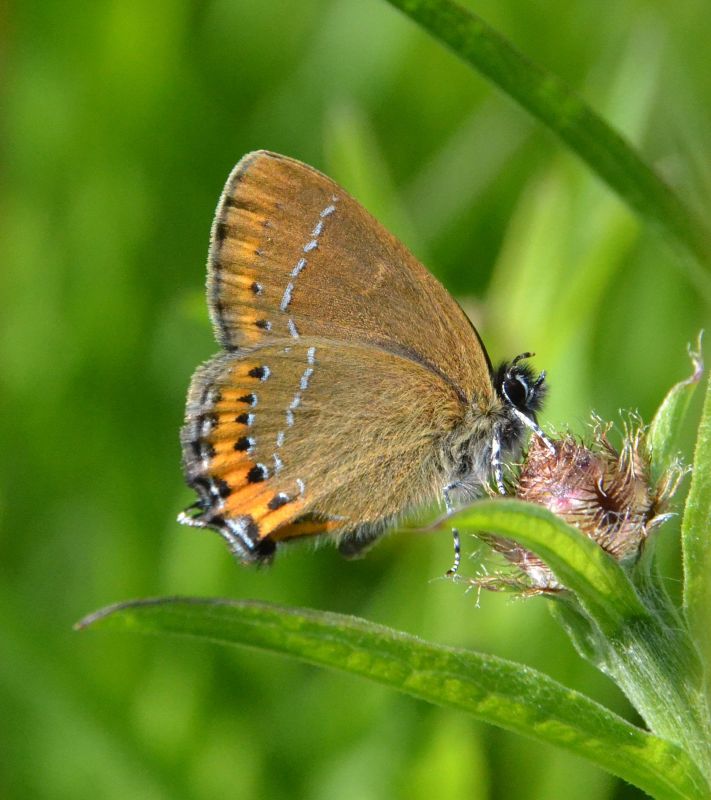
Northern Brown Argus at a Cairngorms site – 27th June

This is a butterfly I have not presented previously in this journal. I had only recorded it once before, in the Cumbrian Pennines in July 2018. Those were worn and faded specimens and I gained only poor quality record shots to support the sightings. Our first day of this trip (26th) set the tone for the week ahead in being a total write-off in Odonata terms. We visited superb habitat but found nothing in the prevailing cool, overcast and damp weather conditions. Nobody could find a better forecast for the rest of the trip, and by the end of Sunday my spirits were low.

On Monday we headed further afield to the Cairngorms National Park where conditions were predicted to be more insect friendly until around 2pm. When our guide announced we were stopping for a break to observe Northern Brown Argus my interest level rose. The site was Craig Dubh (NN673957), a steep hillside rising above one side of the road.

Today’s Northern Brown Argus

Two butterflies were soon located, then the group carried on up the incline to look for Fritillaries. “Yes, I’ll have some of this,” I thought as I was left alone with a subject I very much wanted to capture pictorially. I was now in my element and at once down on my hands and knees performing contortions on the ground.

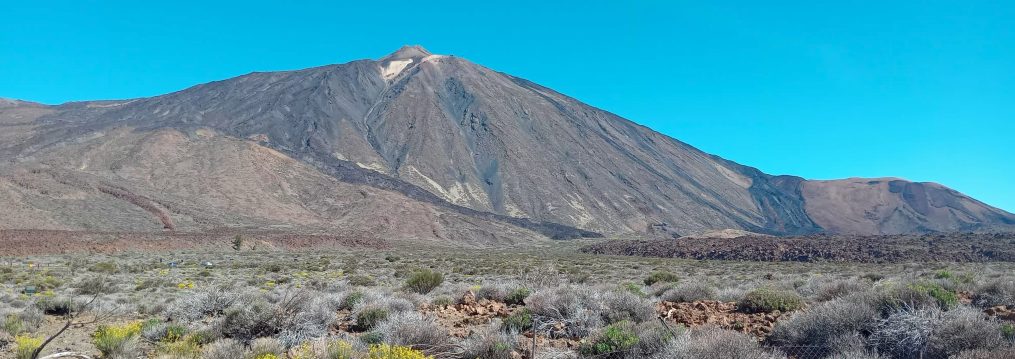
I am very pleased with these images that show perfectly this northern replacement of the regular and familiar Brown Argus’ diagnostic white upper wing dots. These butterflies were beautifully fresh and not having warmed up for the day were keeping quite still. That was a complete contrast to my 2018 experience.

When I eventually re-joined the group one each of Small Pearl-bordered and Dark Green Fritillary had been located here. Then on the way back down the hillside probably the same two NBA were re-found perched up in the long grass, and acceptable under-wing studies were duly gained. This had been a good start to day two.

Northern Brown Argus and Small Pearl-bordered Fritillary today

Northern Brown Argus is described (per Thomas and Lewington) as a locally common though declining species that occurs in scattered colonies. It is found on warm, sheltered northern hill and mountainsides, mainly on limestone and alkaline soils. Typical sites are well-drained, unfertilised grassland with patches of bare ground, abundant Rock Rose plants and an uneven lightly grazed sward. Numerous populations have been lost in recent years due to fertilisation or intensive stocking of such grasslands.

The butterfly was first discovered in Edinburgh at the end of the 18th century and was originally named rather unimaginatively the “Brown Whitespot”. But it resembled the Brown Argus in most respects and for the next 170 years there was much debate as to whether the two were distinct or sub-species. The picture was further confused by most northern English populations, such as those I observed in Cumbria, lacking the white upper wing spot. Those butterflies (known as salmacis – pictured below) have more clearly spotted underwings and more closely resemble continental European NBA.

Northern English form of NBA in Cumbria, 2018

NBA, in common with the most northerly populations of Brown Argus, produces just one generation each season while southern English Brown Argus are invariably double-brooded. Adult NBA are on the wing from June until mid-August, peaking in the first half of July. Most colonies are small, containing no more than 200 adults. NBA is also highly sedentary with individuals moving no more than 20 to 30 metres through their life cycle.

The principal areas for NBA in Great Britain are Scotland, especially the south and east; north Lancashire and Cumbria in north-west England, plus a remnant population in County Durham. I was very pleased of the opportunity to make an adequate study of this species today and in the absence of Chequered Skipper and Mountain Ringlet this was the butterfly highlight of the trip.

The Pine Martens and Red Squirrels of Glenloy Lodge, and other Scottish Highland mammals: 25 – 30th June

For my first holiday in three years I chose a week’s itinerary in the Scottish Highlands run by Glenloy Wildlife. Such group tours are not my natural habitat but with the potential for 10 lifers across odonata, butterflies and mammals, plus two British bird list additions, this was a case of needs must. I would be unlikely to observe that wildlife going solo.

The prime focus was intended to be the northern odonata – Azure Hawker, Northern Emerald and Northern Damselfly. Proper Scottish Chequered Skipper if any were still flying, and Mountain Ringlet given the right weather conditions, were also possibilities. Where birds were concerned I was pleased to add Golden Eagle (376) to my British list though we were not lucky with Crested Tit.

In the event the most successful area was mammals, with my first experiences of Pine Marten, Red Squirrel, Otter, Red Deer and Sika Deer all gained; and good observations of Common Seal and Dolphin. Of those the first two are resident in the grounds of Glenloy Lodge (NN118778) which is run by Jon and Angela Mercer. Each evening food is put out for the Pine Martens, while the Red Squirrels come to bird feeders through the day.

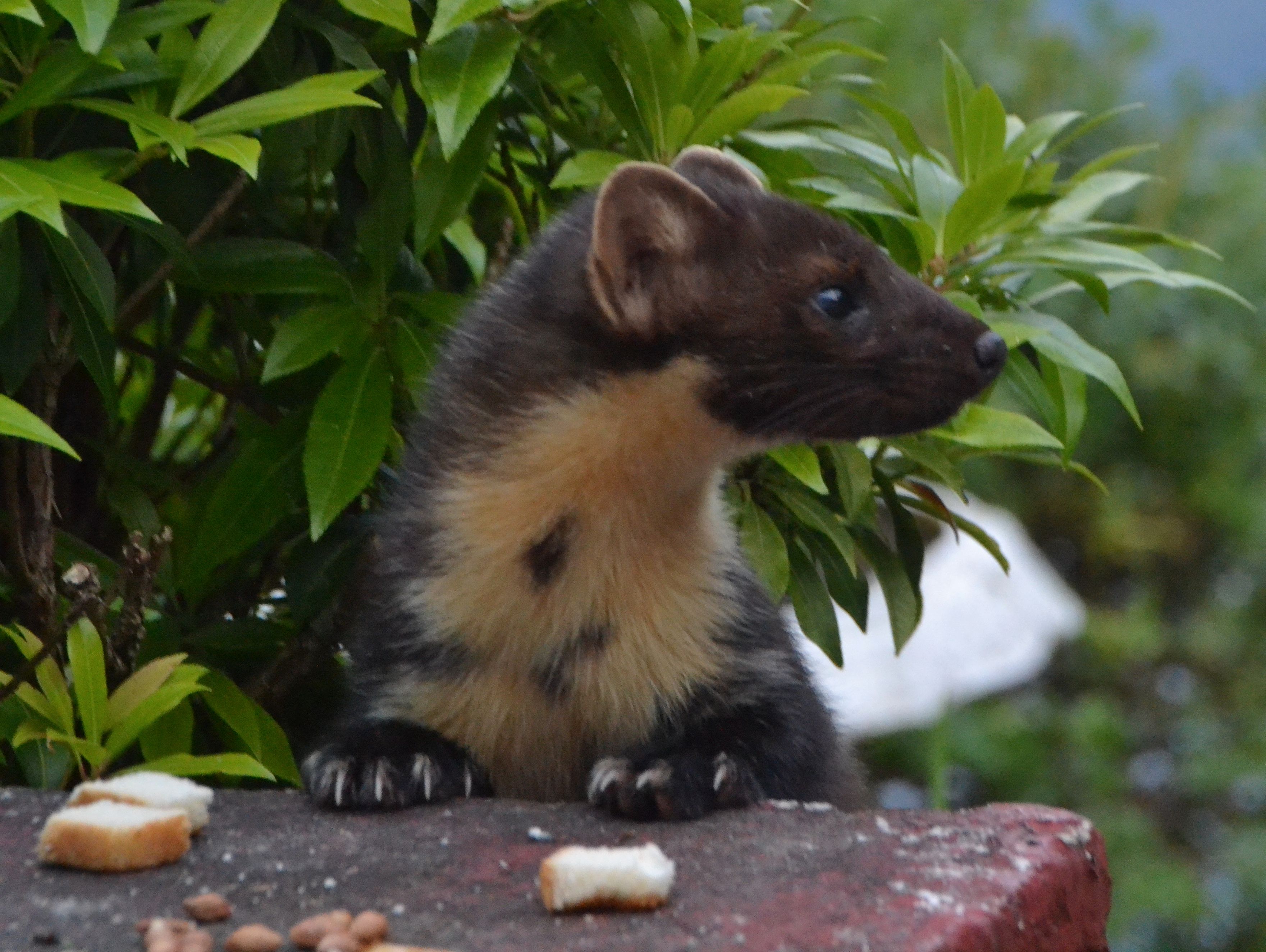
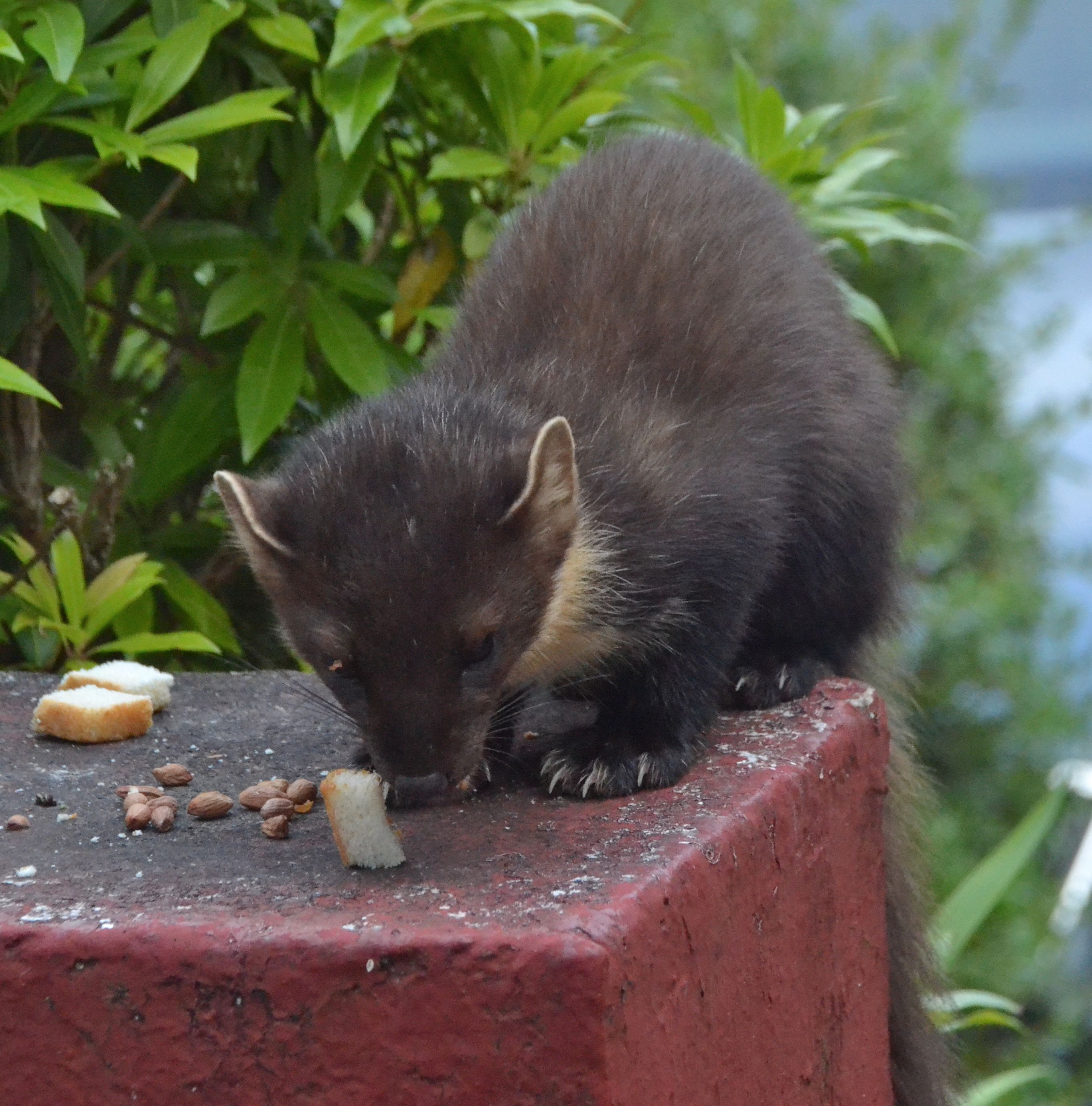
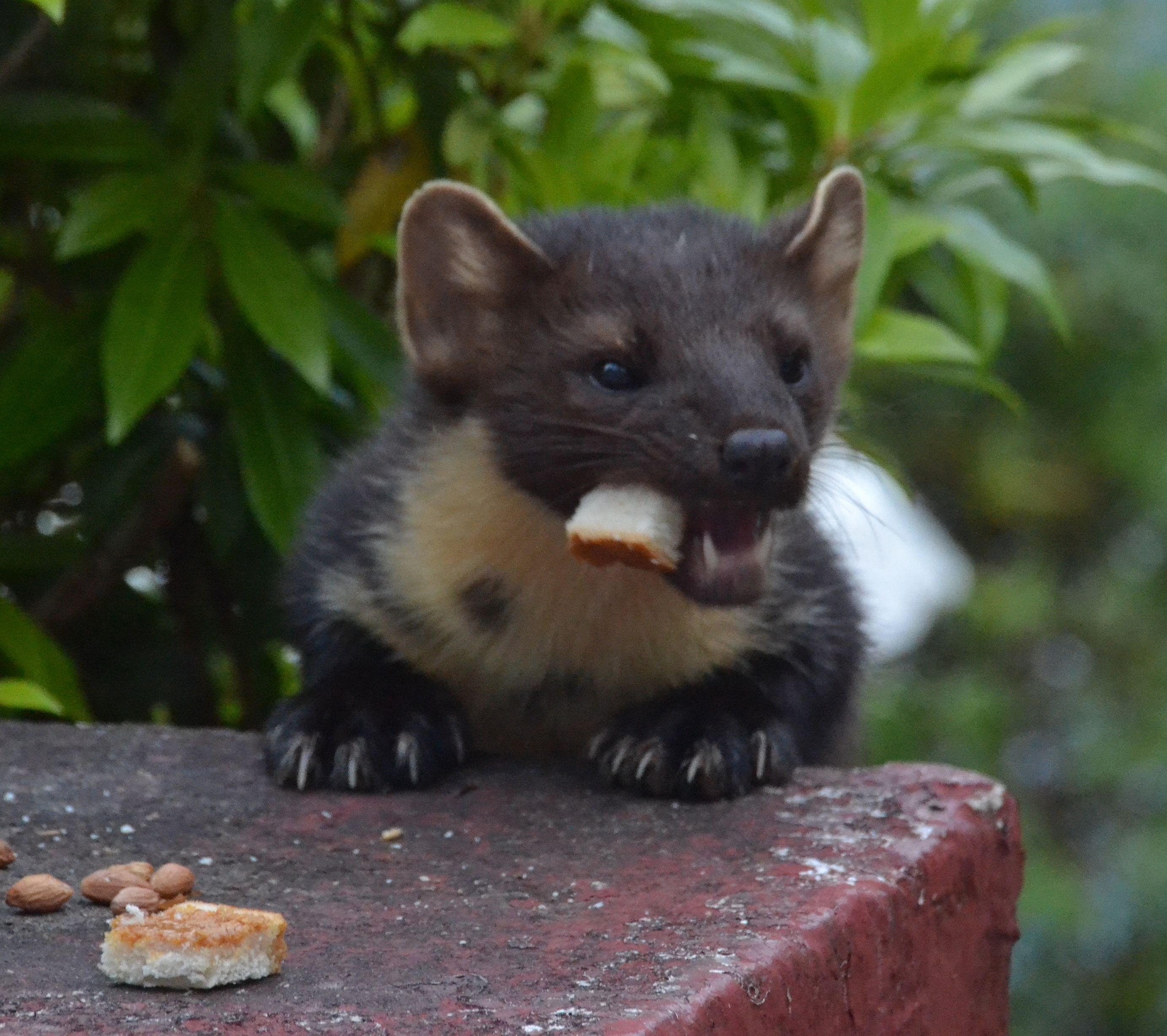
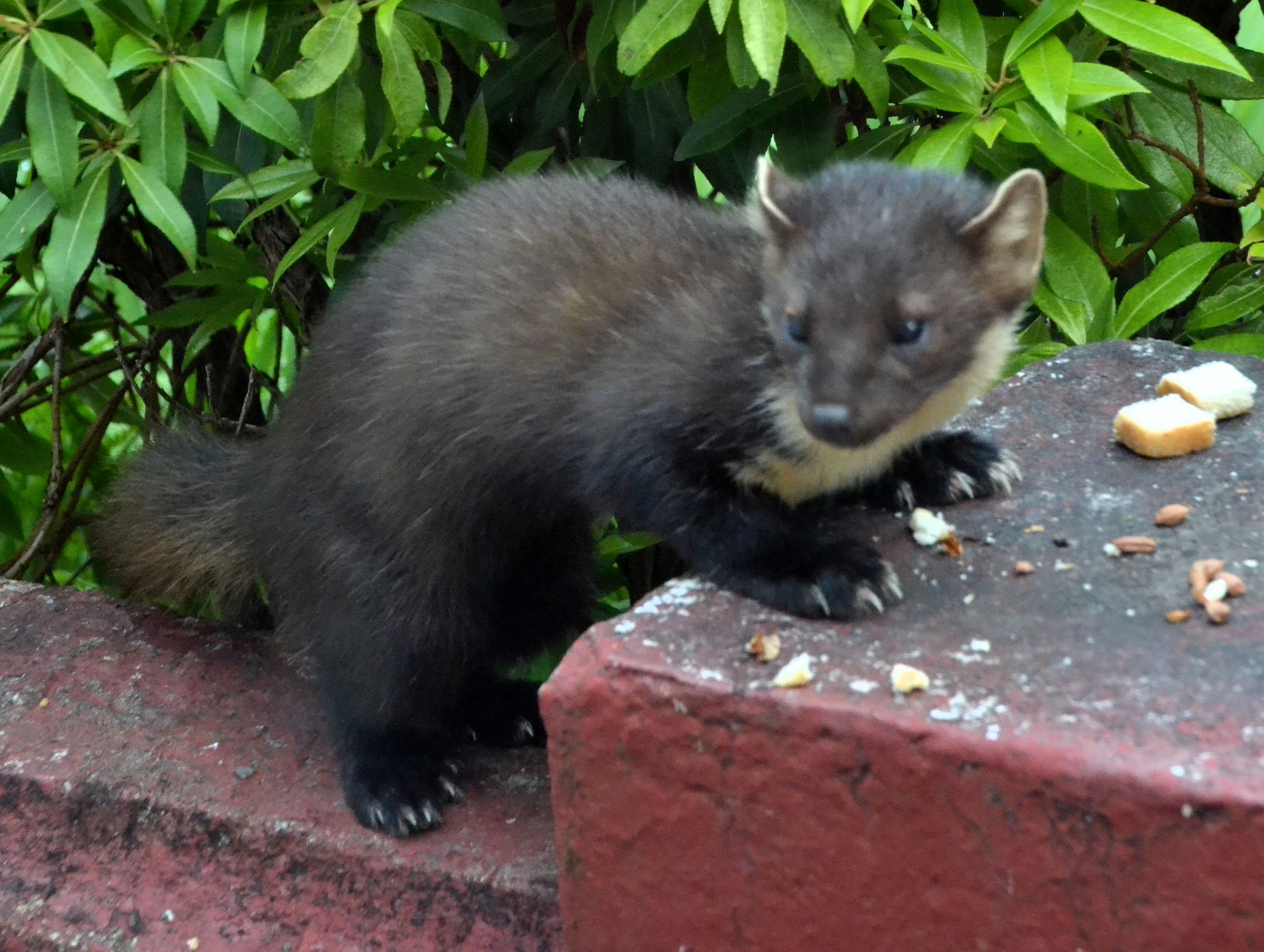
Pine Marten (fem)

Pine Marten occurs widely across most of continental Europe, Andalucia, the Caucuses and parts of the middle east. Generalist predators, they have territories that vary in size according to habitat and food availability. Their dens may be found in hollow trees or the fallen root masses of Scots pines. In the British Isles most of the population is confined to the Scottish Highlands north of the central belt as well as the Grampians, preferring well-wooded areas with plenty of cover. Though they have increased their range in recent decades this remains one of the rarest British mammals and I would not expect to observe them other than in situations where they are attracted by man-made feeding opportunities.

These animals become active hunting and foraging at dusk, and at Glenloy Lodge usually appear from around 8:30pm onwards. There is a sun lounge on the front of the building outside which the Pine Martens’ food is laid out and each evening through my stay a female and two juveniles put on a show for the paying guests. I also saw the resident male once on the squirrels’ nut feeders in the morning. These (below) are the best of my pictorial records, captured through the double glazing of the sun lounge, some of which depict a juvenile … Aaaaw!

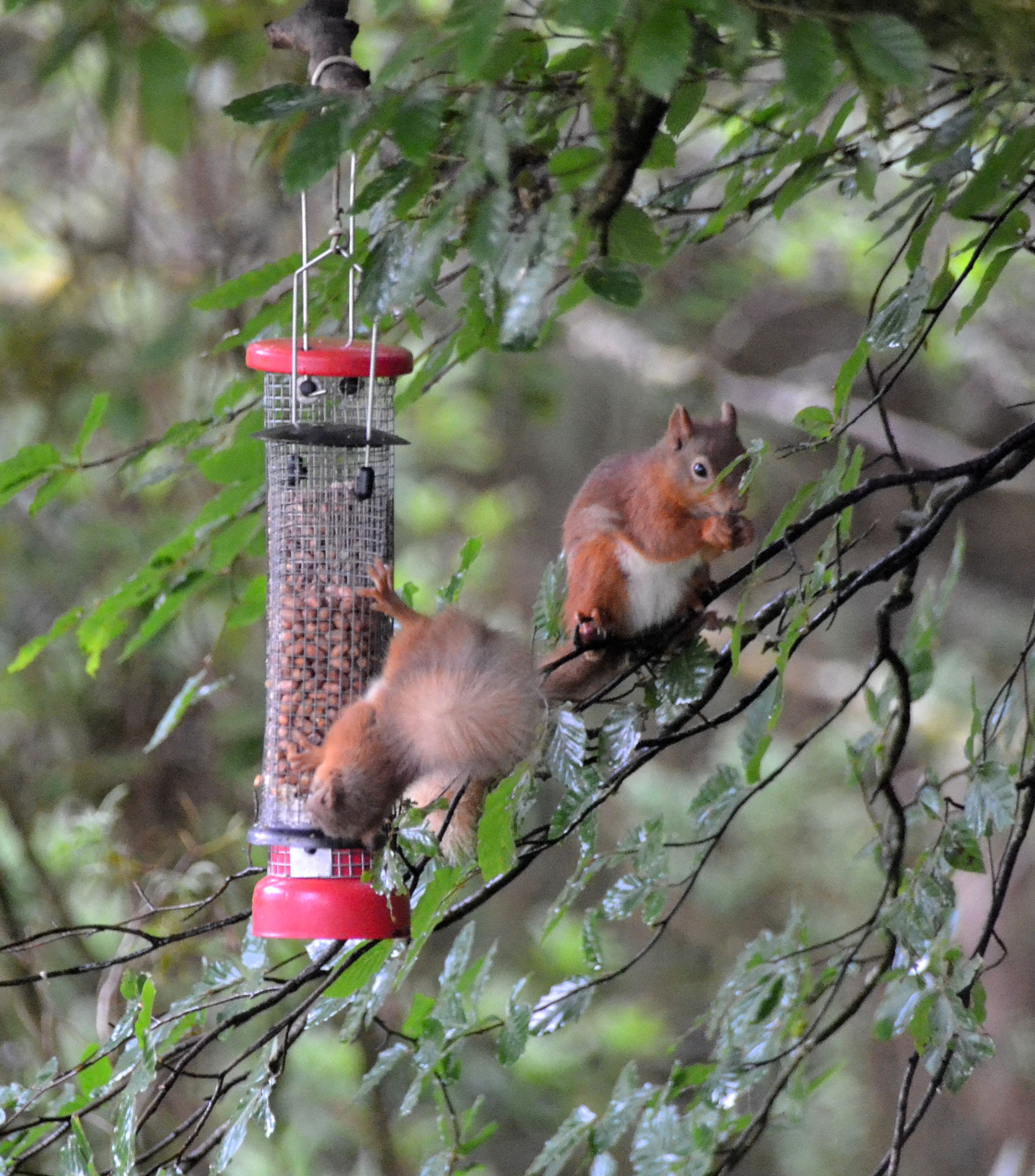
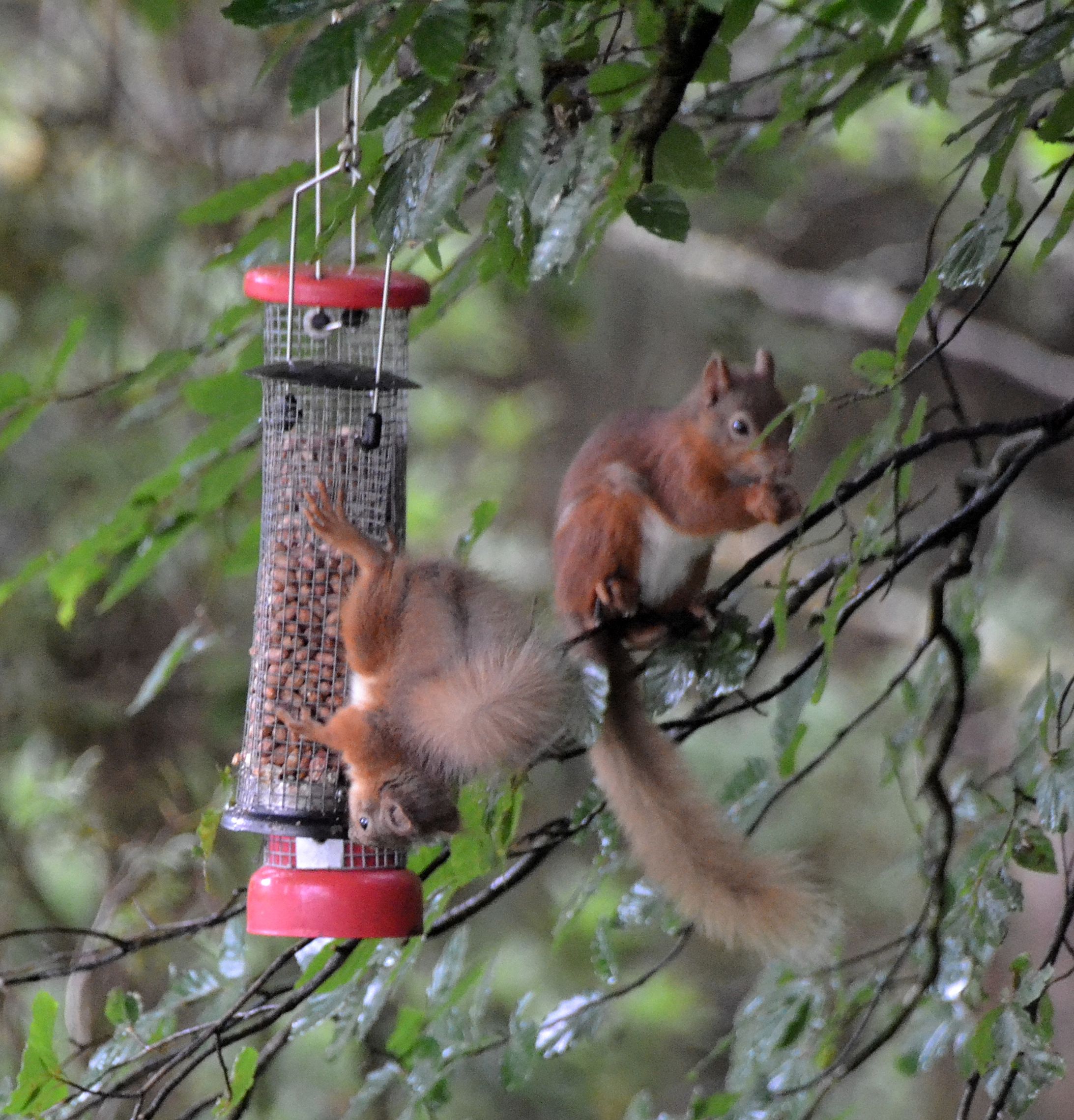
The early shift in the mornings was manned by the Red Squirrels that on some days I watched before breakfast. Ever since childhood I have read of how this native British mammal has been negatively impacted by the introduced north American Grey Squirrel, a story that has not changed too much in all those years. Now I was experiencing the fabled national original for the first time.

Red Squirrels occur across the Taiga zone of northern Europe and Siberia in coniferous woodlands, favouring Scots and Siberian Pine and Norway Spruce. They also inhabit broad-leaved woods in western and southern Europe where the mixture of tree and shrub species can provide better year-round food sources. But they have long been driven out of this habitat in the British Isles by the larger and more competitive Grey Squirrel that exploits the feeding opportunities to its own advantage.

Red numbers are said to have stabilised in Scotland, where 85 per cent of the British population of around 287,000 is now found. Increased Pine Marten numbers actually help the situation since the latter predate and hence help to control Grey Squirrels. Reds could actually live in most rural, suburban and even some urban habitats as long as there is no threat from greys. So conservation management in locations where reds have been re-introduced must keep the two species apart as they cannot live together long term. Such work is essential if the Red Squirrel is not to become extinct in the British Isles.

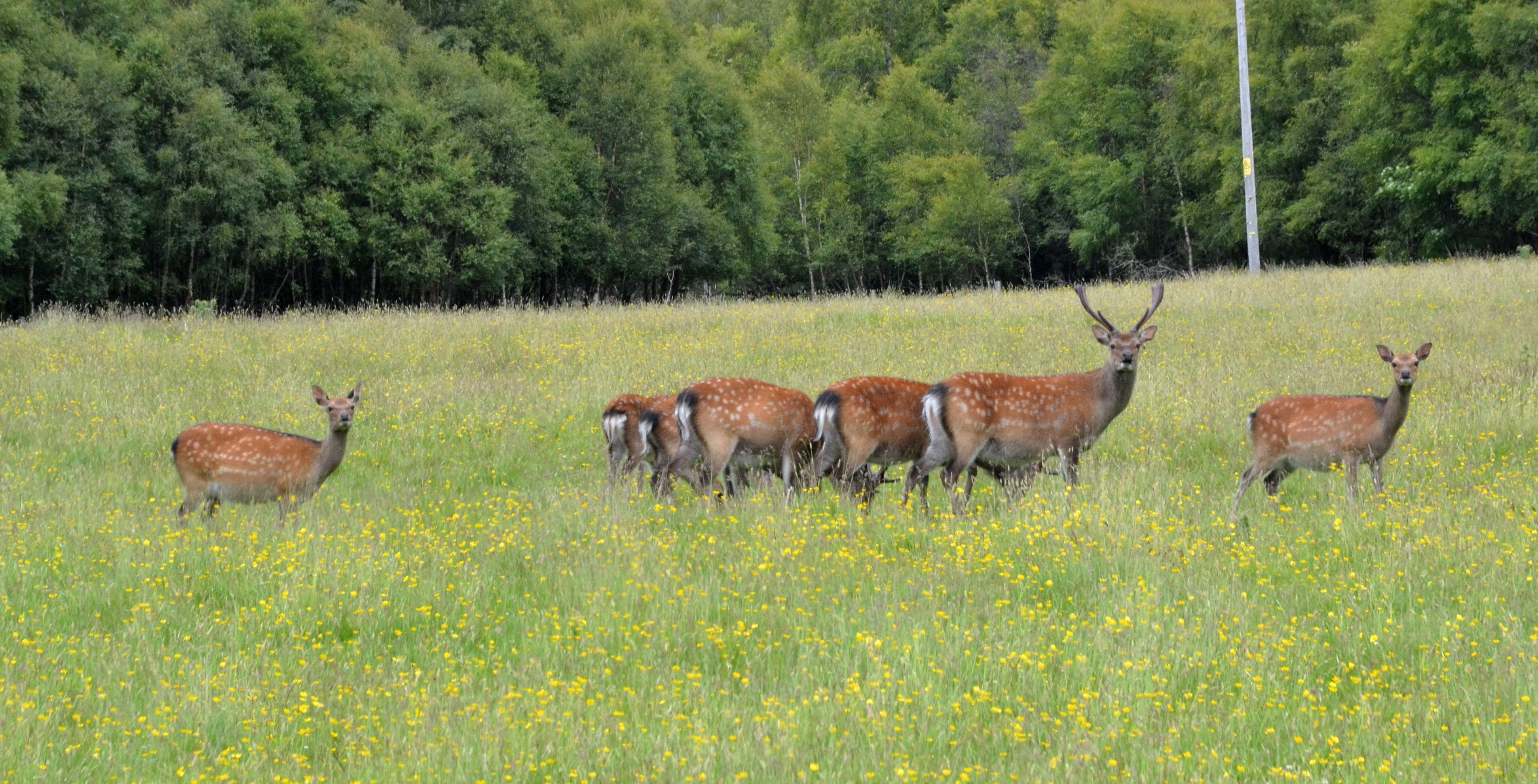
Red (left) and Sika Deer

Driving around rather too much in the tour minibus, in the absence of fieldwork opportunities for odonata, native Red Deer and introduced Sika were encountered fairly regularly. Red Deer is the largest British land mammal, widely distributed and expanding in range and number, and native stock is common in the Scottish Highlands. The distribution of Sika Deer too in Scotland is widespread and expanding. Their preferred habitat is coniferous woodland and heaths on acid soils.

Sika were first introduced from the far east and especially Japan in the 1860s. They are similar in coat colour to Fallow Deer with a distinctive black and white rump, and there is often a dark-coloured dorsal stripe running the length of the back. Populations of both these featured deer species require careful management to maintain health and quality and ensure a sustainable balance with their environment.

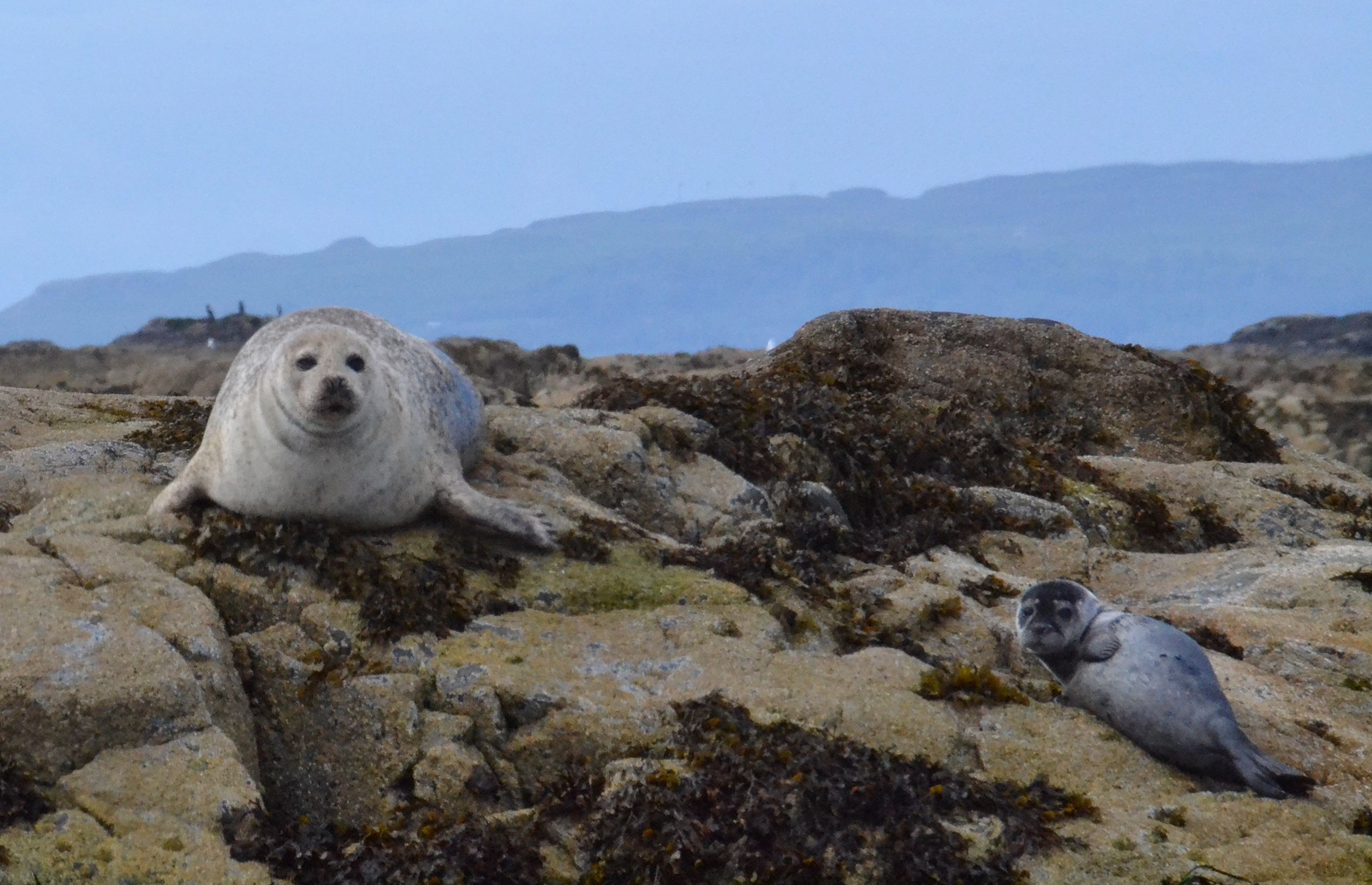
Surprising as it may seem it has also taken me this long to experience my first Otters, as well as the scarcer mammals that headline this post. A probable family group of four were encountered on Loch Linnhie to the south-west of Fort William on 28th. Lastly there were Common Seal in the same area then from a boat trip from Arisaig on 30th. After my superb experience of the Atlantic Grey Seal breeding colony at Donna Nook, Lincs in November 2019 (see here) it was now very pleasing to follow suit with these smaller, scarcer cousins.

Common Seal (pictured above) feed at sea but regularly haul out on to rocky shores or inter-tidal sandbanks around the coast of Scotland to rest or to give birth and suckle single pups in June or July each year. Pups are very well developed at birth and can swim and dive when just a few hours old. This enables Common Seals to breed in estuaries where sand-banks are exposed for only part of the day. Mothers feed their young with an extremely rich milk and pups grow rapidly, doubling their birth weight during the three or four weeks that they suckle. The above images are from Lock Nan Ceall just out of Arisaig on the boat trip.

The Keeled Skimmers of Lye Valley LNR, Headington, Oxford – 22nd June

This is a further piece of welcome evolution in my current pared down and disrupted wildlife summer of 2022. After becoming a little intrigued by the broader wildlife potential of the Lye Valley when Common Frogs were spawning back in February (see here), I resolved to assess it for Odonata in season and with particular emphasis on one species, Keeled Skimmer.

In September of last year news broke on the thriving Oxon Dragonflies blog administered by our county recorder, confirming that breeding had occurred at the Headington site (SP546057) in both 2020 and 2021 (see here). The significance was this represented a notable county range expansion from KS’ historic Oxon stronghold of Cothill Fen to the west of the city. That was logical since both locations comprise remnant and nationally scarce alkaline fen habitat.

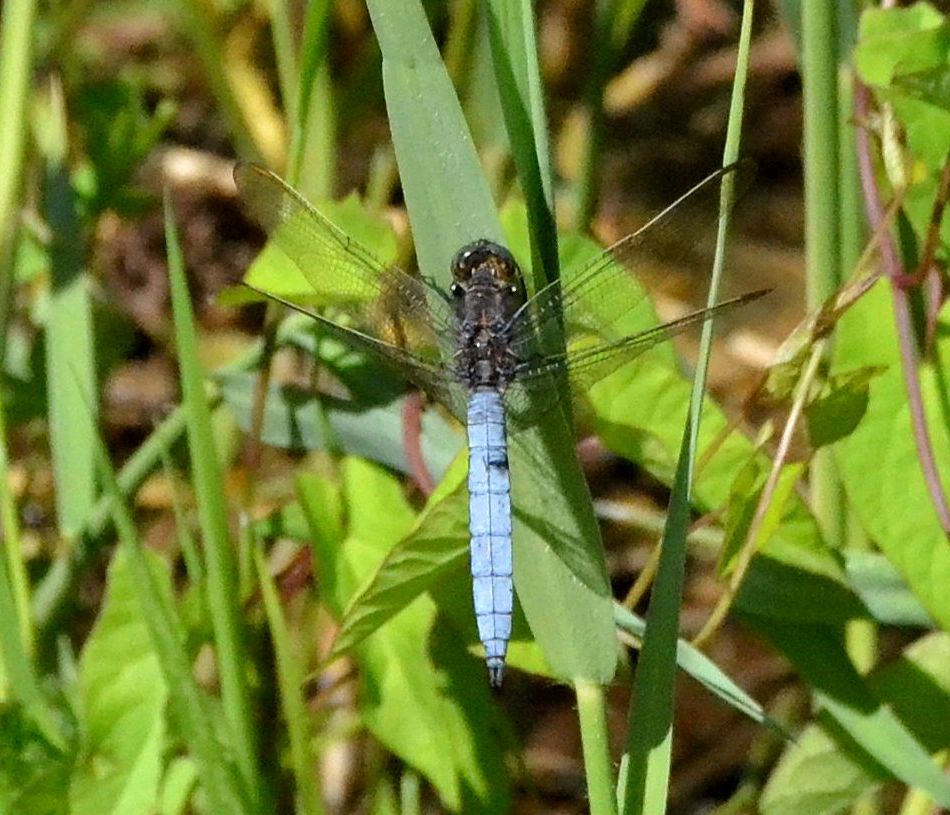
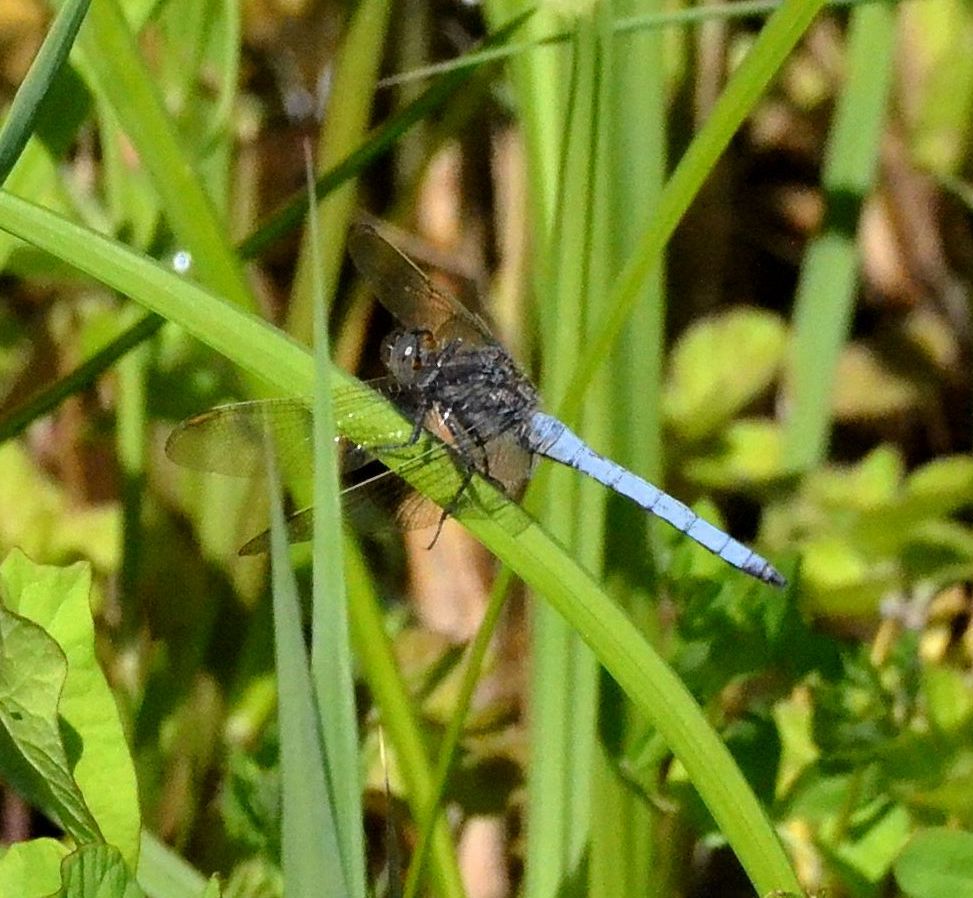
One of today’s male Keeled Skimmers (record shot)

Keeled Skimmer (pictured above) is locally common in acid, boggy peat regions of south and south-west Britain, as well as similar localities in northern England and Scotland. It is a small, darter like dragonfly with a distinctive slender, tapering abdomen displaying a pale blue pruinescence in mature males. These establish small territories of which there may typically be around 15 in a 100 metre stretch of habitat. The flight season lasts from early June to late August.

After two days at home this sunny week, catching up on immediate chores following a week and a half away, I opted to test my fitness with a little local wildlife outing. The season’s first KS records had been published from the Cothill Fen complex, and I wanted to check things out for myself at the new site. Hence mid-morning found me taking things steadily along the boardwalk out to the area of LVNR that is known as “The Ponds”.

Note the bright yellow pterostigma and slim, tapering abdomen

Before long up to 10 powder blue dragonflies became readily apparent mooching around the fen habitat. But I was perhaps a little early in the day to observe females that usually approach the male territories around midday. I had paid no attention to odonata other than Clubtails so far this season, and given recent distractions needed to re-acquaint myself with the diagnostics of both my day’s quest and the larger, heavier Black-tailed Skimmer to confirm the ID.

Returning home with record shots in the can I discerned yellow pterostigma (wing tags), wings held forward over the head, and the correct number of segments with no black tail or yellow edges to the abdomen. I had indeed recorded Keeled Skimmer in a different and evolved Oxon location, so mission had been accomplished. These were the only dragonflies encountered here today. For myself, I suffered no ill effects from the little excursion and in general have felt stronger each day in what is a period of convalescence.

Ground level Black Hairstreak, an evolved first then an enforced break: 7th – 19th June

When Tuesday 7th dawned with unexpected sunshine the next item on my local butterfly agenda beckoned quite clearly. And so I set out for a year’s first attempt for the Oxon / Bucks seasonal jewel that is Black Hairstreak. My choice of location as in the past two years was Bernwood Meadows (SP608109) on the border between those two counties.

Arriving around 9:30am at the 7.5 hectare, BBOWT-managed traditional hay meadow, it’s expanses of more than 100 wild plant species stretched out before me in all their beauty. It was an uplifting sight as for a week and a half I had been laid low by what I assumed to be a viral condition, though not Covid as I tested negative. This kept me in a state of daily exhaustion, with aching limbs and much more marked than usual asthma. But I still need to get out and do something each day and was not going to stand up this opportunity.

(newly emerged?) Black Hairstreak as the day warms

Walking out slowly to test my “fitness” towards the hotspot I usually check for today’s quest the meadows seemed very quiet for butterflies, and all I noted were one each of Small Heath, Common Blue and Small Copper. Then another butterfly almost flopped into the grass to one side of me, a very pristine Black Hairstreak (pictured above). I assume this was newly emerged by its appearance and because once it assumed the pose in the images herein it kept very still for a while. I was thus afforded a first ever opportunity to gain pictorial records of this more usually hyperactive species at ground level.

Eventually my subject flew away, having provided ample reward for my perseverance in locating it today. This was a third evolved item for the season on my 2022 BC UTB agenda, following those with Duke of Burgundy (see here) and Wood White (previous post), and just as pleasing as those earlier two. After around an hour on site and as the day became warmer, things were becoming more lively in terms of both butterflies and a variety of odonata, but I didn’t have the energy to check it all out.

Today’s Black Hairstreak

This Black Hairstreak showed itself just in time, because the following evening I was hospitalised for the first time ever. After two nights in emergency assessment I landed on Friday morning (9th) at the most excellent Osler Respiratory Unit in Oxford’s John Radcliffe Hospital. That is an elite facility, caring for just 24 patients each in individual en-suite rooms, and the care I received was fantastic. I have been diagnosed with an auto-immune / blood disorder called EGP Vasculitis, which fits with my history of chronic mild asthma and allergies. I was discharged on 19th and will remain an outpatient.

There is now very little I can add in this journal to on-line published information on the Black Hairstreak butterfly. But for those new to observing the species, who might have accessed this post via a web search, the following references from past years may hopefully offer some entertaining and informative detail.

A celebration of the Black Hairstreak – June 2017 – 146 views

Four Hairstreak butterflies at home and abroad – June 2018 – 144 views

The first precious jewels of summer – May 2020 – 70 views

The re-introduced Chequered Skippers of FC Westhay Wood, Fineshade, Northants + 2022 Wood Whites at two other sites – 27th May

This is the only planned national butterfly item on my stripped-down 2022 wildlife agenda, affording as it does the opportunity to observe one of the remaining two British species I had yet to record, Mountain Ringlet and Chequered Skipper. The second butterfly was on my to do list in 2020, when flights from Luton to Inverness cost rather less than they do now.

Whilst experiencing truly-kosher CS in Scotland remains an ambition, I decided to tolerate the insurance measure of taking in the re-introduced colony near Corby, Northants. The hitherto closely guarded location was announced earlier this year, and guided walks commenced on 14th May, so today being a suitable weather window I went to take a look.

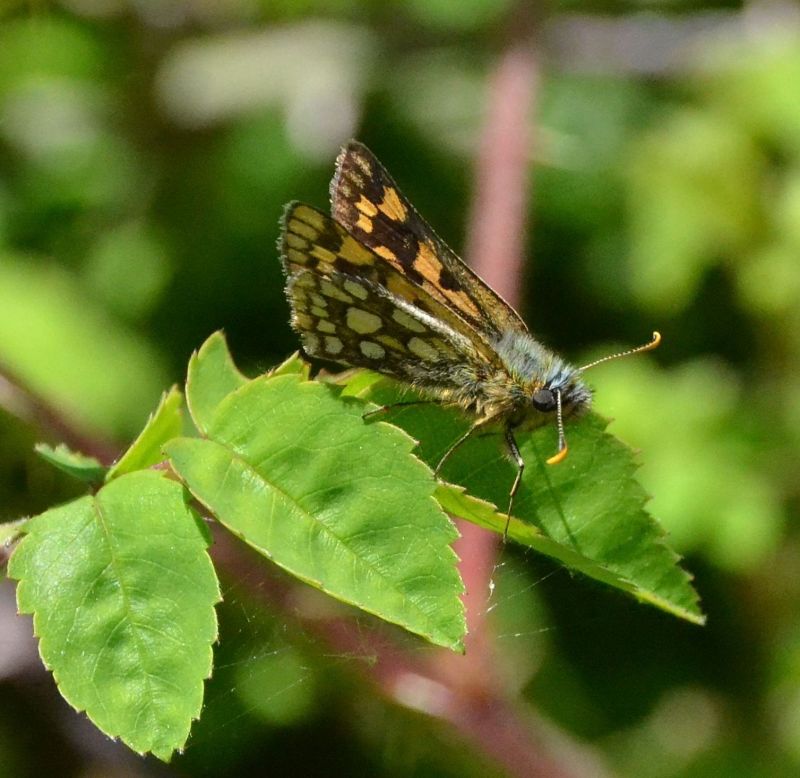
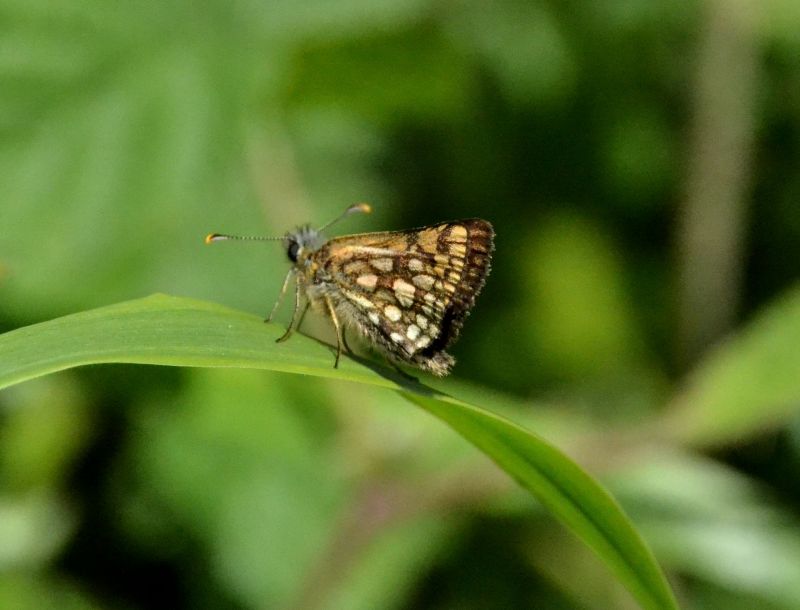
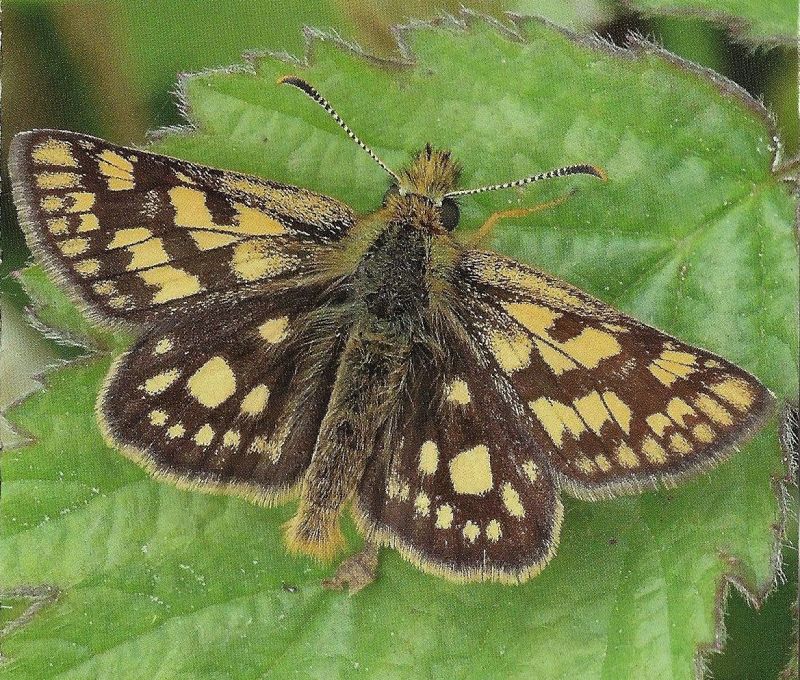
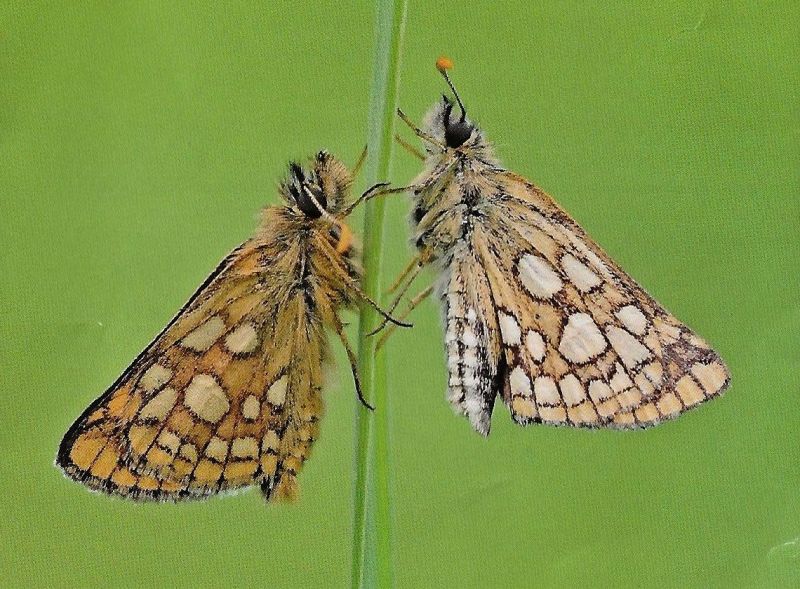
Chequered Skipper today

If I might sound less than enthused it is because I distrust re-introduction sites and dislike the social media-generated circuses they so often entail. But a regular wildlife colleague who is not bothered by such things had preceded me here last weekend and was not inconvenienced too much. They clearly went at the right time because today was quite hectic, exactly as I expected

I arrived on-site at the Forestry Commission Fineshade Wood complex (NN17 3BB – SP 981983 – see here) just before midday and after the guided walk had begun. Weather conditions were sunny but with a strong, cool breeze. Enquirers at the visitor centre were directed to a 5km running route (brown waymarks) that starts on the far side of the car park and leads into the prime CS area of Westhay Wood. After a while the shorter cut brambly habitat along this trail on either side began to assume a promisingly managed look. Then myself and two companions began to enquire of butterfly observers walking the other way.

All told of a hotspot further ahead where up to four Chequered Skipper were active. As we drew closer it became obvious where that location was and what ensued was no more nor less than I had anticipated. Around a dozen people, all with cameras were in place with lenses trained on a sheltered bank of brambles containing our collective quest. As each new person arrived they went straight in, which is only to be expected. There was no pushing and shoving but I myself am invariably far too polite on these more usually avoided occasions.

A couple of times I put myself forward and getting to the front gained the acceptable underwing studies of this post. The likelihood of a decent top-wing image in the prevailing ambience seemed slight. Enquiring of passing BC volunteer surveyors I learned this has been the prime CS hotspot of the season so far. One who had led the morning’s 30-strong guided walk said six individuals had been recorded during it, four of which were at this spot plus two singletons at some distance.

That to me sounded like small needles in very large haystacks if I elected to walk the entire 6km trail, and so I called things quits. BC and the Forestry Commission warn that only a small number of connects are likely at this early stage of their project. There is a huge amount of habitat here in which the expanding butterfly population could be concealed and visitors are under strict instruction not to walk away from hard paths.

Chequered Skipper had become extinct in England in 1976 and the Rockingham Forest complex of which Fineshade / Westhay Woods are part was a former stronghold. Following much work by Butterfly Conservation, Forestry England and other landowners to restore suitable habitat, re-introduction of stock collected from a thriving Belgian population began in 2018 (see here). Breeding success was confirmed in May the following year since when there have been further re-introductions to boost the evolving colony.

In England, the butterfly was historically found in a band of wet woodlands and associated limestone grassland from Oxfordshire to Cambridgeshire and into Lincolnshire. By the 1950s it had become restricted to Rockingham Forest and some sites in Lincolnshire. Then as with other habitat specialists the late 20th century decline in coppicing and management of open rides, in tandem with proliferation of conifer plantations led to the CS’s demise.

Chequered Skipper thrives in open, sunny areas within or on the edges of woodland. The “Back From the Brink” project here enabled parts of the former stronghold to be restored to ideal conditions over four years with an initial 7km of long, sunny rides created and 23ha of vegetation managed to deliver the required network of habitats. A planned second phase, running to March 2023 will extend habitat improvements into other areas of Rockingham Forest and establish further CS populations.

Adult CS are around 30mm in size with a fast erratic flight pattern. At today’s site eggs are laid on Wood Small-reed and False-brome, though a range of other grasses may be used as in continental Europe. Larvae emerge after around three weeks and like other Skippers at first thread the edges of grass blades around themselves to form a protective tube. After moving on to other plants to feed and grow they eventually hibernate through the winter to re-emerge in April.

Public interest in the project is expected to be great since over the previous 40 years it was necessary to travel to the Scottish Highlands to try to see this butterfly. Tales abound of people working the national list who made that effort for little or no reward. Having now converted this tiny, difficult species myself I wonder if going all that way specially would have been worth it after all. I would not say today was enjoyable but the bottom line is I have Chequered Skipper on my own British list, and there is only one more species, Mountain Ringlet to go.


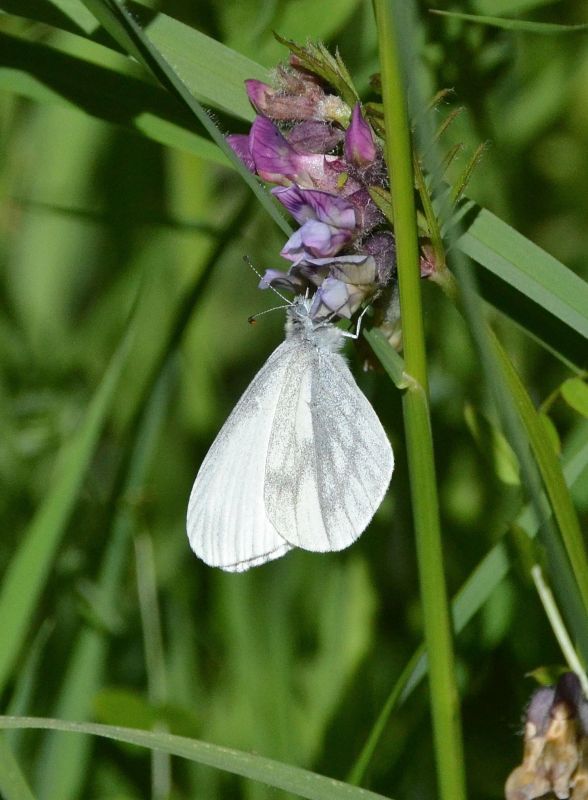
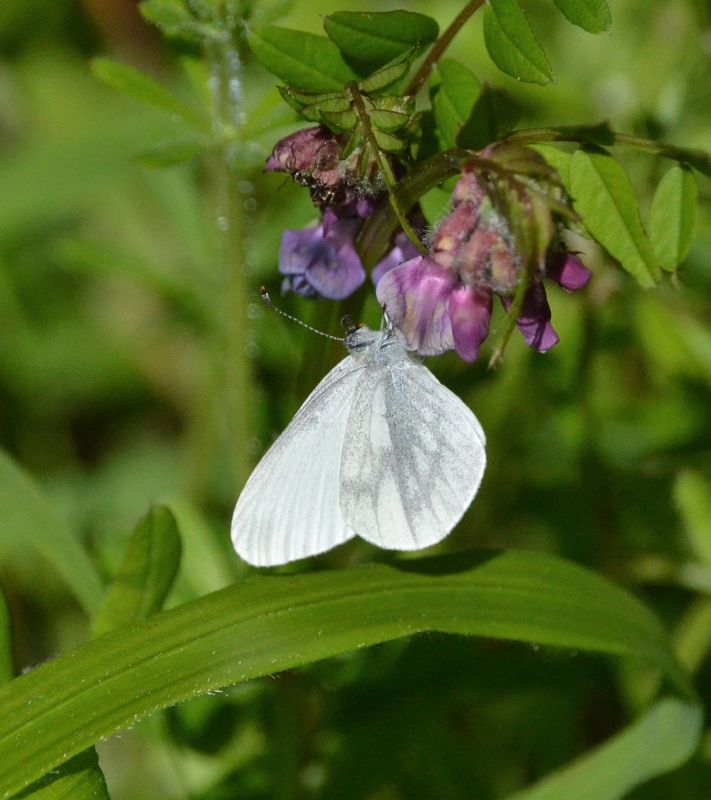
My route today enabled me to make my Wood White observations for this season in two places. On the way out I stopped for leg stretching exercise at my regular Bucknell Wood location (see here and here) near Silverstone, logging five individuals. Then on the return journey I made a personal first visit to Wicken Wood on the Bucks / Northants border. Since this butterfly died out in it’s last Oxon stronghold of Whitecross Green Wood in the early years of the last decade, records have issued almost annually from this other ancient woodland to the immediate west of Milton Keynes.

If successful today it would be my first ever BC UTB record of the species, which would be further welcome evolution after first ever Oxon Duke of Burgundy recently (see here). A large part of the Wicken / Leckhampstead Wood complex is also private but I presume the BC species champion and transect walkers have access to that key site. So I wanted to find out whether Wood White were observable along the publicly accessible trail that runs north to south through the woodland.

Parking in the late afternoon at SP730412, I rather pushed the now necessary leg stretching regime to the extreme by walking the entire length of the trail out then back. Within around 500 metres of the northern entrance gate I eventually came across two flying Wood White at around 5:30pm, but was unable to obtain pictures so those in this post come from Bucknell Wood. Not knowing exactly where the county border passes through the second woodland I cannot say on which side my sightings were, but I’m counting them as my first UTB records anyway.

My first ever Oxon Dukes of Burgundy on Lambourn Down, and a sea of Small Blue – 18th May

My attention was caught earlier this week by a report of hundreds of Small Blue butterflies at a site on the South Oxon Downs. And what made that record all the more alluring was the mention of several Duke of Burgundy at the same place. I recalled being told several years ago of a Duke colony in the vicinity by a mysterious and enigmatic downs-man of local repute who is known by the epithet of “The Keeper”. But the location (as was his wont) had not been forthcoming. Now maybe word was out, at least for myself.

My local butterflying so far this season has been concentrated at Watlington Hill on the Chilterns escarpment, with spring specialities Green Hairstreak, Dingy and Grizzled Skipper, Brown Argus and Common Blue all recorded. But I’m not sure whether Small Blue occurs at that adopted patch, and Duke of Burgundy certainly doesn’t. The popular site of choice for the latter this season seems to have been Incombe Hole (see here) in north Bucks, which hence was bound to be a circus that my current petrol-saving mode gave a second reason to avoid. Now, today’s previously unvisited alternative offered an evolved experience, such as I seek for each of the title butterflies of this post.

Female Duke of Burgundy today (record shot)

So this morning I went to check things out. Parking at the roadside and walking along a right of way I quickly noticed large numbers of Small Blue in the trackside vegetation. Then, as soon as I found Cowslips I beheld a first Duke of Burgundy, though it was quite a worn specimen. Shortly afterwards the female in the picture (above) announced herself, and that was job done. This much sought species is reaching the end of its flight season now, but I had recorded it rather agreeably for another season.

I believe this is a remnant and fragile colony of Dukes and so will not publish the precise location herein. The BC Upper Thames Branch Atlas of Butterflies, published in 2016 cited just three remaining colonies on Lambourn Downs, of which one is private and specially managed for the species. Elsewhere in the survey region, DoB is restricted to a strong population at the Ivinghoe Beacon / Incombe Hole complex of north Bucks, and a smaller one at Bradenham in the same county. The only other recorded Oxon colony of living memory at Aston Upthorpe Downs near Cholsey and Blewbury has long been extinct.

Small Blue today, one of hundreds

All along the track a profusion of Small Blue (pictured above) continued, the most I have ever seen in one place. Brooks and Lewington describes such large occurrences of this most diminutive of British butterflies as few and far between, with the vast majority of colonies containing no more than 30 adults. These typically breed for many generations in very sheltered downland conditions where the soil is thin and unstable and the plant cover sparse and warm. Embankments, old quarries and dunes are all favoured habitats.

Emergence usually begins in mid-May with numbers peaking around three weeks later. A few may linger into July, almost overlapping with a small second brood. Adults are highly colonial, often being confined to no more than 200 sq m of land supporting perhaps two dozen Kidney Vetch food plants. As I saw today, males gather in sheltered, sunny hollows at the foot of slopes, perching for most of the day with wings half open 30 – 120cm above the ground and spaced 1 – 2 metres apart. Females visit these perching sites to be mated and thereafter avoid them.

Today’s experience afforded the opportunity to witness most of this behaviour, but not mating. In the past I have concentrated my Small Blue attentions in Oxfordshire mostly to the Ridgeway above the Devil’s Punchbowl near Wantage, Lowbury Hill above Aston Upthorpe that is now plagued by off-road motor cyclists, Lardon Chase above Streatley, and Hagbourne Railway Embankment. Today’s encounter with what is one of my favourite British butterflies was by far the most instructive and rewarding to date.

The Duke of Burgundy posts in this journal from different out of county sites have been well referred to over the last eight seasons, reflecting the enduring popularity of a much-sought item amongst British butterfly enthusiasts. For archive detail on the species see:

Duke of Burgundy at Incombe Hole, Bucks – 27 & 30th Apr 2021 – 178 views

Pearl-bordered Fritillary, DoB et al at West Wood Hants – 20th & 21st May 2019 – 356 views

Marsh Fritillary, DoB et al at Battlesbury Hill, Wilts – 19th May 2018 – 879 views

DoB @ Heyshott Down, Sussex and Noar Hill, Hants – 8 & 10th May 2018 – 110 views

Duke of Burgundy at Noar Hill, Hants and Butser Hill Sussex – 4 & 5th May 2018 – 192 views

Duke of Burgundy at Noar Hill, Hants – 20th April 2015 – 313 views

The Clubtail Dragonflies of Cholsey Marsh, Oxon: a two-year mission accomplished – 12th May

This all began back in the first lockdown of spring 2020. With local wildlife enthusiasts being limited to walking from home, an unprecedented number of Common Clubtail were recorded along the River Thames in Oxfordshire. These included at least eight sightings in Cholsey by a regular patch worker Alan Dawson. When Covid restrictions were lifted the emergence season for what is an iconic and especially sought dragonfly in Great Britain had passed. But my appetite had been whetted for an alternative Clubtail experience from the perennially frustrating classic sites of Goring and Pangbourne further downstream.

Cue more of the same. A year ago I visited BBOWT’s Cholsey Marsh reserve a number of times and guided by Alan learned where the hotspots were, but without success myself. After another patch regular alerted me twice to Clubtails he had found, then when I reached those spots they had flown I became disheartened and lost interest. This is a notoriously difficult dragonfly to connect with, since the opportunity usually occurs only in the brief “drying off” interval between their riverside emergence from the larval nympth and onward flight to the nearest suitable canopy. Once gone they’re gone, as discount supermarkets like to say.

Today’s Common Clubtail (imm male)

I had played out that patient but unrewarding scenario time and again at Goring and Pangbourne, and the negativity so induced was heightened by some of the emergences I witnessed being deformed or failed. Indeed I only ever recorded two healthy specimens, one in each location (see here and here). Now, going into 2022 with a much-reduced insect agenda, converting the Cholsey site for Clubtails has been an early goal.

My first visit this season was three days ago on 9th May. Despite mingling on site with patch royalty in the personae of Alan, Ian Lewington and Geoff Wyatt I was once more unsuccessful. Alan had seen one before I arrived and Geoff saw two after I left, but none of those Clubtails were perched. So the objective on my second visit today (12th) was to gain what would be only the third pictorial record for the site this season. The other two were by Alan (see here) and Lew (below) on 5th.

Common Clubtail (fem) on 5th May © and courtesy of Ian Lewington

Cholsey Marsh is a scarce remaining example of the kind of riverside marsh that was once common prior to large-scale drainage of such habitat for agriculture. The wet reed and sedge beds here – punctuated with patches of grassland, willow scrub and ponds – are home to a rich spectrum of plants, invertebrates and birds amongst which the very localised Common Clubtail (Gomphus vulgatissimus) is a site speciality.

The larval stage of these insects is thought to last for between three to five years. The nympths require silt in which to burrow, and so the species is restricted to slow flowing or meandering river systems with sufficient deposits. Another requirement is bankside tree cover for adults, as at Cholsey Marsh, Goring and Pangbourne. Emergence on the Thames starts in early May, beginning around 8am to peak in the early afternoon, and most of the population hatches within a tightly synchronised period possibly as short as one week (per Brooks and R Lewington).

Emergence occurs close to the river banks on suitable support, and most healthy tenerals make their maiden flight after around two hours, typically onto higher vegetation at a short distance before dispersing into woodland up to 10km away. This species makes extensive use of the canopy. Because of this, the majority of records each season are of immature Clubtails in yellow and black colouring. Sightings of green-toned mature males are much less frequent, though I know a man who has done so (below).

2020 mature male Common Clubtail © and courtesy of Alan Dawson

Such mature males may return to the river from a week later, where they can be observed perching on exposed bankside vegetation, especially steep banks with good tree cover. They are territorial and disputes occur over the water where flying close to the surface they search for females that descend from the overhead treetops. Their flight season continues until the end of June.

Today (12th) I arrived on site at around 10am and walked the tow path downstream from the end of Ferry Lane (SU601854) to the “four arches” railway bridge. There are several dense stands of brambles, nettles and other vegetation along this route that provide suitable staging posts for newly emerged Clubtails. Those are the hotspots where most sightings occur and the closer they are to the river bank the better.

Today’s Common Clubtail (imm male)

As three days earlier but this time alone I completed the outward leg then retraced my steps, and eventually there was what I sought: a very fresh, yellow and black Clubtail, perched at around head height. Facing away from the river (pictured above), this individual shows quite clearly how the species acquired its name – success at last! Cue celebratory exchanges of WhatsApps with my three earlier field colleagues, once the willing subject had flown off.

This item marks the first important conversion on my non-birding 2022 wildlife agenda. I made one further visit here before deciding that any chance of further success as the Clubtail flight season progresses was not worth the time that local patch workers can put in when they have other reasons for being there anyway. Trying to observe this dragonfly each spring remains a largely frustrating annual chore, but I have now cracked the enigma at Cholsey Marsh.

Helicodiceros muscivorus and Veltheimia capensis at the University Botanic Garden, Oxford – 27th April

Look what I came across on a visit to the University of Oxford Botanic Garden today – a mature Helicodiceros muscivorus or “Dead Horse Arum” in full bloom! To say I was at once transformed into a child in a sweet shop / candy store is an understatement. Being able to experience this most strange, alluring and spectacular of Mediterranean Aroids in all its glory after four years of patient attempted cultivation at home was opportune indeed, as one of my own two tubers is meant to flower this year.

I asked an attendant how old the plant was and reading its label she said the stock dates from 1998, but this specimen could be younger. It had been in bloom for a number of days and was beginning to wilt, while a second stem and two smaller plants in the same glass house had already gone over. Presumably its odour was past its peak too, since this is reputed to be one of the world’s ten most foul smelling plants. Hence its colloquial name of “Dead Horse Arum” in Europe, while across the pond it enjoys the epithets “Pig Butt Arum” and “Ass Plant”. Today the smell was quite gentle and certainly milder than some of the Aroids cultivated at Oxford’s alternative botanic garden here in the city’s green belt at Kings Copse Park.

This journal’s previous post on Helicodiceros muscivorus, coinciding with our acquisition of a FS2 tuber in October 2020 (see here) has now passed 300 referrals, with much of that interest coming from the United States. Given the proportions of the stems (below left) in the specimen seen today, I now doubt whether our own will perform as hoped this spring. It is the left hand growth in the picture (below right). The smaller growth is from a four year old tuber, and that one’s size this season is indeed encouraging, but still some way to go with both perhaps?

I shall of course persevere, especially having now witnessed what the outcome should be. To recap this scarce Aroid occurs in the wild only in the Tyrrhenian and Balearic islands of the Mediterranean, on rocky, coastal cliff tops. But it is more widely cultivated by specialist sources in both Europe and the US and much sought by Aroid enthusiasts. The images suffer from being attempted against glass and the light, but give the general impression.

In close proximity were two very attractive examples of Veltheimia capensis (below, centre and right), a South African bulbous plant (also known as “Sand Lily” or “Cape Poker”) that I first experienced at RBG Kew in February 2020 (below left). Then I was inspired to acquire bulbs of two Veltheimiae from an online supplier, of which the capensis failed. I am learning how imported exotic bulbs can be of variable quality since buffeting and bruising can occur in transit and if so they rot fairly quickly as in that case.

V capensis is one of just two species in the Veltheimia genus. It produces glossy rosettes of wavy or curled, grey-blue leaves and stout stems in September, followed by long lasting, nodding tubular flowers from mid-winter. Plants are usually coral pink but scarcer pale yellow forms also exist. The second variety is the evergreen V bracteata that is said to make a good container plant in British conditions and be suited for indoor cultivation. Our own acquisition at KCP BG has performed well (see here) in its second season after producing a rather puny bloom during the past winter.

The University of Oxford Botanic Garden (see here) is one of the world’s oldest scientific gardens and the longest established in Great Britain. Currently celebrating its 400th anniversary, it contains over 5000 different species representing more than 90 per cent of the higher plant families. I was struck today by finding so many herbaceous plants that also grow here at KCP BG and the different varieties of them present. Hence I have become a season ticket holder and will track these regularly through the growing season ahead.

A late-February Common Frog-fest at Lye Valley LNR, Oxford – 26th Feb

This seems like an appropriate way to reflect the imminent onset of spring. The awakening of frogs from hibernation and appearance of spawn in ponds and slow-moving streams are classic indicators of the changing season. It typically occurs during February, continuing into March with a three week cycle before tadpoles hatch. Shadier and partially reed-filled ponds are especially favoured by larger assemblies of the breeding amphibians.

I have long had a partiality for frogs, a non-bird or insect wildlife group I especially enjoyed recording abroad during my pre-Covid ramblings of the previous decade. So when Ewan featured a mass mating at a site in Oxford on his own blog (see here) a year ago I resolved to experience the spectacle for myself this season. And after pictures appeared on another Oxon wildlife blog a few days ago I went to take a look this morning.

Ribbit … Ribbit … Froggies go a-courtin’ … M-hm

I will admit that my previous experience of the humble British Common Frog (Rana temporaria) is largely confined to those that occur in my garden each year, typically leaping out to startle me from one hidden place or another in late summer and autumn. Since I do not live close to flowing or standing water I must assume these are immatures that have dispersed from hatching sites such as I visited today. Now I have gained a much fuller understanding of our ubiquitous national frog.

Frogs mostly hibernate on land, finding underground places of concealment or secreting themselves in surface structures or piles of vegetation. Unlike mammals that pass winter in deep sleep, amphibians assume a period of low metabolic function and so may be active intermittently. Some males risk lying dormant or leading a slow-moving existence in larger ponds or those with an inflow, where potentially fatal freezing over is less likely. Hence they will be in place when the first new season females arrive. There they are joined by the large scale nocturnal migration of adult frogs that is prompted by rising temperatures as each spring approaches.

One such breeding site is Lye Valley LNR (see here) in Headington, north-east Oxford (SP547058). The wildlife-rich SSSI (pictured above) lies between the Churchill Hospital complex to the north-west and a mid-20th century housing estate on its other side. This is one of the best national examples of very rare “calcareous fen” habitat, a wet alkaline area fed by lime-rich natural springs along the valley walls. Owned by Oxford City Council, it is wonderfully well maintained in partnership with BBOWT and volunteer groups, with a boardwalk running the length of the site to facilitate access.

I arrived there in the late morning today having arranged to meet Ewan on-site. The breeding frog pools (above left) lie in the central stretch of the valley and just two more observers were present. My first comment was “No frogs”, but one of the others then spotted movement. Getting my eye in I became aware of masses of frogspawn in the pool we overlooked. Ewan was next to arrive and things soon livened up as presumably the water temperature rose. Before long we counted around 20 adult Common Frog all active amongst reedy habitat in the centre of the pond, the males commencing to sing in chorus.

My immediate impressions were how much larger these were than the frogs I am used to seeing in my garden, and also the different colour forms. According to Collins field guide adults may be up to 11cm in length. Some of the biggest females today seemed quite bloated, presumably with spawn and often with more than one male in attendance. Females are stouter in build than males, being shorter in the body and longer in the legs. The hind legs in both genders are one and a half times the length of the head and body combined, as shown in the bottom row studies below.

These images from today match the illustration in Collins. Breeding males appeared grey-toned with a bluish throat, while the larger, plump females are reddish brown with pearly white warts on their flanks. But the ground colour of the Common Frog is actually very variable. The upper parts may be grey, olive, yellow, brown, orange or red; and this may be speckled, spotted or marbled with brown, red or black. The variably speckled underparts are dirty-white to pale yellow in males and yellow to orange in females. In the breeding season males’ skin becomes slimier and the warty granules on females’ skin enlarge.

My research further reveals there is a marked tendency for individuals’ colouring to alter from light to dark according to the surroundings, as the pigment cells of the skin can expand and contract in response to varying intensities of reflected light. I have included all this detail here as the immature Common Frogs of my previous experience had always appeared pretty much alike to me, but not so in adults so it seems.

Mating Common Frogs

There is no courtship ritual. Males in a breeding pond will clasp competitively the nearest female around the body and lie on her back in an embrace known as “amplexus”. The females then shed one or two clumps of spawn which is fertilised by the coupled male, though in the above picture things appear to be the other way round. Unmated males will also inject sperm into the proceedings to help things along. The most prolific females can produce up to 4500 eggs, deposited over vegetation in shallow water and often forming a continuous floating carpet with the spawn of other females.

My experience today was much like butterflying in any publicised location, in that finding something means other people will home in and restrict my picture taking space. It being a sunny Saturday morning we were soon surrounded by mums and kids, the young children taking a keen interest in the “froggies” and displaying an encouraging wildlife awareness. All Covid restrictions were lifted in Great Britain a few days previously, which is something I agree with and welcome, but the situation in this next picture still seemed strange.

A frogmeister and his following

One lady and her daughter then walked away and I noticed them stop and point into the next pond, so taking the opportunity for a bit more elbow space I followed. I had checked that one not long previously but now it’s surface had suddenly erupted with many more partially submerged frogs (pictured below) than the first pond contained. To my untrained eye these looked smaller than that 20-strong group in what I suppose might be the “master pond”. And all the while the dull, rasping “grook … grook … grook” male chorus filled the air, augmented by the atmospheric grunts and chirps of the females.

The second pool

After spawning such mass assemblies of Common Frog disperse into the countryside, or in this case suburban Oxford possibly for up to several kilometres. As I now realise, individuals take three years to fully mature and may live for up to ten years. The species occurs almost everywhere in the British Isles, and western Europe other than the Iberian peninsula, Italy and the Balkans; typically inhabiting damp places and undergrowth. I had not witnessed their breeding spectacle before and so was pleased to have done so now.

This annual event here today appeared to be common knowledge amongst local people. Leaving the site in the early afternoon I was passed in the opposite direction by children carrying pond dipping nets. The public is asked not to remove frogspawn, since the alternate location to which it is transferred may not suit and doing so can spread disease affecting other wildlife. Visitors to Lye Valley LNR are also requested to keep to the boardwalk and not enter the sensitive and unique habitat of this beguiling urban oasis.

American Robin in Eastbourne, Sussex and a first national Hooded Crow – 11th Feb

This seemed worth doing. As in 2021 my year’s opening national and WestPal bird list addition is a Nearctic vagrant. Then it was a White-throated Sparrow in early April (see here). This time, on checking the distance it was only 126miles, so a sunny Friday forecast was enough to tempt me out. I’ve not been inactive during the interval since the previous item herein, having dipped the Somerset Baikal Teal in January then connected with the nearby Penduline Tits. Other than that it’s been mostly local birding, which several notable sightings including Pallas’s Warbler aside does not fall within this journal’s remit.

Today’s American Robin (1w male)

This lifer is of course not a Robin at all, but a species of Thrush. The misnomer is said to have arisen from early settlers in north America welcoming the comforting sight of a red-breasted bird and relating it with the favourite from back home. Though a rare vagrant to Europe this is actually the most numerous bird (c370 million) across the US and Canada, where it frequents gardens, parks, open farmland and woodland edges. It resembles familiar British Thrushes such as Blackbird and Fieldfare in shape, behaviour, jizz and calls.

The Eastbourne bird, either the 25th, 29th (or is it 33rd?) British record was first reported three days previously on Tuesday 8th but is said to have been present for rather longer. As the first twitchabIe one since 2010 it is proving to be very popular. I arrived on-site around midday, after a three hour drive despite the modest distance, and parked in the residential cul-de-sac cited on RBA as soon as I saw birders up ahead. Then, on going to investigate, I came upon a 50-plus crowd (pictured below) that included several familiar faces.

Hill Road on the western edge of Eastbourne

I was approached at once by Adam (Gnome), who had been expecting me since we usually seem to meet on the same twitches. He said this bird had not been seen for around 45 minutes, hence the build-up in hopeful observers, and pointed out two favoured locations on its feeding circuit. Then the American Robin re-appeared on a downland hillside just beyond the cul-de-sac. After Adam left to try for a nearby Hume’s Leaf Warbler, my quest settled quite prominently in the same area and I was able to discern all its features.

Over the ensuing two hours I gained more good though restricted views. The bird was mostly alternating between two locations that could only be viewed effectively by a few people at a time and hardly facilitated RBA’s request to respect the privacy of residents. It wasn’t rocket science to surmise the number of people present was diverting the visitor from the berry-laden spots of the previous days’ RBA gallery (see here). I also heard tales and was shown back of camera images of how it had posed openly earlier.
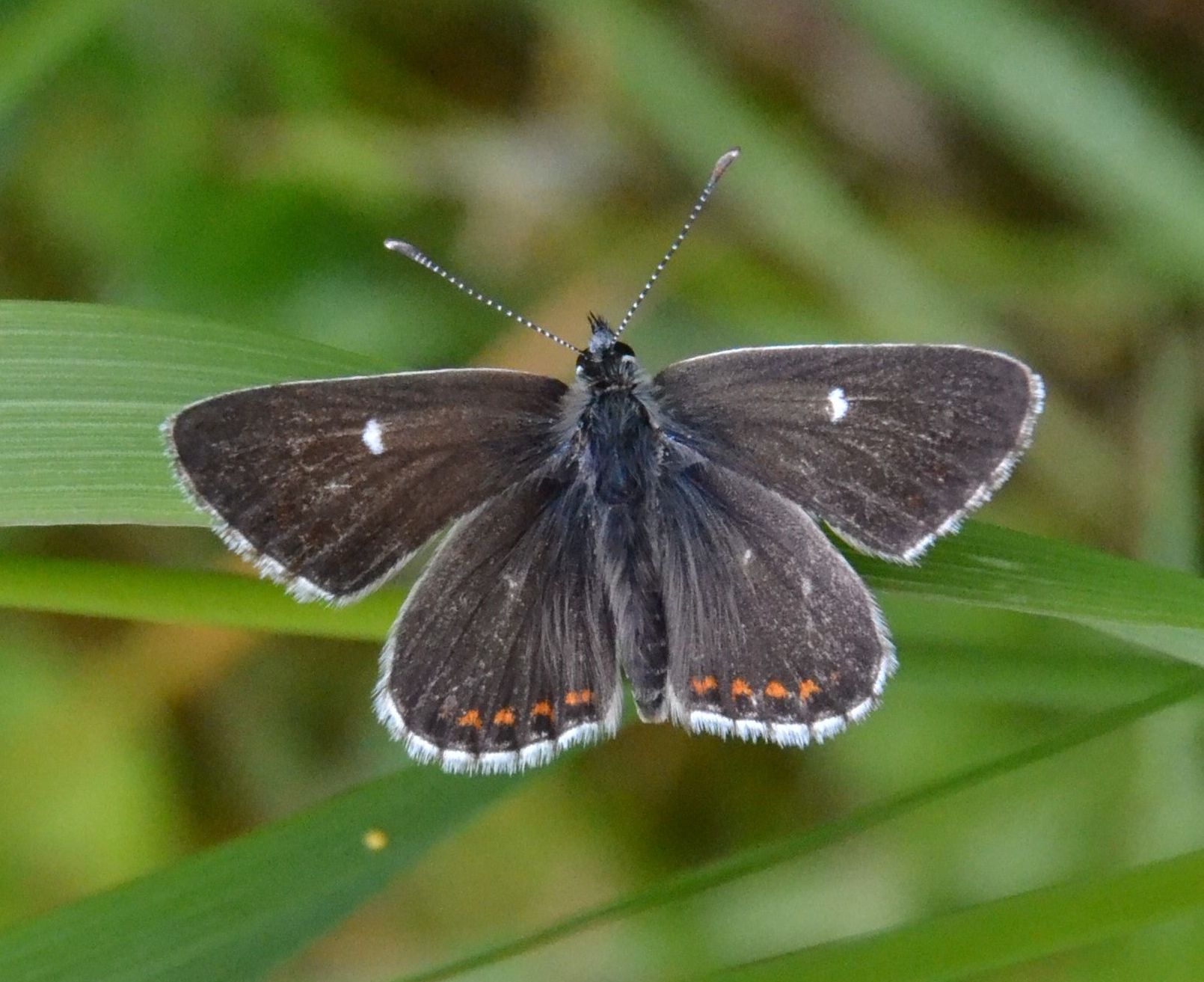
This first-winter bird has paler and speckled orange underparts by comparison with the rusty red of an adult male, lighter grey head tone and darker bill. Otherwise it shares the slate grey upperparts and prominent white eye ring displayed in all plumages. American Robin is quite heavily built, with long wings and tail, and strong feet.

Eventually I called Adam to see how he was faring with East Sussex’s alternative avian attractions. The Hume’s Warbler had not performed well, and I didn’t need it anyway having had a good experience not too far away in Newhaven three years ago (see here). But he was currently seeking out and finding a Hooded Crow around a service area just out of town on the A27. That was a potential second national list addition of the day for me, and an opportunity too good to miss.

Hooded Crow (record shot)

Hence I relocated to Polegate (TQ 578057) where my colleague put me onto the corvid in trees close by the A27. I only needed to tick the thing for Blighty, having seen any number of these abroad in areas where this two-toned grey and black species replaces the all-black Carrion Crow. But I retrieved my car from the service area to drive closer through an underpass and try to get a picture. There another birder pointed out the “Hoodie” perched atop a pylon (above) and that was job done.

It being 2:30pm I didn’t want to negotiate an early Friday rush hour on the dreaded south-western section of the M25. So I opted to return to the first location hoping that with fewer birders in attendance the American Robin might pose on those berry bushes at the end of Hill Road (BN20 8SN – TQ 583004). Back there I engaged with a photographer I know from previous twitches who had been staking out one of the favoured spots for six hours since the bird had last thus obliged.

American Robin (record shot)

Soon the star attraction became visible again on the hillside behind the houses. This time I was one of the first to reach the end of a passage between two bungalows, managing to get an image of a kind (above). I am never comfortable about birding in residential streets, but here as on other occasions when I have done so the local residents were good humoured and tolerant, generally taking an interest in the bird themselves. When we walked back to the earlier spot the irony was not lost on my companion that several lenses were now trained upon the bush he had so recently abandoned.

Things do not get better than what next played out (pictured above). The American Robin fed on the ground, digging for invertebrates just beyond that bush for around 20 minutes. In company with several other birders and photographers I walked around some garages to where there was a clear view, and everyone kept a sensible distance from our subject. Once the show was over the big lens contingent all began to chimp amongst themselves, dismissing as “crap” any back of camera image that wasn’t absolutely pin sharp and perfect, and showing their best results around. For myself I was delighted with the images I had gained. This was by any measure a cracking bird.

It was now 4pm, the light was declining and more new birders began to arrive after work. I hoped it wasn’t too early to brave the M25 and so headed home. If my outward journey had been tedious the return was horrendous, emphasising fully why I normally choose not to bird in East Sussex or Kent. Due to road works on the A27, motorway congestion and three leg stretching stops to counter muscular pain I have been experiencing this winter, the “manageable distance” took four hours to complete. To top everything even the in-car entertainment of a new SMKC album released today largely disappointed, something I couldn’t have imagined ever having to say. But I was returning home with life totals of 375 British and 513 WestPal birds, and nothing could take the shine off that.