Greek Macedonia 2: Days in the Belles Mountains – 8, 10 & 12th May

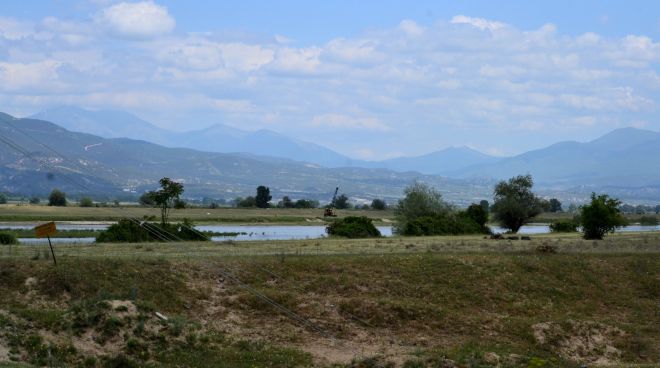
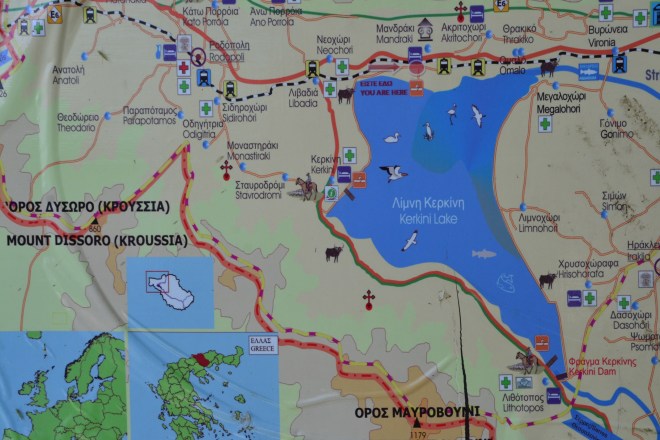
DSC_0513The huge, man-made reservoir of Lake Kerkini was created by flooding an area of former marshland lying between the Belles Mountains on the Greece / Bulgaria border in the north, and the Mavrovouni Mountains to the south-west. On three separate days during the Naturetrek tour I joined here our group visited a number of locations in the northern range that is split in two by the River Strimonas valley.

DSC_0187

The Strimonas valley and river with mountains beyond

On Monday (8th) we drove up into the mountains to the east of this divide. Our first stop was another quarry location near a town Sidirokastro. This reminded me of many places visited in southern France and we encountered some of the same birds. Several each of Black-eared Wheatear and Blue Rock Thrush adorned the cliff tops while the air space was filled by Barn and Red-rumped Swallow and Crag Martin. But once again Rock Nuthatch that are said to breed at the site eluded us.

From there we drove eastward into the mountain range, stopping at a raptor viewpoint. There some of my colleagues scanned the distantly soaring birds, picking out Long-legged amongst the Buzzards. But as is well known at home I am not greatly motivated by specks in the sky, though a Griffon Vulture here must be quite a record for the area as well as a very big speck. This was also a Masked Shrike site and the resident pair tantalised us from bush top perches.

Unsurprisingly I became distracted by what was happening on the ground. This (below) is Chapman’s Blue, a butterfly I had pondered over before in the southern European field, but not ID’d conclusively until now. The underwing pattern in the right hand picture exactly matches the illustration in Collins. Lesser Spotted Fritillary, the trip’s most frequently seen butterfly was also flying here but not much else.

We now drove onward in search of warblers. I was impressed by our tour leader, Phil Thompson’s skill in listening for birds through the minibus window while driving. Eventually we stopped to observe a roadside Woodchat Shrike and he heard an Eastern Orphean Warbler that flew further along the road. We followed but could not relocate it, then stopped instead at a corner where we found a nesting pair of Eastern Subalpine Warbler. I have not searched for small, skulking birds such as these two warblers when birding alone in southern Europe because that is too much like hard work. Hence another reason for coming out with a group and expert leader this time, and didn’t my tour colleagues just love the skulkers and specks!

This was our outward turning point and on turning back both the Woodchat and another Masked Shrike were active again where the Orphean Warbler had been a short time earlier. We played a phone app recording to try to attract the last-named and it came out of cover and crossed the road towards us. This big chunky warbler then perched briefly and prominently in the bare top of a thorny shrub, giving everyone excellent views. On my scale of lifers this one is fairly huge as its western equivalent is one of those elite though dwindling stragglers of my south-west Europe wish list.

After lunch back at the watch point we returned to Sidirokastro where a rock face in the town centre is another reliable location for Rock Nuthatch that birding tours to the area all visit. There was even an ice cream parlour opposite the cliff in the past where birders could sit and watch, but that has now shut down. Indeed it was third time lucky for us as this large, pale Nuthatch bobbed and ducked on a ledge close to twin mud nests that he would sometimes fly onto; an easy observation in the end (lifer, pictured below).

We now continued east from the town along the Strimonas valley towards the Bulgarian border. In this area one wood that holds several Woodpecker species is another regular stop for visiting bird tours. The dense canopy here made me pessimistic about gaining Syrian, the one remaining pecker I still need after April’s Estonia trip. The white-barked Maples that we looked up into were an imposing sight though our tally was indeed one Great Spotted Woodpecker. But a superb find here was Sombre Tit, the trip’s eighth lifer and my 450th career bird, but more of that species in the next post.

The site had become flooded in places at our chosen entry point, so we went to look for alternative ways in. Stopping at the head of one track we came across what I am assured is the butterfly of the trip. Iolas Blue (pictured below, left) is a rarity much sought by collectors, having a patchy and highly localised distribution across south-eastern Europe. One of the largest Blues, its status is not helped by robbers stripping it’s food plant of the seed pods in which the larvae feed, in search of eggs.

Two more Masked Shrike (pictured above, right) were also active at this stopping place. Though at the edge of its breeding range in northern Greece, we did very well for this charming little Shrike through the week, indeed coming across eight separate individuals on this day (8th). We also disturbed a Middle Spotted Woodpecker that flew away calling loudly. I recognised that sound at once from my recent experience of the species in Estonia.

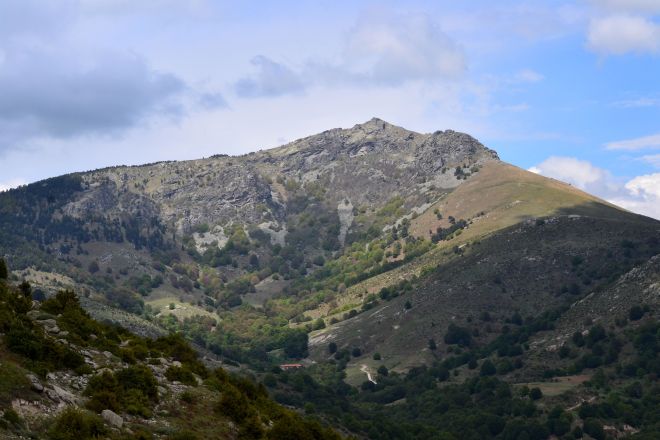
On Wednesday (10th) we penetrated the Belles Mountains further to the south-east above a town Serres. Access into this area is mostly by dirt roads but on one peak, Mount Vrondou (c1900m) there is a small scale ski centre and so a metalled road goes all the way up. The landscape and montane habitat here is Alpine rather than Mediterranean and within it we set out to explore a very different bird mix to that occurring at lower elevations. At the summit the stand-out birds were Common Crossbill and Tree Pipit, while much of the other bird life was of common species from home such as Robin, Chaffinch, Chiffchaff and Lesser Whitethroat.

DSC_0841

The peak of Mount Vrondou

For the rest of the day we made our way back down the mountain, stopping at various locations. Our first walk was along a track into the mixed beech and pine forest that cloaks the slopes immediately below the summit. The main interest for me here was butterflies that will be dealt with in a separate post. These included two new (for me) regional butterfly species, Northern Wall Brown and Eastern Wood White.

Below the treeline we stopped for our picnic lunch on a grassy, rocky slope that we shared with three different lizard species. The haunting song of Woodlark revealed their own presence here, and Red-backed Shrike was seen again. Fortunately in this trip’s company I am able to put names to the reptiles. In this collage (below) are Erhard’s Wall Lizard, Balkan Wall Lizard and a male Common Green Lizard in its breeding colours.

This (below, left) is something I haven’t seen before: a Dung Beetle rolling dung on which their larvae feed in the nest. They apparently prefer to go in reverse so I’m not sure how they get the dung back home. Well I have to write about something other than birds in this journal from time to time! The right hand one for obvious reasons is a Rhinocerous Horn Beetle. There were a lot of Green-winged Orchid growing on these slopes so I have included a picture.

Lower down again we came upon one of the region’s key mountain birds Rufous-tailed Rock Thrush, only my second and another of those sightings that were not accepted in Cyprus. The male (pictured below) kept us amused as it moved around a slope below a bend in the road. This altitude specialist breeds only above 1500m in habitat such as this or higher Alpine meadows. The striking red, slate grey and dark blue colouration is offset by a white patch in the middle of the back that resembles a large dropping from on high. Another Red-backed Shrike and Cirl Bunting were also active at this last site on 10th.

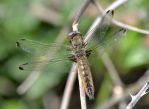
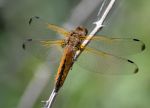
In the early afternoon of our final day in Macedonia we took a walk through a scenic forest site to the west of the Strimonas divide, above a village Ano Poroia. Here my tour colleagues enjoyed themselves craning their necks in search of woodland birds. The week’s only Black Woodpecker was heard but very little actually revealed itself. For me the main interest was a second dragonfly lifer for the trip. I had been led to expect Eastern Spectre (pictured below) by the tour leader, but still mistook it at first for Blue-eyed Hawker for obvious reasons. Doh! – we were in quite the wrong habitat for the latter.

This small and sleek dragonfly is common in most of its range from the Balkans and northern Greece east through the Caucasus, into northern Israel and as far as Afghanistan. It occurs strictly around fast-flowing and shaded streams, and is crepuscular in habit with a preference for suspended perches in semi-shade, as in the picture. Mature males are brown-black with crisp blue markings, with “inverted 7” antehumeral stripes on the thorax. Another diagnostic is the short dark pterostigma (wing dots).

The Belles Mountains had produced four additions to my bird life list, four previously unseen (for me) butterflies and one new dragonfly. More birds – Syrian Woodpecker, Eastern Bonelli’s Warbler, Collared and Semi-collared Flycatcher (all potential lifers), even Nutcracker and Western Capercaillie – may also be found here but these could require a lot of time and effort to locate. Our group’s approach was not one of intensive dawn to dusk birding since everyone had other wildlife interests too, as this post reflects. Despite the motivation for growing my avian life list, just being in beautiful wild places and enjoying the habitat often becomes more important during days in the field abroad; and so it proved again in Greek Macedonia.

Lake Kerkini in Greek Macedonia: 6 – 12th May

This is by any standards a beautiful place. From my window I could see the mountain tops along which runs the border between the Greek region of Macedonia and Bulgaria. Below them is tucked the Ramsar designated wetland of Lake Kerkini that is famed amongst birders for it’s breeding populations of Dalmatian Pelican and Pygmy Cormorant, transient White Pelican and for hosting most of the European population of Lesser White-fronted Geese in winter. I have come here with the wildlife tour operator Naturetrek in search of more bird life list additions, and to sample this region’s butterflies and dragonflies.

As the northern landscape in Estonia last month was dour, samey and, well northern so this southern spot on my 2017 birding agenda is a rich and scenic patchwork of farms, fields and settlements. Tourists who come to Macedonia other than wildlife enthusiasts are mostly Greek city dwellers with a mind for rural tranquillity in summer. And there is plenty of that to be enjoyed here. The pace of life is gentle, the roads lightly trafficked to say the least, and I didn’t set eyes on a McDonalds or Costa all week.
DSC_0544

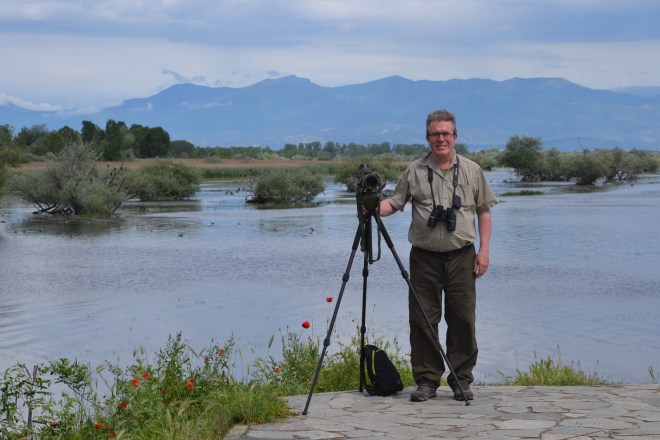
Yours truly: “So the story goes, this is a tale that must be told *”

In recent years when birding abroad solo in Cyprus and Portugal I stayed in mass market hotels then hired a car to get out to where the wildlife is. Our base for seven days here is the private Limneo Guest House in the village of Hrisochorafa, just to the east of the lake. Catering for the needs of visiting bird tours is amongst our host Nikos Gallios’ eco-tourism interests. He is well known in the Greek birding community so has the local bird knowledge with which to brief tour leaders. He also knows all the taverna owners around the village’s main square and hence arranged an authentic range of evening meals for us.

This is only the second time that Naturetrek has visited Kerkini in spring, the first occasion being a few years ago. The tour was researched by our leader Phil Thompson who knows the area intimately. I have been wanting to visit Macedonia for some time and this tour offered the best available agenda. We arrived here in the early afternoon on 6th May after a flight from London Gatwick to Thessaloniki, then following a light lunch set out to explore.
DSC_0533

Kerkini, a man-made irrigation reservoir is fed at it’s north-eastern corner by the River Strimonas that flows out of Bulgaria and is dammed at the south-east. We drove a short distance from our base to a spot about half way along the lake’s eastern embankment. As we approached this place a skein of White Pelican flew overhead to one side of our vehicle, the trip’s first lifer. Having seen just that solitary Dalmatian before dozing its time away in Cornwall, I had not appreciated Pelicans as soaring birds until now. They are certainly magnificent. Within 15 minutes of leaving the vehicle I had gained two more lifers: Pygmy Cormorant and Levant Sparrowhawk, both as fly pasts. Phil was especially pleased to have connected with the latter so early in proceedings.

We were in an area of small scale agriculture divided up by drainage ditches and stands of tall trees. As we walked around Great Reed Warbler were keeping up an intermittent rasping from watery hiding places, distant Hoopoe could be heard here and there, and both European Bee-eater and Golden Oriole were going about their own business in their own ways. As throughout this trip, the song of concealed Nightingale filled the air wherever we went. Given such a birds-cape memories of the Algarve countryside in spring came flooding back inside me. At one pool a Penduline Tit was seen carrying food and we located the nest.
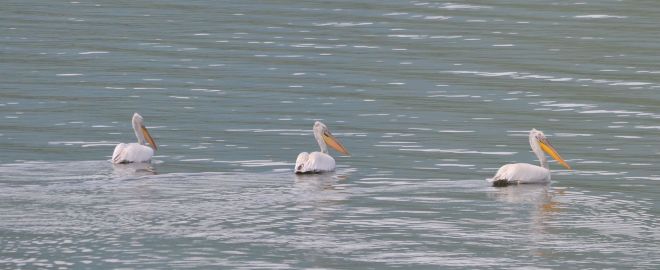
pelican.dalmatian.1701 kerkini

Dalmatian Pelicans (sub-adult)

Returning to the vehicle we drove up onto the embankment then south along it to Lithotopus by the Kerkini Dam, stopping from time to time. More White Pelican passed overhead and further Pygmy Cormorant occupied drainage ditches here and there below. Out on the lake lone Dalmatian Pelican or sometimes twos and threes (pictured above) were seen in places, these being sub-adults with a yellow bill pouch.

Arriving in Lithotopus, we parked to scan the area downstream from the dam. I walked ahead of the group and heard a Reed Warbler-like song coming from scrub, not reeds on both sides of the road. Surely Eastern Olivaceous Warbler, an important lifer since it is missing from my Cyprus list. I had heard the separated western equivalent once but not set eyes on either before. When the group arrived my find was confirmed. We all then observed both individuals moving in and out of cover, the most striking feature being the long, pointed and upheld bill. This south-eastern European breeder was often heard and sometimes seen on many subsequent occasions through the week.

Below the dam a fine array of large water birds served to get us in the mood for the days ahead. Pelicans loiter here, Squacco Heron is frequent; while Spoonbill, Great White Egret and White Stork all come and go. Only my second ever Black Stork was also present at this location today and again when we passed by later in the week. As we walked back to the minibus, a perched Common Clubtail dragonfly was sunning itself at the road side. This had been quite a reconnoitre and a taste of things to come.
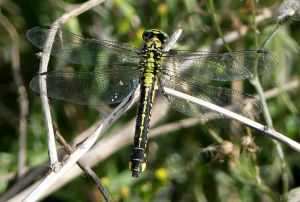
clubtail.common.1701 kerkini

Common Clubtail courtesy of Alan Skull

On Sunday (7th) from the same start point we drove the other way along the eastern embankment and eventually into the lake’s north east corner. Most of the previous day’s birds were present again starting with Penduline Tit. We watched one coming and going from the previously located nest and soon became aware of others in the vicinity. One of them perched at length on an overhead wire, quite a novel way in which to observe a reed dwelling species. PT is plentiful here and these masked bandits’ calls were heard from several locations in the hours ahead.
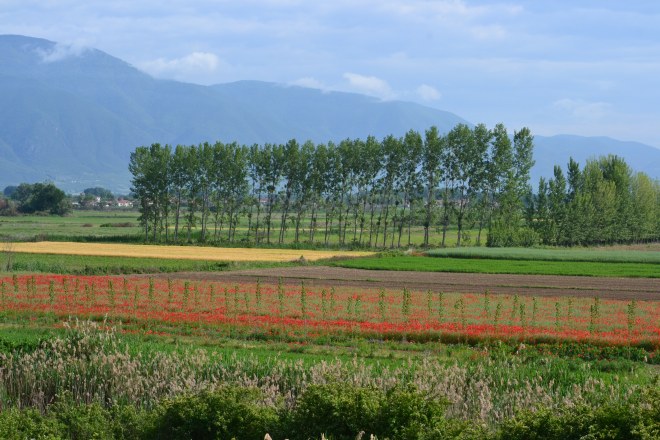
DSC_0048

Landscape from Kerkini’s eastern embankment

As we drove northward atop the embankment European Bee-eater kept going up from the grassy slopes below our vehicle. There were dozens of these colourful and charming icons of southern European days in the field here. Two different butcher birds were encountered: a subly-toned Lesser Grey Shrike, this region’s default grey shrike in spring and summer; and also Red-backed Shrike half concealed in shrub tops. Pygmy Cormorant and Black-crowned Night Heron were both observed whiling away their time in a drainage channel. A leggy Tawny Pipit foraged at one side of the track and a Black-headed Wagtail also put in an appearance. Everywhere we turned it seemed there was something to add to this impressive roll call.

On the lake side of the track the hunched, ochre-necked profile of Squacco Heron was a frequent sight. Small numbers of Dalmatian Pelican drifted lazily on the surface in places, and larger concentrations could be seen more distantly. From Kerkini’s north-east corner the lake’s drowned forest stretches westward but at the moment this area is unusually dry. The trip’s first Purple Heron was seen standing way out in the open amongst the other herons and egrets there. And over the water in places the dark shapes of Whiskered Tern stood out amongst the busy Common Tern and gulls.

In places as we progressed there were concentrations of Scarce or Blue Chaser dragonflies (pictured above) in the track-side vegetation. Amongst the dozens of powder-blue and black males, with their striking blue eyes and black pinch marks on the abdomen from mating, I watched and took pictures of both deep yellow females and orange teneral males for the first time here. So that will be one less odo task off my summer’s agenda in more difficult habitat back in blighty this coming season. I am particularly pleased with these pictures (above) and felt a happy bunny as the group sat down to our picnic lunch at journey’s end.

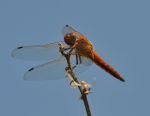
In amongst the many Blue Chasers the sunlight kept catching smaller numbers of a sleek, iridescent gold looking dragonfly. These were female White-tailed Skimmer (pictured above), a previously unseen species for me that ranges patchily across south-eastern Europe. In the female (right) the white tail stands out clearly. I didn’t see any blue-toned mature males today, but they were seen in a few different places this week. The left hand image was captured at Mandraki on the north shore on our final day. The white tail is far less apparent, being in males a feature of the anal appendages.

After lunch we drove along the Strimonas valley to check out some abandoned carp pools. On the way we found possibly three Black-headed Bunting (below left) on overhead wires. This is another important lifer that owes that status to being absent from my Cyprus list, since I was there rather too early in 2012 for their season. This is by no means a scarce breeder in south-east Europe, favouring open country with lightly dispersed bushes and trees.

As we watched the RBB today the trip’s second Levant Sparrowhawk went up, showing to good effect its generally pale colouration except for the sooty wing tips. A migratory raptor, they winter from Egypt east to Iran, and breed in woodlands from the Balkans to southern Russia. My second ever Long-legged Buzzard, a resident species across south-east Europe, was pointed out rather distantly soon after we saw the LS.

Our last location today was a quarry above a village Vironia a little to the lake’s north-east, to seek out Rock Nuthatch. There we came across a courting pair of Masked Shrike, a bird that is right at the western edge of its breeding range in Macedonia. The male’s display behaviour is likewise unusual to witness. I had self found three of this species previously on the slopes of Mount Olympus in Cyprus in April 2012, those being amongst the stand out birding moments of that trip.

Also observed at the Vironia quarry today were Black-eared Wheatear, Red-rumped Swallow and Spotted Flycatcher. Three different raptors, another Honey Buzzard and one each of Osprey and Golden Eagle all put in appearances overhead, this being a reliable location for the last-named. But of Rock Nuthatch at the first attempt there was no sign.
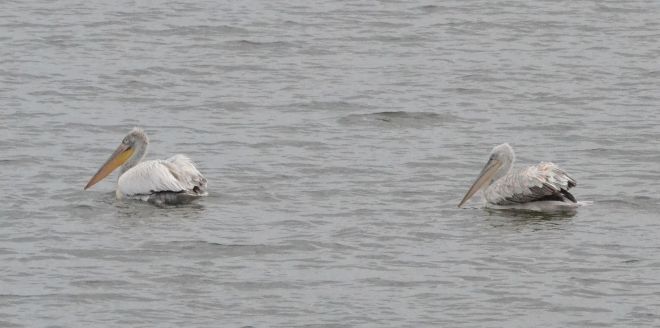
pelican.dalmatian and white.1708 kerkini

Dalmatian (left) and White Pelican (sub-adults)

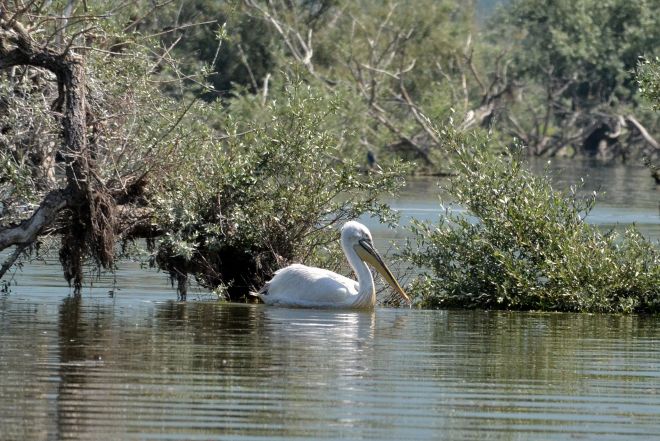
On Tuesday (9th) we completed a circuit of Kerkini by road. First we visited another quarry site near Himaros, south-east of the dam where Lesser Spotted and Booted Eagles were amongst the soaring raptors. Next we stopped in Lithotopus to scan the lake from a roadside viewing area. A swimming White Pelican (pictured above) was amongst the Dalmatians here. I was surprised by how difficult the two species were to tell apart on the water. The sub-adult birds we observed are both buffish grey above and dirty white below. Dalmatian has a shaggy mane on the back of its neck while White has more of a crest, as well as a pinkish face and more beady eye.

But in flight identification is much easier since White shows a lot more black on the underwings, in roughly the same proportion as White Stork. In adults the flight feathers are black and the coverts white, while for Dalmatian the flight feathers are grey. From Lithotopus we took the road that runs parallel with the south-western shore towards the village of Kerkini. Along that road we walked a track up into the Mavrovouni hills to the west that will be the subject of a separate post.

Stopping for lunch in Kerkini village we headed out to the fishing jetty from where boat trips also depart. There a few more Pelicans were loitering out on the water and both Squacco (pictured above) and Night Heron stood sentinel amongst their own allies at the water’s edge. I was amused by one Dalmatian that came in to land on the surface with the profile of a jumbo jet, not having seen this before. Fortunately a gull that was under the big bird’s landing path did see it eventually. There was also a colony of Common Tern amongst which Whiskered came and went.

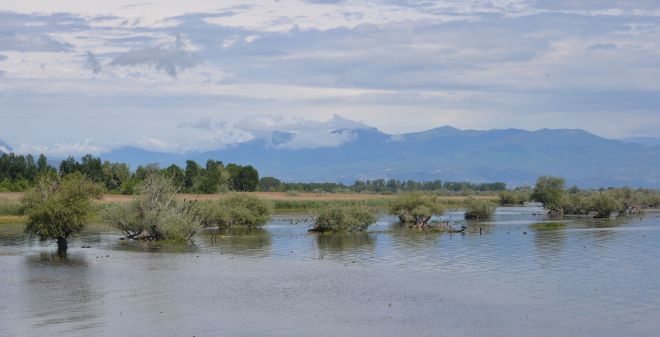
The weather was still deteriorating so the decision was made to cancel our afternoon boat trip. Guess what, by our scheduled departure of 2:30pm the cloud dispersed and glorious sunshine prevailed for the rest of the afternoon. Now we drove on to what is known as Mandraki Harbour on the northern shore. Here a track leads down to a causeway out into the lake from where breeding structures provided for the Pelicans can be viewed. To one side of the causeway is a large reed bed and on the other Kerkini’s drowned forest stretches into the middle distance (pictured below).
DSC_0572

The view from Mandraki Harbour

pelican.dalmatian.1705 kerkini

Dalmatian Pelican

Kerkini is the most productive lake for fish in all of Greece, as is evidenced by the numbers of Pelicans and Cormorants here. The site and its associated breeding programme has been key to the recovery of Dalmatian Pelican as a European breeding species. Prior to the provision of the breeding islands the most DP chicks raised in one season was around 130, but that number rose to more than 200 in 2016. Earlier wooden structures had been vulnerable to removal by local fishermen.

In the drowned forest beyond Mandraki groups of Pygmy Cormorant (pictured above)were sunning themselves in the trees, their brown heads and small bills being readily apparent. This localised south-east European breeder favours lakes and rivers with big reed beds, often associating with Herons and Egrets. There are between two and three thousand of the Coot-sized PC at Kerkini. When seen in proximity with Greater Cormorant, that number 25k here, the size difference is striking.

Out in the reed bed Great Reed Warbler belted out their strident song from reed mace heads. We picked out the trip’s second Black Stork soaring against a hillside, rising higher and higher on a thermal prior to it’s onward departure. Then a Little Bittern settled into a marshy area beside the causeway, the second that we saw on this day .

I also acquired some froggy pictures for the trip here. There must have been hundreds even thousands of Greek Marsh Frog out in the water lilies and marshy lake margins. From time to time seeming Mexican waves of their chuckling, cackling chorus would erupt from all around us before fading again with a little flourish at the end. European Pond Terrapin was also present.

We returned home via Vironia as we had a day earlier. Between the village and the Strimonas just to the south two tracks are worth a visit. On the 8th we explored the first of these along a woodland edge where an array of insects were flying in the early evening sunshine. Green-eyed Hawker dragonfly and Southern White Admiral butterfly were both new for the trip here and the most numerous odo was once again Blue Chaser. The second track skirts a marshy site. There (on 9th) an ageing Eastern Festoon was amongst the butterfly highlights. I also came across another female Blue Chaser dragonfly and also a few female Scarlet Darter.

On the road between that location and our base Red-footed Falcon were seen on both days. On 8th we had first sighted two males in a field to one side, then my first female of that species perched on overhead wires. Unlike the males who soon flew off she was very tolerant of our presence, and having the front passenger seat at that moment I didn’t waste the photo opportunity. On 9th there were five males and two females, all foraging for insects in roadside fields. This small raptor is known to migrate in groups in order to maximise feeding opportunities before dispersing.

It had been an unsettled weather pattern all week but finally on Thursday (11th) conditions were right for our boat trip on Lake Kerkini. At 10am in bright sunshine we met our host at Kerkini village, where he keeps a boat. We had heard horror stories over the preceding days about the soakings endured by some of Nicos’ clients. But the torrential downpours had also been a blessing since the water level would now be a little higher, allowing better access to the drowned forest area where the best birding experiences are to be had.
DSC_1054

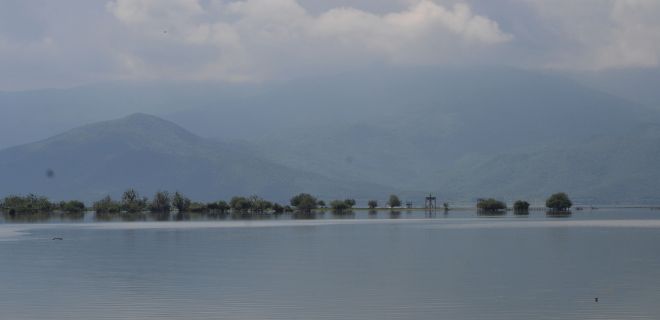
Kerkini mood shot

We set out across the perfectly calm lake surface towards the north-east corner, crossing paths with loafing Pelicans here and there and many more Great Crested Grebe. As we approached the drowned forest some Black-necked Grebe could also be picked out in the distance. All three marsh terns are present here and White-winged Black Tern made a number of fly pasts, showing the two tone patterns and black saddle of their breeding plumage to good effect. But it was the Whiskered Tern (pictured below) that provided the best photo opportunities, arrayed on perches extending out of the water.

We had reached the drowned forest and now moved slowly into the trees in which a hefty chunk of Kerkini’s Great Cormorant population was nesting. In amongst the tree borne colonies were some Pygmy Cormorant and an array of herons and Spoonbill all raising young on countless nests. This wildlife spectacle can only be enjoyed from the water in a boat. Because the lake is so shallow at this end, a rise or fall of just half a metre can mean the difference between viewing the birds at a few metres or everything being up to a kilometre away.

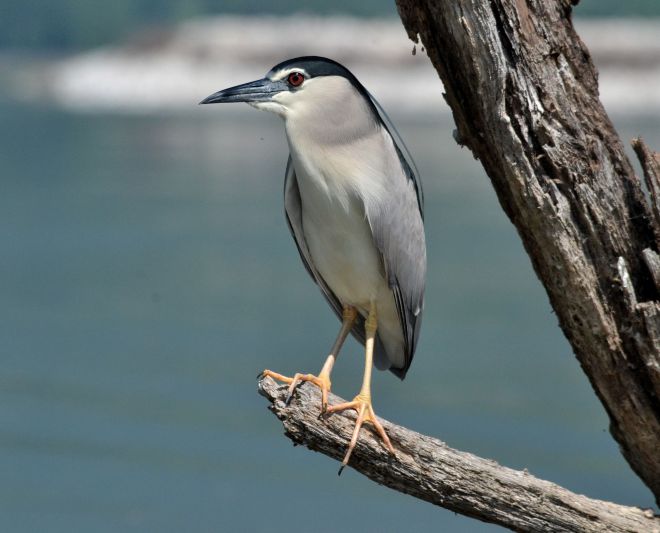
I particularly liked the Black-crowned Night Heron that here at Kerkini do not seem to have read the script that they are meant to be night herons, roosting half concealed in cover through the day then emerging at dusk. This (below) has to be my bird image of the week.
heron.black-crowned night.1701 keerkini

Dreamy Black-crowned Night Heron – just look at lovely me!

Lastly we drifted at appropriate distance past the Pelican nesting structures. From Mandraki I had thought the new, specially created islands were covered in birds but closer to I could see the structure was composed of white rocks with Pelicans mostly on the top. Dalmatian Pelican is a globally endangered species that has suffered dramatic population declines from wetland drainage and persecution. They normally require secluded islands on which to breed, so prior to the early years of this century they had not done so here.

After the first wooden platforms were provided from 2002 these were immediately accepted, the result being the first recorded expansion of the Dalmatian’s breeding range in more than 150 years. Kerkini’s breeding population currently numbers around 250 pairs of Dalmatian with maybe another 100 birds present in total. In 2016 White Pelican bred successfully for the first time with 11 pairs raising six chicks. Up to 2000 of the latter pass through the lake from March to September.

This slideshow requires JavaScript.

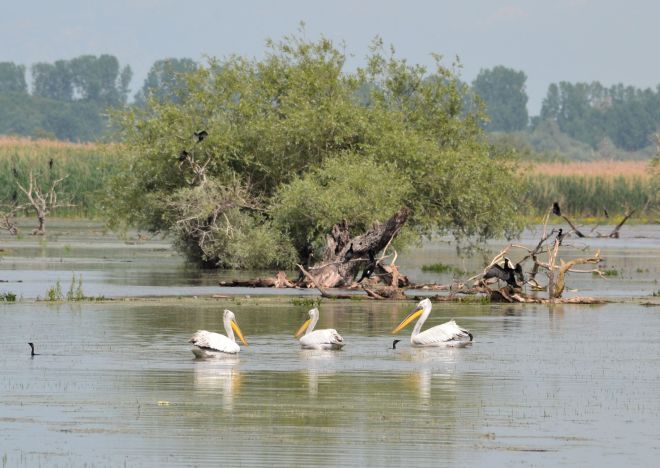
Late in the afternoon of my final day in Macedonia, we returned to Mandraki to say our farewells to Lake Kerkini. This time we had the causeway almost to ourselves. I caught sight of two, then three, then four Dalmatian Pelican approaching from afar and photographed them as they came nearer. I regret not managing better Pelican pictures on this trip, but with it being the height of the breeding season the need to minimise disturbance meant that we just did not get close enough. Most of the birds encountered were hence non-breeding sub-adults.
pelican.white.1705 mandraki

Dalmatian Pelican amongst Pygmy Cormorant

As the week had started with an unusually showy Penduline Tit so it ended here with another that, like the local Night Herons had not read the script. We watched this particular individual feeding in the top of a Weeping Willow. Squacco Heron were all around us and provided some photo opportunities of their own. I have at no time seen so many of this charismatic small heron as this week around such an amazing wetland.

At last, possibly sensing our imminent departure the surrounding marsh frogs treated us to one final and spectacular serenade … and with that we left all this behind. Lake Kerkini had not disappointed and I will carry its memories for a long time. So the story goes … this is a tale that’s just been told* (*Lyric © S Hudson / M Kennedy).

But other major wildlife sites in northern Greece are not so sympathetically managed for birds as Lake Kerkini. In 2008 Birdwing (Bird Watching In Northern Greece) was set up by British birder Steve Mills and his partner Hilary Koll to raise awareness of issues impacting on birds in Greece, and raise funds for conservation and restoration of habitat. The organisation also aims to bring more eco-tourists to important bird areas, provide education for children and local adults about birds, and to lobby political decision makers. Steve is also the author of the region’s definitive birding guide: Birdwatching in Northern Greece that I invested in a copy of before leaving Kerkini. All proceeds from sales of the book go directly to supporting Birdwing’s work. Donations may also be made via the web site.
My second Bonaparte’s Gull: a local celebrity – 24th Apr

For the last 18 days a vagrant north American Gull has been the main draw for visiting birders to Oxford’s Farmoor Reservoir. This bird was first found on 7th April whilst I was away in Estonia. On receiving the text alert I sighed and wrote it off as the latest major county bird to turn up when I am abroad, Black-winged Stilt and Spotted Sandpiper being the most notable past instances. But one can hardly not go anywhere for fear of missing a county tick. I needn’t have concerned myself, because this cracking first summer Bonaparte’s Gull has remained in Oxfordshire ever since.

For the first 10 days of it’s stay the gull was either confiding or elusive in turn. It seemed to favour Farmoor early in the day before disappearing elsewhere, and on some dates was absent entirely. I myself missed it three times in the days after returning from Estonia. Then on Easter Monday I got the tip off and after a mad dash finally gained what for me was a county list addition. But this is actually the fifth record for Oxfordshire, and all at the same site.

Since Easter the “Boney” appears to have taken up residence, favouring a pontoon at the south end of Farmoor 2, the larger of the twin reservoirs here. Some excellent images of the bird on or around that structure have appeared in local media, which whetted my appetite to take a better look. On my second visit last Friday 21st the bird was posing perfectly on the pontoon but I didn’t have my camera with me.

gull.bonaparte's.1501 radipole lake

2015 Bonaparte’s Gull in Dorset

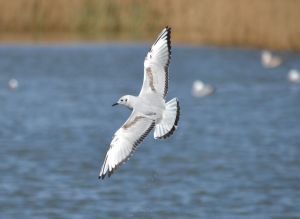
I had captured the above flight shot of this species two years ago at Radipole Lake in Dorset (see here). Bonaparte’s Gull is mainly seen in Britain in late winter or spring, and the Oxon 1w / s bird is one of three in England at the present time. Noticeably smaller and more delicate looking than Black-headed Gull, they have a finer, all-black bill; and immatures have pinkish legs and an attractive upper wing pattern that to me seems to stand out at a distance. The flight pattern is often described as being Tern-like.

Having brought my Oxon year list (had I been keeping one) up to 145 in the period under review, I resolved at the weekend to take a little gardening leave. But first today I would pay a quick visit to Farmoor to seek portrait shots of this Gull to go with the Dorset flight pictures. Or that was the plan, anyhow. I often start the day with good intentions regarding household chores. As I walked around F2, patch worker Dai (who has a vehicle permit) stopped to say the BG was sitting atop the reservoir wall. But when I reached the favoured location the bird was perched some way out on a buoy.

gull.bonaparte's.1702 farmoor reservoir

Bonaparte’s Gull over Farmoor Reservoir

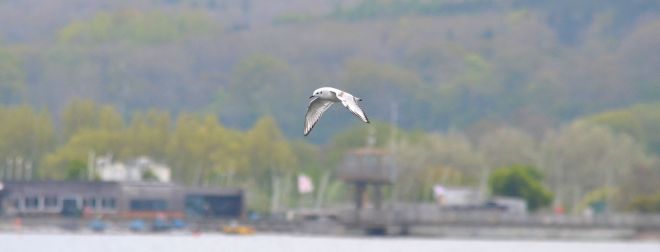
For the next 90 minutes or so my quest spent it’s time flying around the northern end of F2, at times settling on the water or the said buoy. There was a lot of disturbance from passing anglers cars and power boats out on the water, the latter making it increasingly unlikely the gull would favour the pontoon today. I rather like the above image that conveys how well this gull stands out from the background. Then the weather deteriorated.

A squall blew in and I took cover in one of the “bus shelters” at this part of the site. Another  birder joined me and pointed out the BG again walking along the reservoir wall towards us, seemingly picking midges from the inside wall. I attempted to get pictures as it approached but the light was very murky. When the rain stopped the bird was nowhere to be seen.

gull.bonaparte's.1701 farmoor reservoir

First winter / summer Bonaparte’s Gull at Farmoor Reservoir, Oxon

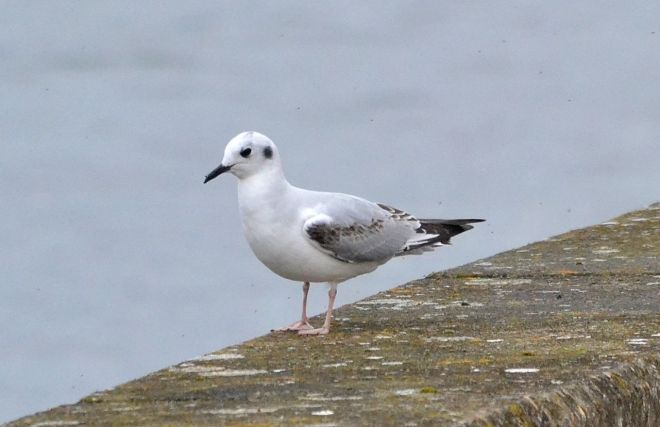
Conscious that the entire morning had now passed with no attention at all having been paid to the day’s task list, I gave up on the BG returning to the pontoon. But as I walked further there was the local celebrity again in exactly the same pose as before, coming along the top of the wave wall towards me feeding on insects along the inner edge. And this (above), for what it’s worth is my own muddy, grainy best effort at a portrait shot of the Farmoor Bonaparte’s Gull.

wickster.1701

Marathon man: Oxon’s legendary jogging birder

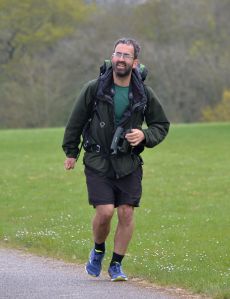
Footnote: While writing this I received a text from another local celebrity Tom (pictured above) – who originally found this gull – saying two Black Tern, the first of the season had arrived on F2. So it was back out to Farmoor to see those. By 5:30 pm no gardening or any other household chores had even been attempted. But I shall start tomorrow, or at least set out with good intentions!

Steller’s Eider in Küdema Bay, Estonia – 5 & 6th Apr

Having experienced most regular (ie non-vagrant) birds in south-western Europe over the last five years my attention in 2017 has turned to new countries in which I might gain multiple life-list additions. One of these is Estonia, the most northerly and least populated of the Baltic states. Hence I joined a group tour by birdingbreaks.nl that was featured in Birdwatch magazine. The trip targets were mainly woodland species: Grouse, Owls and four new Woodpeckers out of a possible eight here; as well as Eagles and the globally threatened sea duck Steller’s Eider.

One landscape predominates in northern Estonia: flat, mostly yellow-toned fields mixed up with tracts of predominately pine, silver birch and spruce woodland. The pictures below give the general impression. It is endlessly samey, dour even but very wildlife rich.

We set off from Tallinn airport by minibus at around 2:30pm on 5th April, our destination being the Baltic island of Saaremaa. The first stop along the way was Kasari floodplain meadow, one of the largest extant open meadows in Europe. Flooding is caused here by snow melt in the catchment area and strong south-westerly winds that push sea water onto coastal lowlands. At the time of the spring flood thousands of migrating wildfowl stop over here, and as the waters subside the meadow attracts large numbers of waders.

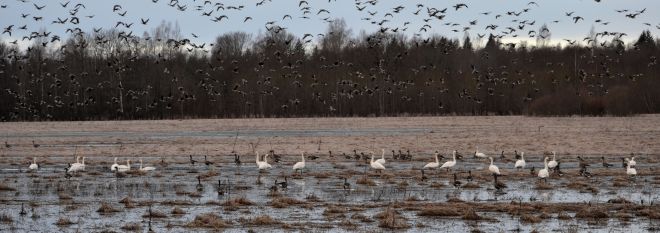
Scanning the Barnacle and White-fronted Geese we found two Red-breasted Geese in amongst them. This was a good scene setter for northern birding I thought. A White-tailed Eagle made a long and languid fly past, then another one drifted through at greater distance. These huge raptors that have a front-heavy, large-billed, long, broad-winged profile with deeply fingered primaries, were seen on every day of the trip. From time to time along our route Common Crane would adorn roadside fields, almost always in pairs and sometimes dancing.

On the ferry crossing to (and from) Saaremaa what seemed a roll call of northern wildfowl would drift by on either bow, or fly busily from one spot to another. Long-tailed Duck were everywhere. There are thousands of them in the northern Baltic. Common Scoter were well represented, while the white eye and wing patches of a few Velvet Scoter could also be picked out in some of the rafts that rode the waves in the middle distance. Also seen in varying numbers were Scaup, Common Eider, Common Goldeneye and Red-breasted Merganser. It was impressive to see all these ducks in such numbers, quite a contrast to winter birding at home and a different bird-scape from other parts of Europe certainly.

Before reaching Saaremaa the road crosses a smaller island Muhu. Between the two is a narrow strait which is traversed by a causeway. Offshore here were very many Bewick’s Swan and also numbers of the larger Whooper Swan, as well as Mutes. In amongst these were more familiar wildfowl such as Tufted Duck, Wigeon, Teal, Gadwall, Northern Pintail and Mallard; and also Smew here and there. But the must-see attraction of this island is the wintering flocks of Steller’s Eider which grace it’s western seaboard that is ice free all year round. Those would have to wait for the morning.

Early on Thursday we headed for the coastal national park of Vilsandi that covers a total area of 237.6 km sq comprising many islets, peninsulas and relatively sheltered bays. It is the last-named that attract around 2000 Steller’s Eider from December to mid-April. They have to be picked out from amongst their Common cousins and the ubiquitous Long-tailed Duck here, as well as the assortment of wildfowl noted a day earlier. The tundra breeding Steller’s prefer shallow coastal waters in winter, especially with in-flowing fresh water, and they often come quite close inshore.

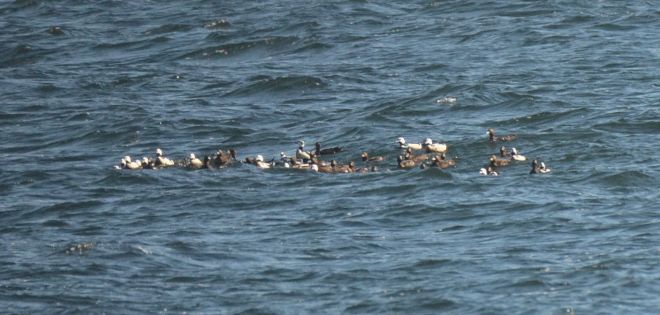
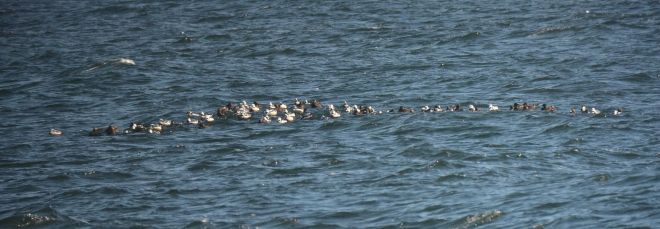
Our guide checked out a number of likely locations without success, before we arrived at a rather remote and deserted jetty location in Küdema Bay. This internationally Important Bird Area (IBA) in the island’s north-west corner is a major staging and wintering area for many water fowl. Here we scanned through the by now familiar assortment of offshore duck until from right at the end of the jetty a raft of about 80 or more Steller’s Eider were located (pictured below) bobbing in and out of view towards the far side of the bay.

stellar's eider.1701 estonia

Mission accomplished and this is what the picture shows see here

These birds are about two-thirds the proportion of Common Eider, roughly the size of Common Goldeneye. Steller’s have a square head and spatulate, not wedge-shaped bill. The body appears elongated and the tail is cocked upwards like a Scoter when at rest. The stunning males are intricately patterned though at a distance stand out as almost white amongst the dark, chocolate-brown females.

We all observed them for some time before it was time to move on. I was one of the first to return to the minibus but was then called back. Our raft of duck had relocated closer inshore and so the diagnostics were plainer to see, especially with the pale-toned drakes. And so we watched a little longer before departing.

stellar's eider.1702 estonia

Raft of Steller’s Eider in Küdema Bay

See here for a full trip report on this visit to Estonia from 5-10th April.

Little Bunting at Great Barford, Beds – 8th Mar

Today was the latest of its kind when I just needed to go somewhere, but on this occasion not too far. Upon scanning RBA I elected to experience my third Little Bunting, a wintering bird at a site near Bedford. My first record of this taiga breeder was at close quarters from a hide at a LNR in Cardiff (Feb 2015 – see here). Then earlier this year I stood in line with Oxon’s finest at a feeding station near Chipping Norton in the north of God’s own county to gain what was a county tick for myself as well as quite a few other people.

Working a late shift immediately following a sleepless night two days ago had taken their toll. But on struggling out of bed mid-morning I at once felt that a little cleansing of the system would be beneficial. And so I headed for the village of Great Barford, just 60 miles from home and parked beside a church near Barford Bridge (TF134516). Two other birders returning to their own car said the LB was coming to seed a short walk to the south-west, just before a green metal bridge where the Ouse Valley Way crosses that river.

great barford.1701

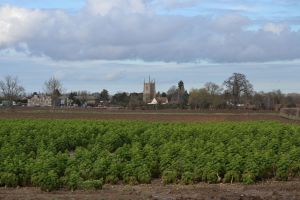
Great Barford from the riverside site

Upon reaching the described spot at 2:30pm I found a carrier bag containing bird seed on the ground and took the liberty of spreading a small amount on the path ahead of me. I soon realised that hadn’t really been necessary. Numbers of Chaffinch, Reed Bunting and other small passerines were moving about in a thicket to one side of the track (pictured below, right) and coming down to feed on much more seed that had been put down at the edge of a ploughed field. Amongst them before too very long was the Little Bunting.

I was the only person present and spent the next 40 minutes puzzling over various female Reed Buntings. Then a second birder arrived. Whilst appreciating he knew what he was talking about, it had been pleasant enough to be free of plumage topology conversation in the interval and irritating when he put the doubts in as to my own sighting. I now needed to see this bird again to reassure myself and that happened twice more, the first time under this other birder’s direction before he left.

By now two more local birders had arrived and eventually what was needed transpired: a nailed-on, self-identfied repeat sighting. Like so many small (or indeed not so small) birds, when this one appeared it stood out clearly and some diagnostic features were obvious. The head pattern can be variable in tone but this individual’s chestnut facial features were noticeably bright. The other stand out feature for me was very marked streaking of the bird’s flanks. As ever I am not a great one for plumage topography, which is perhaps just as well since the Helm guide to confusion species devotes the best part of a page to it for Little Bunting. Unfortunately I did not manage to get a photograph, but the couple with whom I observed today’s bird sent me this excellent video.

Great Barford Little Bunting – courtesy of Peter and Kathy Blackmore

Though sporadic in it’s appearences during my two hours on site here today’s Little Bunting provided good value. The Cardiff bird had been viewed mostly into bright sunlight and the north-Oxon one was somehow difficult to appreciate in such a large gathering. So of my three records to date this is the one that has told me the most about a regular winter visitor. And though I regard baiting birds with seed as contrived, today’s encounter aptly illustrates how difficult it would be to locate those many scarce passerines that go unseen in the British countryside were it not for feeding stations such as this.

Footnote: Having not got a photograph I returned a day later to try again, but waited three hours from 12 to 3pm even to see this bird. Various local birders came and went in that time and conveyed that this Little Bunting is often elusive. It was first found by a surveyor before Christmas, and after Beds county listers spent a lot of time here without success the county bird recorder authorised the bag of seed to make things easier. So this site is not a permanent feeding station like the one in north Oxon.

In Memoriam: Bluethroat at Willow Tree Fen, Lincs – 15th Feb

The rather exceptional discovery last Friday of what has become a showy wintering Bluethroat in the Lincolnshire fens was a suitable draw for two reasons. I have encountered the species briefly twice before at Larnaca Salt Lake, Cyprus (Nov 2011) and after much searching Tavira Marsh, Portugal (Jan 2014), but had yet to observe an adult male. So the opportunity to add a first winter male to my British bird list just 110 miles from home was not one to stand up.

The nearest wintering Bluethroat to Great Britain are normally in the south of France and the Iberian peninsula, and are of the southern white spotted sub-species. There is currently some discussion amongst birders online about the origins of today’s bird, that could be of the Scandinavian red-spotted sub-species or other forms occurring further east in Russia. But such taxonomic concerns were of less interest to me than getting what is a regular though declining passage scarcity onto my British list

I headed north in reflective mood after events in the previous two days. At my charity shop on Monday there had been a murder in the street outside. But more particularly, after deciding to go for this bird yesterday I learned of the death of a good (non-birding) friend after a brief hospitalisation with cancer. I felt no inclination for the usual accompaniment as I travelled what has become a familiar route via Northampton and Peterborough. Instead I pondered the transience of all the many phases of our lives and what the remainder of my own might hold.

I arrived at Lincs’ Wildlife Trust’s Willow Tree Fen reserve near Spalding at 12:30pm after taking the best part of 30 minutes to remember where it was. I had been here once before in August 2015 (see here) to see a beautiful Red-footed Falcon, probably my British bird of that year which subsequently was also murdered. There seemed to be a general movement of birders off the reserve, but I was directed to a group along the main track where the Bluethroat was said to be popping in and out of reeds to one side. Many close-up pictures taken at this spot, reflecting various degrees of expensive technology, had appeared on RBA and Bird Guides over the preceding days.

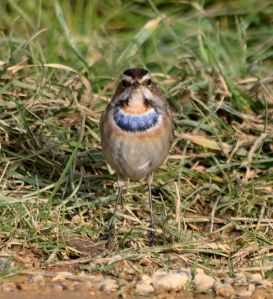
Upon my arrival a minibus carrying school children passed slowly in the opposite direction. Considerate yes but not especially helpful, and a dog was also present. None of the birders waiting here seemed to have seen the Bluethroat yet. Having made a late departure after working an evening shift I now feared the worst. But after just a 20-minute wait, and once the dog had gone, a murmur of: “There it is,” issued from my left. The bird had emerged from the reeds right in front of me. This (below) is what I call a result.

The above images were all captured with my entry level Nikon SLR and 300mm telephoto lens. I would like to dedicate them to the memory of Jeremy Hill, who was a very fine man and will be sadly missed by all who knew him. My thoughts throughout this twitch were with his widow Penny, one of my longest standing friends and their sons Sam (17) and Tim (15).

The Bluethroat spent several minutes moving about and feeding in the grass beside the track, where food must have been put down for it by photographers and/or other people with cameras. Mealworms were mentioned by some birders around me. As in the Algarve three years ago I was struck by the larger size of this Robin-like passerine, and also by the way he constantly flicked his cocked tail. From time to time he just seemed to stand and look back at the line of observers who were all so fascinated by him (pictured below).

bluethroat-1706-willow-tree-fen

Who might this be?

Finally and rather coquettishly he flipped back into the reeds from whence he had come, and immediately I thought of my stomach. After a sandwich break back at the car I decided not to linger further and so headed home. Standing in line watching a bird at such close range always seems a little contrived to me, especially if it has been baited with food. But I am unlikely to get better views of a rather under-represented species in my past records that is now well and truly ticked for blighty (no 335). I believe this is only the second British wintering Bluethroat this century.

Winter is almost over now, and I have negotiated the dark season without a break abroad. That has been a difficult, at times brutal ride, as needs must but also an experience that instils some sense of achievement. Hitting the road to “see a bird” always helps: that is why I do it.

White-billed Diver at Bardney, Lincs – 25th Jan

This is the last European diver, or loon as they are also known that I needed for my birding life list. I usually associate reports of White-billed Diver with northern Scottish coasts. So when a juvenile turned up five days ago at an inland river site south-east of Lincoln, just within my preferred range, it was a must see. Even more so after I viewed these images (here) on RBA.

On Monday at a county twitch in north Oxfordshire I overheard a conversation about this bird and expressed my interest. The next day Ewan called to say he was up for it if I would do the driving and so it was agreed. I was sickening for a cold that I did not want to pass on to my friends at the charity shop, so a birding day out with a hardy soul who though warned was not bothered by my germs was an attractive prospect. And so we set out northward at 9am on a foggy Wednesday morning.

In Europe White-billed Diver breed in arctic coasts of Russia and winter chiefly along the north-west Norwegian coastline. It is a rare winter visitor further south around the North Sea though there are notable annual spring gatherings in Scottish waters off the Isle of Lewis and the coast of north Aberdeenshire. Inland British occurrences are very rare indeed and hence this bird has been nominated the Bird Guides bird of the week.

white-billed_diver_from_the_crossley_id_guide_britain_and_ireland

White-billed Diver: first winter (foreground) and adult breeding © Crossley ID Guide to Britain and Ireland

The day’s first sighting on RBA told of the Lincs WBD drifting north along the River Witham past a tiny village called Southrey (TF138663). We arrived there some time after midday to find a gaggle of birders milling about and wondering in which direction to search along the towpath. The latter half of our journey had been through cold clear sunlight but once we got close to the location it became apparent the whole area was blanketed in freezing fog that would not be burning off any time soon.

At 12:20 a birder checking RBA announced that the diver had been relocated a few miles to the north at Bardney Bridge (TF113693). Cue a mass re-location. Ewan and I were amongst the first to arrive there and about 500 metres north of the said bridge we sighted a very impressive looking bird indeed, keeping company with a Cormorant. White-billed Diver is the largest of its genus that breeds in Europe, even bigger than a Great Northern Diver. The two species are quite similar in appearance but WBD’s distinctive and most impressive feature is a large, straight, up-tilted white bill that in summer turns yellow. Hence this bird is also cited as its north American title Yellow-billed Diver (or Loon) in some sources.

I observed the diver for a short time then attempted to photograph it, at which point I realised there was no SD card in my camera. It happens … well sometimes! And so I rushed back to the car to retrieve the spare I always carry, passing many more birders converging from various points along the River Witham and all enquiring about the WBD. “Keep going, you can’t miss it,” and such like I responded but it appeared that all of them did. I could not have imagined this bird could move on so far in the short time that I was away.

Returning to take my pictures, or so I had thought I stomped on and on to eventually rejoin a confused melee of birders all at a loss to know where the WBD had got to. It seemed that only the first several people on site, including ourselves had managed to connect. Ewan said he had seen the diver turn around and probably head back south, and so we agreed to search in opposite directions. Walking north I quickly encountered people coming back from a lock and barrage beyond which the bird was unlikely to have passed. Then Ewan called to say he had viewed the WBD very briefly as it surfaced back near Bardney Bridge. I conveyed that to those ahead of and behind me and so things continued.

It became clear this powerful swimmer must be travelling for considerable distances under water. The thing was that people walking the towpath all headed for the group of birders they could make out in the fog ahead instead of keeping an eye on the river. And so almost everyone missed the bird. Meeting Ewan again he suggested we went back to Southrey and wait for the WBD to pass. Back there it soon became apparent that lots of other people, most of whom had yet to see the bird all had the same idea. By 2:30 pm we decided to look further south again, but discouraged eventually by the dismal and freezing weather we gave things up and headed home.

In various ways this was a frustrating day, due not least to the local weather conditions and also because out of carelessness I did not capture my own images of an important lifer. But I had seen the WBD well which most birders in the area did not on this occasion. It seems rather bizarre that such a large and stand-out bird could have eluded most of its audience so thoroughly for much of the time, but that is what happened. Most importantly I have now observed all of the European divers in Great Britain.

Rose-coloured Starling at Crawley, Sussex + Oxford Waxwings – 10 & 11th Jan

The first-named is a bird I have intended to visit for some time. The now second calendar year juvenile has been gracing a suburb of the Gatwick Airport metropolis since early November. But I wanted to wait until its moult progression more closely resembled the splendid pink and black plumage of an adult (outsourced picture below right).

There are 30 plus British records of Rose-coloured Starling in most years, some of which like this particular youngster over-winter. It is a scarce south-east European and south-west Asian breeder, and the normal wintering grounds are in southern Asia. I had seen a first winter juvenile once before in my home area close to Oxford in January 2010. But that distantly viewed bird had just looked like a very pale common Starling in a large flock. So when Ewan, who had seen the Crawley bird closer to its arrival (pictured below left) said he was going for a second look and invited me along, I jumped at the opportunity.

Arriving in the residential district of Broadfield (TQ255345) late morning we found the RCS at once, its presence being revealed by two other birders. We too were able to walk right up to the low trees it was favouring beyond a garden wall where clearly a large amount of bird food was being put out. Then for the next hour or so we just snapped away with our cameras, while more birders came and went, mostly on time out from their jobs and also doing a check on the juvenile’s progress into adulthood. Now and again local residents would drive by smiling knowingly inside their cars: “birders again”.

rose-coloured-starling-1701-crawley

Rose-coloured Starling (2cy juv) at Crawley today

As the partially moulted bird moved around it became readily apparent just how well things were coming along. My favoured Helm guide to bird identification describes juvenile RCS as pleasant, bland-faced, innocent looking birds with rather loose, fluffy plumage; and I have to agree. The images in this post were captured with my 300mm telephoto lens. It really was that easy, unlike the recent Dusky and Blue Rock Thrushes.

The above sequence shows the frequent bill cleaning behaviour that the bird engaged in. Also in addition to the more developed glossy black plumage, how the beak is turning from yellow to pink and a noticeable crest is forming. I believe the moult should be completed by February when I will be greatly tempted to observe this bird again if it remains. After all I have yet to come across one in southern Europe.

rose-coloured-starling-1705-crawley

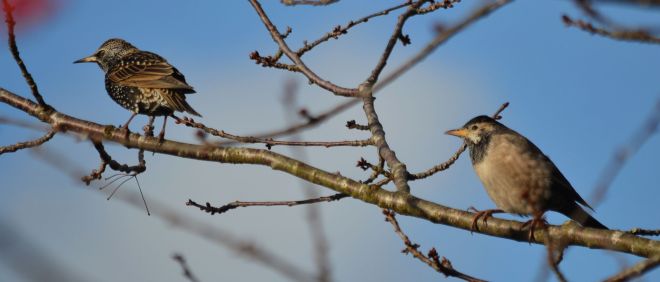
Common (left) and Rose-coloured Starlings for comparison

Back home in Oxford, one of the stand-out birding events of the new year has been the much anticipated arrival of Waxwing in the city. 2016/17 has been touted as an irruption winter since the early influx of large numbers of the Scandinavian berry bandits into Scotland and northern England. Now for the last four days a small group of six birds has been active along one arterial road in north Oxford, paying frequent visits to an ornamental berry tree from more lofty surrounding perches, as Waxwings do. I have visited the location in each of the last two days, and these (below) are my better digiscoped records of the occasions. The right hand image illustrates just how thoroughly the berry tree has been stripped of its fruit.

On the subject of local birding, my Oxon county year list for 2016 had I been keeping one would have ended on 173 (plus two heard only). Somewhere in the 170s is usual unless one doesn’t go on holiday in the passage season, is able to drop all other commitments and go after every county bird, and is an excellent networker to get all the tips quickly from other birders. So topping my 2012 and 2013 totals of 181 will have to wait for another year, if I should choose to indulge such a widely denied practice. The 2016 Oxon year rather fizzled out in December, but then two Bean Geese arrived late afternoon on New Year’s Eve, the month long presence of three Cattle Egret has been revealed on a north Oxon pig farm, and more Waxwing are likely as forecast “Arctic blasts” look set to “batter Britain” through January.

All the 3s: Blue Rock Thrush in the Cotswolds – 28th Dec

Another fine reason arose to be out and about in the frosts of mid-winter when news of this bird broke yesterday from the Cotswold town of Stow-on-the-Wold, Glos. I have encountered Blue Rock Thrush often enough abroad. The national bird of Malta where I commenced my southern Europe travels five years ago, I have also observed the species in Cyprus and Morocco, and several times each in the south of France and Portugal. But more parochial British list additions are always welcome and this one represents bird number 333.

12 months ago an incessant Atlantic weather pattern was dampening my spirits prior to a January escape in the BRT’s home territory. Now the elements have contrived to cater for my choice to endure the British winter this time around, by offering up more cold, clear days of the kind I so enjoy. It was a glorious, frosty daybreak at home in Garsington but on the other side of Oxford there was fog that endured throughout the day. The A40 was closed west of Witney due to a 20 vehicle fatal accident, necessitating a detour through that town. Eventually I arrived in Stow some time before 11:30am.

The pay and display car park closest to the bird was full, with green clad optics carriers coming and going. As I walked from there towards the BRT location people coming back the other way were all content and saying: “It’s showing well,” and such like. As with the Derbyshire Dusky Thrush this occurrence demonstrates how a rarity can remain beneath the radar for some time, in this instance a week before someone with a passing interest puts images on social media and news gets out. Then local residents need to brace themselves for an invasion, prepare the charity buckets and sit tight.

blue-rock-thrush-1601-stow

Thar he blows!

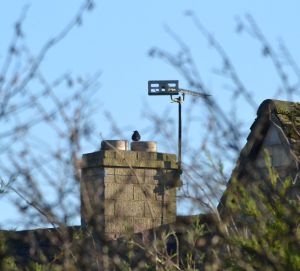
On reaching Fisher Close I found a rather modest gathering who were all clearly on the Blue Rock Thrush that was perched obligingly atop a chimney (pictured above). Voila! Apparently there had been around 200 birders crowded into the small cul-de-sac at first light, which must have been a bit of a shock to any late-waking resident who might not have been forewarned. I myself do not feel the need for dawn starts unless there’s a significant advantage in seeing a bird. But I likewise appreciate that getting there early is a matter of form for many birders.

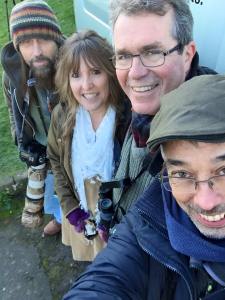
I only needed to tick this BRT for Blighty and thereafter was content for the twitch to turn into a social occasion. There wasn’t long to wait as I looked to my left and found fellow Oxon birder Adam (Hartley), who I would have been surprised not to see here. We chatted for a while then I looked behind and someone else was smiling and waving. Andy? No the Viking beard couldn’t have grown that much since before Christmas. Here were Wayne and Julie (Bull) and before long we were joined by Keith and Shirley (Clack) who I also somehow expected to meet. As we stood around talking these various friends greeted other birders who they knew from here or there: twitching is like that!

All the while the reason for our being present kept coming and going, perching on roof apexes and taller chimneys. It seemed a rather incongruous location for a Thrush that I have always associated with inland or coastal cliff faces in southern Europe. But this bird was treating the environment of it’s adopted resting place in exactly the same way as I had always observed its kind in the past, as I consider the above images show.

This is only the seventh British record of a shy species that normally is seen at distance in its home range and tends to hide itself when disturbed. Today’s BRT was no exception. It behaved just as all those others I have seen abroad did, appearing at height as a silhouette and surveying all before it. But when light caught this male bird in the right way its deep blue colouration and strikingly long bill could be plain to discern. For some quality images see here.

stow-1601

Definitely not a covert Oxon sortie into Glos … just a social gathering

It remains to reflect upon how I seem to have spent some time in Gloucestershire of late. That neighbouring county has hosted Dusky Warbler and Eastern Black Redstart in December 2016, as well as the Richard’s Pipit and Blue Rock Thrush of this journal’s last two entries. All of those are birds I have yet to record in God’s own county (Oxon) where we currently survive on a diet of Bittern, Harriers, Caspian Gull and Tristis Chiffchaff. Whilst appreciating those are all excellent birds to have in a central, land-locked English county, I as always yearn for something new and different. And so far this winter I have not fared too badly a little further afield.