Stilt and Least Sandpipers at RSPB Lodmoor, Dorset + Oxon Grey Phalarope – 12 & 13th Sep

The autumn bird passage season has now clicked into gear both nationally and locally with westerly gales bringing a variety of pelagic (ocean going) and Nearctic (north American) species to our shores. After the frustration of dipping four out of six selected national birds through the summer I will therefore be seeking renewed avian motivation in the coming weeks. The two groups offering the most potential for me personally are waders from the west and Siberian breeding passerines from the east.

Recent days have seen a fair smattering of Nearctic waders within my preferred range around the country. But these were all species I had logged previously: Pectoral, Baird’s and White-rumped Sandpipers; and Long-billed Dowitcher. Then on Tuesday morning (12th) one new record on RBA stood out: Stilt Sandpiper at one of my favourite south coast reserves, Lodmoor (SY687815) just outside of Weymouth. This was an important lifer and hence a must-see, and there was also a Least Sandpiper at the same site: a further Nearctic wader I have observed once previously (see here). But I was working the evening shift that day.

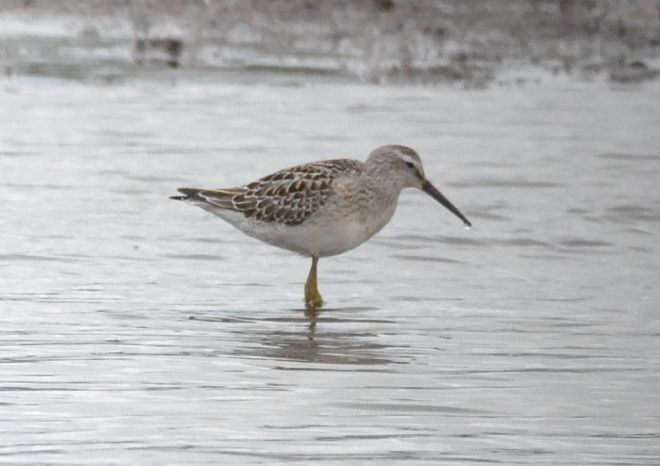
stilt sandpiper.1711 lodmoor

Stilt Sandpiper (juv) at Lodmoor

Strong winds on Monday had also brought in numbers of Grey Phalarope nationally, including one in north-Oxfordshire that I went to see. Walking away from there was Ewan, fresh from an epic outer Hebrides twitch to connect with the North American passerine of the autumn so far (see here). I told him of my plans for the morrow and he at once expressed an interest. With another storm set to batter Blighty through the intervening night it seemed hopeful the Dorset scarcities would not move on too soon, and so it transpired.

On the journey down my passenger checked the bird news at intervals. The overnight squalls had deposited many more Grey Phalarope at inland sites across England and Wales, including two more in Oxfordshire. Sabine’s Gull, Leach’s Petrel and other pelagics were being reported from all round the west and south coasts by those dedicated or dour enough to sit out in the conditions and log them. But there was nothing new of significant interest to myself.

lodmoor.1702

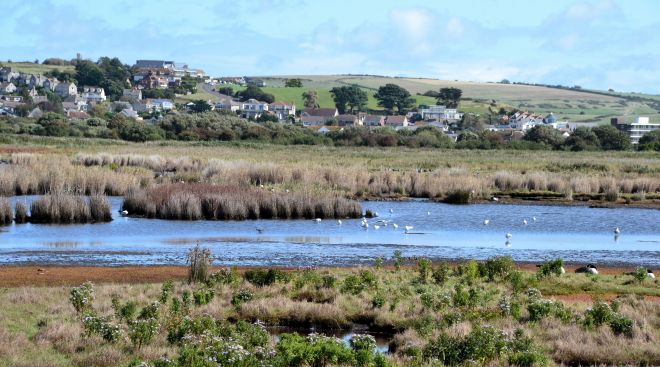
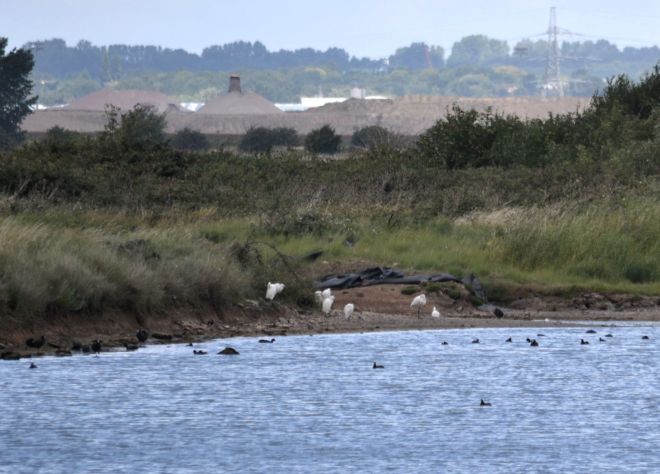
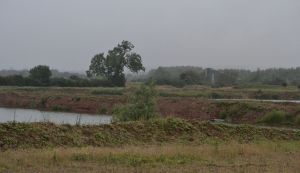
The Stilt Sandpiper location at RSPB Lodmoor

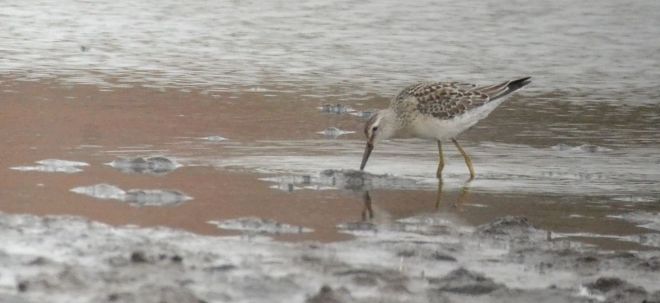
We arrived on site late morning and the first birders met to the north of the reserve confirmed the Stilt Sandpiper was showing well at the location being cited on RBA. On our reaching that spot, at Lodmoor’s western edge the connect was immediate. The Stilt Sandpiper had a quite distinctive, generally pale appearance. Around one-third of the way between Dunlin and Redshank in size, today’s pristine juvenile displayed attractively scalloped upperparts and light breast streaking with a prominent supercilium (eye stripe) and down-curved bill. And then there were the long yellow legs, hence the species’ name. This was a very pleasing package all round. Juveniles are an extreme rarity in Britain, with most of the species records over the last 15 years thought to relate to the same couple of passage adults.

The bird was feeding in the middle distance amongst Redshank and Black-tailed Godwit. On our last successful twitch for a Marsh Sandpiper in Kent (see here) I had made the mistake of leaving my new Swarovski digiscoping collar in the car. This time I made sure to take it with me and though the results (below) are hardly sharp they illustrate this expensive piece of kit’s potential. I could have secured half-decent images on that other occasion had I not been so careless. On my right Ewan machine-gunned away using his 400mm Canon telephoto with 1.4 converter. To assess the outcome see here, not in any competitive way I stress but merely to compare technologies.

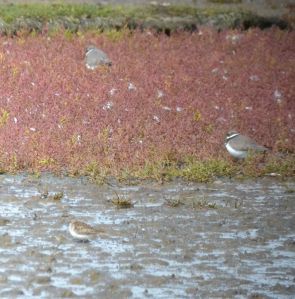
With the more important (for me) of the two visitors in the bag we moved on to observe the day’s second bird. The Least Sandpiper had relocated to the eastern end of Lodmoor and we came across it associating with two Ringed Plover. The juxtaposition emphasised just how tiny this true dwarf of the accidental small Sandpipers is, just 13cm in length. It would have been impossible to record this bird (below), also a juvenile feeding on rather distant mud without the disgiscoping collar. For a good picture of this bird see here.

least sandpiper.1703 lodmoor

Tiny Least Sandpiper (front left) with Ringed Plover

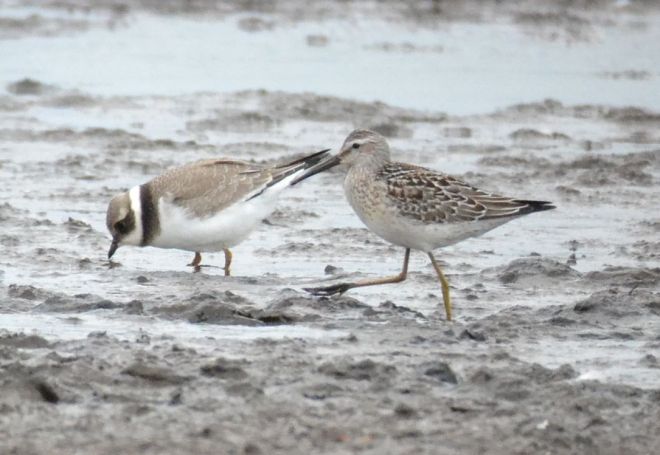
With both waders now seen well we could relax and enjoy our surroundings at this superb reserve. These were my third and fourth Nearctic waders at the site, where I had previously recorded Long- and Short-billed Dowitchers in November 2010 and September 2012 respectively. We next returned to the first spot to get more of the Stilt Sandpiper that had moved closer to the path. In the improved light the bird was moving around an area of subtle contrasts and I am quite pleased with these images. This is the first proper workout I have given the digiscoping collar and I must remember to take it with me in future.

stilt sandpiper.1731 lodmoor

Stilt Sandpiper (juv)

stilt sandpiper.1734 and ringed plover lodmoor

Stilt Sandpiper (right) with Ringed Plover (juv)

stilt sandpiper.1737 and knot lodmoor

Stilt Sandpiper (left) with juvenile Knot

Below are more digiscoped pictures of some other interesting birds observed today. It had been a hugely enjoyable excursion that was only slightly spoiled when Ewan found on Twitter that another sneaky Oxon birder had got down to Lodmoor on Tuesday afternoon and blogged his account first. Really, some people have no shame! Adam’s experiences of the twin attraction (see here) seemed broadly parallel with our own.

So perhaps my recent birding fortunes have taken a turn for the better now. Things began at Oxford’s Farmoor Reservoir on Monday evening (11th) while I was in a hide with two other Oxon birders being grilled about some kind of year list it’s rumoured I keep in the county. Asked what are the two most obvious birds I have yet to see locally in 2017 I replied Ruff and Whimbrel. At that point three medium-sized waders flew past and I called: “What are those?” “They’re Ruff!” replied my companions in unison. This was a very minor occurrence but on such nuances perhaps can sequences of luck change.

When I got home the first of the three Grey Phalarope had been reported on Oxon Birding, and an exhausted Manx Shearwater had landed in someone’s garden north of Oxford. Things were picking up in the county and the following morning so it seemed nationally too. But first I went to Banbury’s Grimsbury Reservoir (SP460420) for the Phalarope, since if I was actually year listing I would need to see it. This is the third consecutive autumn in which we’ve had these ocean going waifs in Oxfordshire, and as usual the bird was very fearless probably having no prior experience of humans.

I am not used to seeing Phalaropes standing out of the water and so am particularly pleased with the first three pictures. They were taken through a wire mesh boundary fence, but at one point an angler laden with all his gear strode along the water’s edge right past the bird and it barely moved. That was incidentally most considerate of him as he could see what I was doing, but no doubt he pays to be there and birders do not.

Being out and about relaxing with the camera photographing insects has been very enjoyable through the summer, but the buzz that goes with having birds to see is something extra. Here’s hoping for more life list additions nationally in the autumn weeks ahead.

Moorland Hawker and other late summer dragonflies at Priddy Mineries, Somerset – 28th Aug

The last weekend of August produced a break in the month’s hitherto unceasing Atlantic weather and so I took the opportunity to complete my insect agenda for this season. That was to have a better than previous experience of Moorland (or Common) Hawker dragonflies, and hopefully gain a picture of a perched male. The location for observing this species in southern England is Priddy Mineries atop Somerset’s Mendip hills. And most importantly I had read online of people actually capturing perched images there, which is very difficult to do because these insects rarely settle.

I had been waiting throughout August to make a first visit to what is by repute a superb odonata site, but first I had some local birding business to attend to. My day began at Oxford’s Farmoor Reservoir where eight juvenile Shag had roosted overnight. This was the first county record in six years and were I to be year listing in 2017 I would need to see these birds. In the event they were rather attractive and I spent a respectful amount of time in their presence while indulging in parochial chit chat and banter. Not for the first time I was called sad for my love of dragonflies. Then I left my Oxon birding colleagues to count the first winter scapulars on some distant passing gull or tern, and set off to do some real wildlife watching.

moorland hawker.1701 priddy mineries

Moorland Hawker (male)

Priddy Mineries SSSI (ST547515), a former lead mining area is a mosaic of heather and grassland, valley mire, open water and acidic pools. The site’s industrial past, from Roman times up to the early 20th century, has left a landscape of mounds and hollows that now host more than 20 species of damsel and dragonfly, as well as uncommon flora and important amphibian populations. On my arrival I parked in a lay-by overlooking the site’s main lake (pictured below) that in the pleasing early afternoon light suggested odo excellence.

This slideshow requires JavaScript.

Walking away from the car I at once began to notice Black and Ruddy Darter (pictured below) in the long grass. Then upon my reaching the water’s edge a female Moorland Hawker announced herself, and was quickly followed by a first patrolling male. As I made my way around the lake to it’s far side, where the sun would be behind me, other large dragonflies were on the wing: Brown and Southern Hawker and Blue Emperor, all with their distinctive jizz that I sat and appreciated for a while. In amongst them more occasional Moorland Hawker looked rather non-descript by comparison, with dullish brown and blue hues but distinctive yellow patterning on the thorax.

At the sought for spot it was readily apparent this was Moorland Hawker territory, and so I sat on a convenient tussock, watched and waited. Several males were all competing for space here. These have a very restless flight pattern, being constantly on the move and indifferent to human presence. They show broad yellow stripes on the sides of the thorax, while the antehumeral (top side) stripes are narrower than in Southern but still much bolder than Migrant Hawker. The bright yellow costa (front edge to wings) is another very apparent diagnostic. When errant Southern Hawker entered the fray from time to time their own brighter blue and green patterning was obvious by comparison, as was the iridescence of occasional passing Emperor

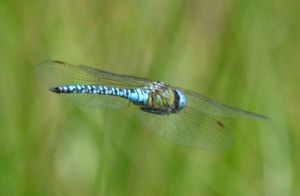
My previous experience of Moorland Hawker was all at a true wilderness location in Hampshire’s New Forest, Ashley Hole (see here and here). There the few males encountered would fly in strongly then around the same circuit over and again without pausing. Today’s dragonflies seemed to favour smaller circuits, flying low over and in amongst the water side vegetation. They hovered frequently, allowing many flight shots my best of which are below, but as expected did not settle in the lakeside willow scrub that I was staking out.

Unlike Ashley Hole, that is at the back of beyond, there was a degree of disturbance on today’s bank holiday afternoon. Initial peace and tranquillity soon acquired the usual accompaniment when dragonflying of splashing dogs and calling owners, and two groups of anglers set themselves up. Later in the day I went back to the car for a power nap, then returned to the same spot in the hope that one or more Moorland Hawker might perch in the aforementioned willows as the light faded.

I now acquired two companions with the same idea, one of whom like myself said no more than is necessary while concentrating on the task in hand. The other just could not stop talking, and eventually I retreated to a safer distance from the one way barrage on every photograph ever taken, the birds seen on each foreign trip and what his best shots were. I had waited four years for the pictures I was seeking, and four weeks for this day’s opportunity, and the edge was definitely being taken off what might now be the climactic moment.

moorland hawker.1702 priddy mineries

Moorland Hawker (male)

All the while the Moorland Hawkers continued in their same way, fluttering and hovering around their chosen circuits and challenging one another without perching. When they did settle now and again it would be tucked in on the blind side beneath water’s edge tussocks of long grass. Yes there are a lot of them at Priddy Mineries so the better experience I wanted was gained. But as with Downy and Brilliant Emeralds at Warren Heath (see here) earlier in the season those much sought perched photo portraits will have to wait for some or perhaps a long time yet.

Butterfly therapy: a celebration of roosting Blues + Silver Spotted Skipper – 14th Aug

Two days ago, having paid very little attention to downland butterflies this season, I made only it’s second visit to the Chilterns escarpment. Feeling confused and fragile in spirit after two gruelling shifts at work over the weekend, I needed to clear my head and spending more time extracting weeds from my wildlife garden wasn’t going to achieve that. So I went out to do some butterflies instead.

Conditions were lightly overcast as I walked out onto the noisy hillside above the M40 motorway at BBOWT’s Aston Rowant NNR (N) (SU733967). But plenty of butterflies were still active and I was at once reminded of the wealth of wild plants at the reserve. In the early years of this decade I would spend many days in summer wandering sites such as this, making counts of every species and taking bad, grassy pictures. But there are only so many British butterflies to record and hence more recently that enthusiasm has waned. Last year it had been difficult to get motivated at all, but it would have been a pity to pass by the late summer specialities in 2017.

adonis blue.1702 aston rowant

Adonis Blue (male) on Parsley sp

The pale, floppy forms of Chalkhill Blue were immediately apparent, keeping low to the ground and striking up many a grassy pose that I ignored. The objective now is always better, premium pictures but flower-head studies of this downland specialist were less likely in the cool breezy weather. All around tiny Brown Argus (pictured below, right) ghosted about in the long grass as they do, always hyperactive and fiercely territorial. And a few fiery Small Copper (centre) stood out in places. Meadow Brown numbers are now waning but here some were still in good condition (left).

Before long I began to come across Silver-spotted Skipper, one of the August specialties at this and other Chilterns escarpment sites. This diminutive, moth-like butterfly is often first seen buzzing about the downland sward in a blur or darting sideways from the observer’s footfall. When settled they have a pleasing penchant for intriguing poses on flower or grass heads and are always photogenic. Having many good pictures of SSS in my collection I tried to find new angles or back drops, without great success. Here (below) are my day’s better results, with some concession to grassiness.

But my heart still wasn’t in it, having done all this so often before. As I continued I pondered how when abroad I can become immersed totally in experiencing new and different (for me) butterflies and dragonflies so all else becomes unimportant. If it was possible to dwell all my existence alone in beautiful wild places, luxuriating in such communion with nature I could remain very contented. But the human psyche doesn’t work like that. Ultimately there is always the need for company and unsatisfactory involvement with one’s own kind; and so all the frustration, conflict and hurt that goes with it. More’s the pity but thus is life.

And so I walked on, the traffic noise from below being a constant reminder of that downside to life’s mix. Having crossed the prime SSS area I climbed back to the top of the hillside then walked all the way back down, directly through the hotspot for Adonis Blue but without finding any of the latter. It was now around 4:30pm and conditions were becoming duller and cooler with the imminent onset of light rain. Then an episode unfolded that illustrated most aptly why indeed I still do this, and made the afternoon out worthwhile after all.

In a sheltered spot near the foot of the hillside I first noticed a nicely posed female Brown Argus (pictured above) in a large clump of Knapweed, then became aware of other roosting Blues in the vicinity. Brown Argus is indeed a species of Blue. Was she aware of the smaller male behind her? I expect so and also that he had things on his mind. A kind of dance then ensued as the pair seemed to assess one another tentatively, but then she flew to one side leaving the male to his own devices. A case perhaps of faint heart ne’er winning fair lady.

I next became aware of various Common Blue all roosting in the straggly, swaying vegetation. And the more I looked the more there were to find. This is a butterfly that in my experience is difficult to capture pictorially well, too often appearing fuzzy somehow in top wing and washed out in underwing studies. But on this occasion they just seemed to stand out in the failing light, and with the right exposure compensation I was able to gain my best ever premium pictures of the species (below). Hence I remained here for some time, re-motivated once more and relishing a reminder that insects can and will deliver new variations on the old experience if sufficient time and patience is expended in the field.

A photo-celebration of roosting Common Blue butterfly

Here and there butterflies were concerning themselves with rather more than roosting. The rhythm of insects actually pumping away is always sensuous to behold, well it is sex after all. This mating pair of Common Blue (pictured below) were getting things on with gusto and loving it. Images as good as this cannot be planned or anticipated, they just leap out and happen now and again. And so the picture opportunities continued to improve.

Having done Common Blue justice I next went in search of other roosting Blues, capturing first a male Chalkhill Blue on an enticing flower head (below, left) and finally a male Adonis Blue (right). The full set of Blues for the site had thus all contributed to what was ultimately a rewarding exercise, and I returned home to the editing suite feeling partly refreshed but still world weary.

At the petrol station last night I was back on form behind the counter. Pleasant to deal with customers made a comeback against the inky grunters and pushing, impatient obnoxiae; and there were no technology issues that I couldn’t deal with. And so I awoke this morning with a different kind of warm glow from that other essential communion with people. But thank heaven for butterfly therapy!

Late summer Hairstreak and Hawkers at Rushbeds, Bucks – 10th Aug

Today offered a window in what has been more than three weeks of conveyor belt Atlantic weather since the previous insect post in this journal. My choice was to try to track down some Brown Hairstreak butterflies at a new and different location, and in the process hopefully photograph Southern and Migrant Hawker dragonflies that are also on the wing at present. When I visited BBOWT’s Rushbeds reserve in the first days of July (see here) I had noted some areas that looked like ideal habitat for Hairstreaks and resolved to check them out later in the season. So that was where I headed this morning.

The soggy second half of July and start to August has been good for my wildlife garden at home, that is currently under re-establishment, but not so for getting out and about. It must also have helped Brown Hairstreaks that having emerged early this year in common with other butterflies, will have suffered less of the harassment they always endure with the change in the weather. After all butterflies are quite capable of getting on with reproducing their species away from human gaze, whatever the conditions.

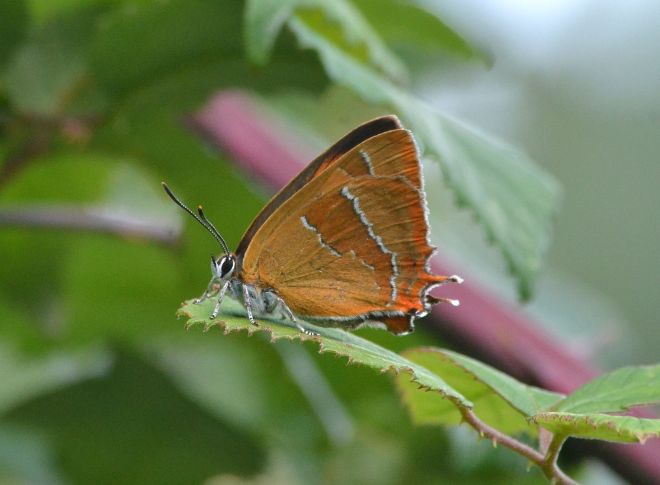
brown hairstreak.1706 fem rushbeds

Mission accomplished – premium Brown Hairstreak

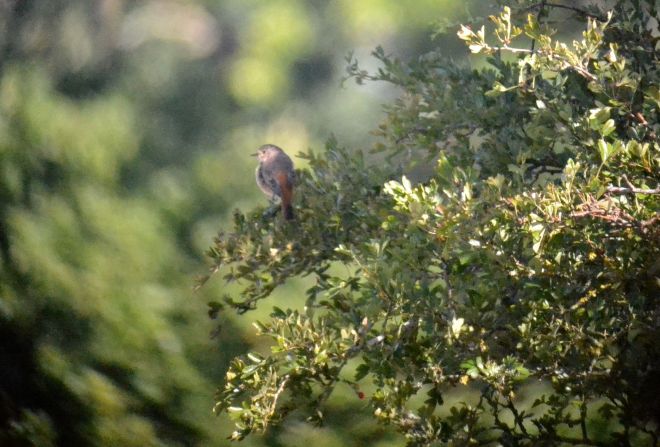
I started the day at Oxford’s Otmoor RSPB “home for nature” where the yearly Hairstreak bun fight has resumed in earnest during recent rain breaks. But that situation may also be of wider benefit if the destructive attentions of butterfly tourists can be concentrated at one welcoming site. My reason for going there was to see Common Redstart on land adjacent to the reserve these birds frequent at this time of year. I found two females and in making a complete hash of photographing them gained one of those images (below) that look more like a painting but to me are strangely pleasing.

common redstart.1701 otmoor

Female Common Redstart in oils (or dodgy record shot?)

On waking to fair weather I had just wanted to get up and out and there was no point in going to my insect destination too early. In the event I lost time due to a road closure and HGVs not being able to pass one another on the diversion around it. So it was not until 11am that I arrived at the southern edge of Rushbeds Wood (SP672154). Here there is a lot of Blackthorn, the BH food plant and bramble banks; and the hedgerows were bursting with an abundance of autumn fruits. It didn’t take long to come across a first Migrant Hawker dragonfly in its immature colouring (pictured below).

migrant hawker.1703 imm male rushbeds

Migrant Hawker (immature male)

This was one of the forms I most wanted to capture today. It is still early in this autumn hawker’s flight season and many of the insects being observed will be of this brown and mauve, grey-eyed appearance. In early July it had been the emergent Southern Hawker that were in their own immature colours, now today along this woodland edge I encountered several brightly patterned adults, both male and female (below).

Through all this I was careful not to trample habitat, only treading where other people had already trod, not moving around too much once on a subject and always trying to look where I was putting my feet. I would like to think of this as a best practice model. After walking in such a way as far as possible to the western edge of the reserve, I retraced my steps then continued to the east of the exit gate from the woods. This looked even better for Brown Hairstreak with huge, mature Ash towering above extensive stands of Blackthorn and a brambly under storey.

I was at this point joined by a Butterfly Conservation transect walker with whom I am acquainted. He confirmed this is indeed a site that is both managed and regularly monitored for BH, but neither of us saw one today. Of the butterflies that were on the wing the few remaining Silver-washed Fritillary (top left, below) were very worn, quite a contrast to their majesty in June and July. Meadow Brown and Gatekeeper were still active but the myriad Ringlet of mid-summer were all gone.

Some butterflies always seem to photograph well and others not. Green-veined White (bottom right, above) are definitely in the former category. This second brood individual shows bolder patterning than the paler insects seen in spring, and the rather striking veining with creamy yellow highlights and pale green eyes always seem to stand out from a suitably subtle backdrop. Common Blue rarely make a good top-wing picture, but the underwing shot (bottom left) was worth saving. The top right picture is the drab form of female Common Blue Damselfly, yes really and always an interesting variant to come across.

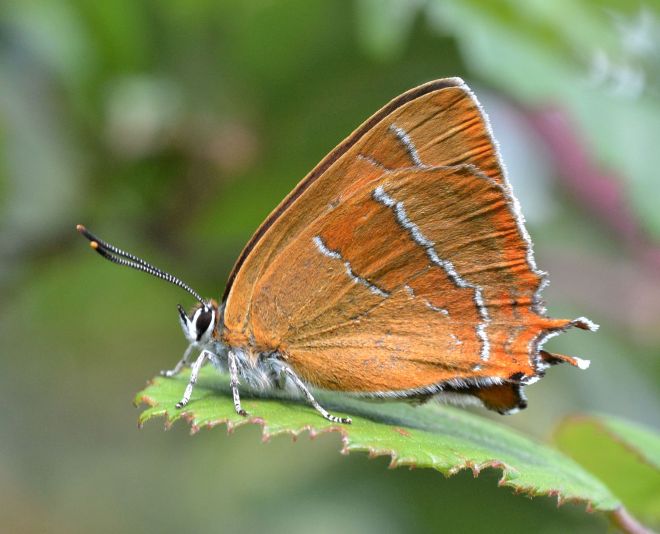
It was now early afternoon and I next walked the main ride through Rushbeds Wood without observing anything more of note. At the northern end of the reserve lies a wild flower meadow that is surrounded on three sides by Blackthorn hedges. In mid-summer this area teems with common grassland butterflies but by this time of year it has been mowed. As soon as I walked through the gate from the northern edge of the wood a small brown butterfly flew up from the grass at my feet into a hedge to one side. This looked promising and indeed I was connecting with a fresh female Brown Hairstreak.

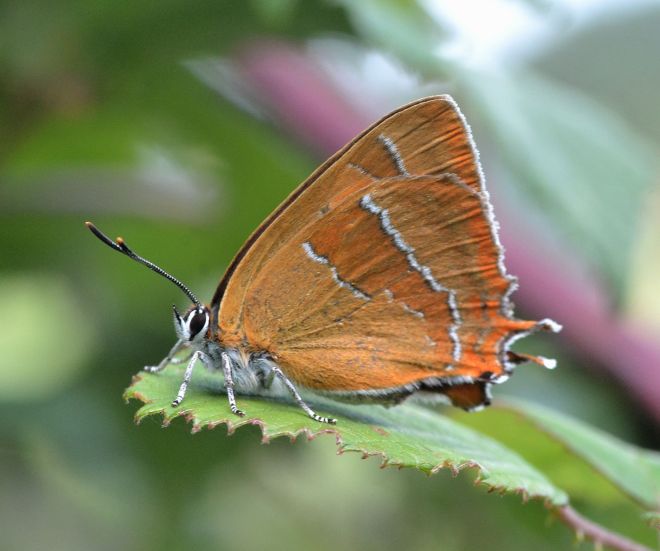
brown hairstreak.1701 fem rushbeds

Oh you beauty – female Brown Hairstreak

Almost at once the sun went in and a cool breeze blew up. As a result my butterfly kept stock still for some time just inches from my admiring gaze, glistening in all her pristine beauty. I changed to my macro lens, set my entry level Nikon to its freeze the action sports setting, then commenced upon the kind of peaceful communion and oneness with an insect in the field that I most crave. This is only possible when butterflying or dragonflying alone. If insects are not chased about, surrounded and jostled they will give of themselves freely in this way. I have enjoyed dozens of such encounters at the back of beyond in Portugal, Cyprus, Morocco, the south of France and elsewhere and today was just the latest such occasion.

brown hairstreak.1704 fem rushbeds

And a little closer … but she doesn’t mind

It wasn’t going to get better but I still walked a quick circuit of the meadow without seeing any more Brown Hairstreak, before returning through the wood to my start point. This had been a most rewarding day out. I had encountered all my sought after wildlife whilst crossing paths with just one expert naturalist and two genial dog walkers. After rather too much recent rain whatever the benefit to my garden, it goes without saying that I returned home with spirit well and truly refreshed.

Marsh Sandpiper and Black-winged Stilt at Cliffe Pools, Kent – 31st July

Having followed reports of a juvenile Marsh Sandpiper on the north Kent marshes for the last few weeks, now seemed a good time to go to see it. This is an eastern European and taiga-breeding wader that I had recorded previously in Cyprus in 2012, so it would be a British list addition. But as most citations on RBA stated the bird was being observed distantly, I waited until there was more of interest at the site to make a day out worthwhile.

The RSPB-managed Cliffe Pools reserve (TQ721769), on the Thames estuary just east of Gravesend has a mixture of big salt water lagoons, fresh water pools and grassland; with a network of visitor trails. It attracts large numbers of waders and wildfowl and has hosted other scarcities such as Lesser Yellowlegs and Terek Sandpiper in recent years. This is one of three English sites where Black-winged Stilt have bred in 2017, and as the end of July approached Spoonbill, more than 1300 Avocet and 1700-plus Black-tailed Godwit were all present here.

marsh sandpiper.1201 akrotiri

Marsh Sandpiper, April 2012

Hence the time seemed right for a visit, but having dipped three out of my last four national birds – a female King Eider duck in mid-Wales being the most recent – I needed a talisman to change my luck. Ewan duly obliged, accepting an invitation to partake of a little Mediterranean birding in soggiest English July. We arrived on site late morning and set out to find “Radar Pool” where the Marsh Sandpiper was being reported on RBA.

I soon became distracted by the numerous Migrant Hawker dragonflies along our route, while Ewan strode on ahead as is his wont. When I caught up with him he was talking to three local birders who put us onto the Marsh Sandpiper: a talisman indeed and an immediate connect! Our target was associating with two Greenshank and somewhat resembled a smaller version of the latter. It is just about visible in this picture (below) along the shoreline, right of the furthest right Egret; but I really should have brought my digiscoping kit. For a comparison photo published on RBA recently see here.

cliffe pools.1703The bird then moved through a gap onto a larger lagoon to the east of Radar Pool and gave us good if always distant views. I recalled at once the species’ delicate jizz from my experiences five years ago at Phassouri Marsh on Cyprus’ Akrotiri peninsula. MS is between Wood Sandpiper and Redshank in size, with a very fine dark bill, slim body and neck, and long spindly legs. It has a dainty walk and rather deliberate downward dabbing bill movement. The species inhabits grassy lowland marshes and pools and migrates through eastern Europe to winter in Africa, the southern Middle East and India. There are typically several British records each year.
This slideshow requires JavaScript.

From our second viewpoint large concentrations of Avocet and Black-tailed Godwit were indeed visible, as well as two Spoonbill and numbers of Little Egret and common waders. It now remained to find the Black-winged Stilts, and the local birders directed us to where they had last observed them. But as we walked around the reserve’s perimeter track a Peregrine put all the waders up, so a bit of a search ensued. Ewan forged on ahead again and when I eventually re-joined him he had located the family party of seven Black-winged Stilt from the northern edge of the marsh.

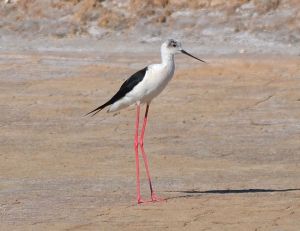
Two pairs have fledged seven chicks following long term habitat creation work (see here). This was my third British encounter with a rather special water bird that I have watched on numerous occasions in southern European wetlands. It would be difficult to tire of such a beautiful, even exotic looking species : tall, slim and elegant with those endless red legs that seem barely capable of supporting the body weight. As with the Marsh Sandpiper the birds were too distant to photograph, so here instead is my best archive picture from Tavira marsh in Portugal. For recent pictures of the Kent birds see here.

black-winged stilt.1410.tavira marsh

Black-winged Stilt, May 2014

This had been a very satisfying day out and the extensive marshland reserve of Cliffe Pools had not disappointed. The vast open spaces and untroubled environment for birds here reminded me of Alkborough Flats on the Humber estuary where I went to see a Purple Gallinule last October (see here). For me there is just too much going on at many Royal Society for Populist Birdwatching (RSPB) reserves for visiting them to be enjoyable. But today’s more tranquil site is how I prefer things to be and testimony to all the fantastic conservation work the charity undertakes, before the mass marketing that funds it all sets in and spoils everything. If only there was another and better way.

migrant hawker.1701 imm male cliffe pools

Migrant Hawker (immature male)

Everywhere around the visitor trails today there were reminders of approaching autumn: flowering Buddleia, ripening Blackberries and newly flying Migrant Hawkers. I had gained one more bird on my British list and hope the summer’s bad run of form is now over and more new birds will be added in the shortening days of the passage season ahead.

Blue-eyed Hawker and Scarce Emerald at Canvey Island, Essex – 13th July

The county of Essex where I grew up has some choice odonata specialities, two of which prior to yesterday I had recorded just once each. These are Blue-eyed (or Southern Migrant) Hawker dragonfly and Scarce Emerald damselfly that occur in marshlands along the northern shore of the Thames estuary. When both were reported last weekend from a particular drainage dyke on West Canvey Marsh this was an opportunity to experience them properly. I had seen just one deformed individual of the first-named before (see here), while the latter was a matter of removing all doubt.

This is the fourth season since Blue-eyed Hawker arrived in England around here. When news got out from Wat Tyler Country Park on the southern outskirts of Basildon in 2014, the odo equivalent of a mass twitch ensued. Prior to then there had been just three national records. In mainland Europe the species is present permanently only around the Mediterranean, but there can be influxes further north in hot summers. It’s range in Essex has expanded somewhat since 2014, thankfully since a country park in the school summer holiday is not an ideal environment for serious observation.

I parked at South Benfleet railway station and walked out across Benfleet Creek, arriving on site just before midday. Opposite a local authority recycling facility a public footpath gives access to a stretch of sea wall (TQ779852) to the southern side of which lies the ditch in question. It didn’t take long to encounter a first Blue-eyed Hawker (pictured below): a medium sized, bright blue hawker with even more vivid blue eyes. Even by dragonfly standards these are seriously beautiful creatures, if a little prone to grassy poses.

The weekend post on the BDS sightings page cited more than 30 males along the length of this dyke. I continued to walk westwards and began to see Emerald damselflies as well, but were they of the right variety? I had forgotten to read up on the diagnostics before leaving the station car park, but now some of it came back to me and on the back of the camera these insects looked right for Scarce Emerald. Company arrived at this point in the form of two more odo hunters, one of whom said this was the place to see what is a highly localised damselfly 20 years ago. But both were much more interested in the star hawkers.

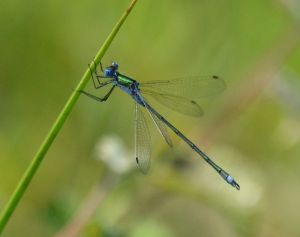
On reviewing my pictures (below) they all showed the correct characteristics for Scarce Emerald. Abdominal segment 1 and half of 2 are blue, with two darker spots on the blue part of segment 2. In Common Emerald both segments are plain blue. The second key diagnostic is the inner anal appendages that in Scarce Emerald are broader and more inwardly curved than for common. Brooks and Lewington also cites squarer shape of the pterostigma (black wing tags) and brighter blue eyes.

It had been much easier to identify this insect positively here than at nearby RSPB Bowers Marsh a year ago (see here). Then just one or two had been mixed in with Common Emerald and were in immature colouring. There were many more at the Canvey Island site this time as the BDS sighting had stated. So all doubt concerning what was the final species on my English damselfly list has been well and truly removed.

I next continued searching along the dyke for more Blue-eyed Hawker, counting 12 males on the walk out but there seemed to be more on the way back. One of the people I spoke to had counted 21, so between 20 and 30 at this site seems a reasonable estimate. I only hope there are females around too so this most attractive dragonfly can continue to establish itself, but I didn’t see any mating pairs on this visit. What I did see at intervals were hovering males at head height, patrolling up and down the ditch.

blue-eyed hawker.1706 canvey island

Blue-eyed Hawker (male)

blue-eyed hawker_01.1709 canvey island

BEH has a penchant for hovering, keeping still for relatively longer than other hawkers, which makes it easier to photograph. The upper picture, above was the icing on the cake of a pleasing experience, while I also like the lower capture of the dragonfly through it’s own wings. It is always a bonus to obtain flight shots. This had been a fairly brief visit of around three hours, in between peak periods on the M25 motorway, and I would like to come here again for longer in the future. With more reports getting out on-line I suspect this site will be very well attended this summer.

A Black Darter in Berks and much more at Decoy Heath, Pamber Forest and Silchester Common – 6 & 10th July

I always enjoy a visit to the heathlands of the Hampshire basin lying between the old A4 and A30 trunk roads, since in Oxon we do not have this habitat in which much special wildlife can be found. Last Thursday (9th) after concluding my butterfly business in Pamber Forest I moved on to BBOWT’s Decoy Heath reserve (SU613634) a little to the north, to see if any Downy Emerald were still about. This is a hidden gem of a place and one of the best odonata sites in Berkshire with 23 species having been known to breed.

There are three large ponds here, one of which is now seriously off-piste, and other areas of shallow surface water that often dry out. I didn’t find any Emerald dragonflies this time but Common Emerald damselfly (pictured below), a site speciality were much in evidence. These long-bodied, metallic green and blue damsels struck up some nice poses as they are wont to do, being an insect that rarely disappoints.

common emerald.1701 decoy heath

Common Emerald damselfly

At the most open of the ponds I was surprised to find a lone male Black Darter (pictured below), my first ever record at this site. The closest to home I had observed this acidic heath-dwelling specialist before was Thursley Common in Surrey, so this was a very welcome find. I view these dark and diminutive darters with their rock star shades of eyes as rather dashing and mysterious. This individual remained faithful to the same perch from which it ventured out and returned continuously. So it could only be photographed into the sun, though that did make for some interesting Chernobyl effects.

Another first for me here was White-legged Damselfy (pictured below), a further site speciality. So many damsels are difficult to capture well, but this species has a nice knack of settling against interesting backgrounds. The pastel tones of blue, green and brown are both unmistakeable and to my mind very enticing. Other odo species observed on this visit were Blue Emperor dragonfly, Four-spotted Chaser, Ruddy Darter and Common Blue Damselfly.

Four days later on 10th I returned to try to photograph the Black Darter in a better light. Conditions were now cooler and upon my reaching the pond he was the first dragonfly I found, perched on a protruding stick (pictured top right, below) some distance from the location favoured first time around. I then spotted another male, but on checking out the first perch again realised this was the same individual moving between the two. Thereafter he frequented an area of rushes close in to the nearest shore (other pictures, below) and with the sun behind me that was mission accomplished quite nicely.

As on my earlier visit, this appeared to be the only one of its kind on site, though the species is a wanderer and often occurs at non-breeding locations. It was notable how the resident four-spotted enforcers and big boss Emperors seemed to leave the dark vagrant alone. Indeed my Black Darter was most often displaced by Common Blue Damselfly. In addition to those species already noted, Brown Hawker, Black-tailed Skimmer and Large Red Damselfly were also seen this time. And once again Common Emerald and White-legged Damselfly offered themselves to the camera well (pictured below).

This is the site where odo watching all began for me. Several seasons ago I came here looking for Grayling butterflies and ran into an Oxon birder who had just seen a Brilliant Emerald. He suggested I get into dragonflies too and I replied they don’t keep still for long enough. Then he said: “That’s the challenge”. A couple of years later I took up his advice and the outcome has been endless hours of motivation and enjoyment.

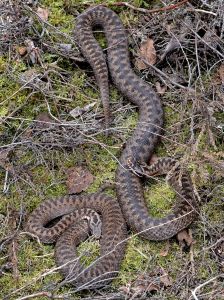
Decoy Heath also has an important population of Adder that is sustained by BBOWT’s habitat management. I came across this contented couple (below) absorbing what warmth was on offer, before they realised there was company and slid back into their burrows. I presume the smaller snake in the foreground is the male, since females are often much larger. It is always good to get reptiles into this journal … I just adore ’em!

adder.1701 decoy heath

Mr and Mrs Adder

I next explored some interesting footpaths to the immediate south through what is an extension to the ancient woodland of Pamber Forest. I don’t usually bother with moths in the field, on the reasoning that trying to pay attention to everything is too distracting. But a Black Arches (below, left) roosting on a tree trunk just caught my fancy. It is a common woodland species in southern England.

In the afternoon I went back to Pamber Forest but this time instead of heading south from the usual parking area (SU616621) I walked eastward into what is known as Lord’s Wood. Then I reached an area through which a brook flows that floods to form a large pond in especially wet times. This I understood to be a prime location for Common Goldenring dragonfly. While scanning for them from a low wooden footbridge a Holly Blue (above, right) began foraging around the stream bed beneath. Though a common or garden species this butterfly is somehow easy to overlook and tricky to capture, so it is always good to add another image to my collection.

I was at this point engaged pleasantly by a quite exceptional dog walker who actually took an interest in what I was doing rather than talking at me about her dog. As we chatted a Common Goldenring appeared below us. But though I caught two more glimpses this dragonfly didn’t patrol the stream bed for long and I could not relocate it. Numbers of Beautiful Demoiselle were also active in this place.

It remained to pay my annual respects to the Silver-studded Blue (pictured above) on neighbouring Silchester Common. The hotspot for these tiny blues is at the northern end of that heath near a classic car dealership (SU621625), but today I walked in from the village of Pamber Heath to explore a little more widely. This is a declining butterfly restricted to southern English heaths, but locally very numerous. At the peak of their June to August flight season the ground here can seem alive with SSB in places, but today things were strangely quiet.

Eventually I came across a very small number of females and glimpsed just one male. The preference in photographing all heathland butterflies is to capture them on Bell Heather, as in the right hand image. After some patchy attempts the sun went in just as I took up position over the miniscule female pictured. This insect then remained so still for so long I was able to completely re-educate myself on f-stops and other camera settings in the search for sharper images. The results are quite pleasing, but I was puzzled as to why so few SSB were on the wing here today at what has been a prolific site on some past visits.

These had been two more very pleasant outings with the camera just relaxing and seeing what could be found. If there is no particular agenda much more time can be focussed on gaining better quality images. And as always I returned home to the editing suite at peace with the world, with my spirit refreshed.

European Bee-eaters at East Leake Quarry, Notts – 29th June

This excursion owed most to the need to hit the road and see something after weeks of limited national birding options. I have seen any number of Bee-eaters in southern Europe (pictured below), where to my mind this is one of the most charming and evocative of summer visitors. So with up to seven birds present 110 miles from home in the East Midlands all this week, putting the beautiful EBE onto my British list offered sufficient motivation for a much needed day out.

It seems plain that small numbers of these birds have been roaming England this summer, being a species that is tipped to expand its range northward due to climate change. Indeed some passed through Oxfordshire in late May but were seen for around eight seconds by just one sharp-eyed patch worker. Since last weekend a cluster has been frequenting an active gravel extraction site East Leake Quarry (SK564248), a little to the north of Loughborough and fairly close by the M1 motorway.

east leake quarry.1701

East Leake quarry on a dull and damp day. The Bee-eaters favoured the large Ash tree in the centre

I arrived there late morning in drizzly conditions and was surprised by the number of birders cars parked in a roadside lay-by and an RSPB-stewarded field opposite. ‘Well if there’s this many people here the birds must be showing,’ I thought. But on reaching the viewing area close to the quarry (pictured above), I was told they had flown off around 40 minutes earlier. Recollections of recently dipped Marsh Warbler and Elegant Tern stirred inside me but there was nothing to do but wait.

After about 20 minutes a first European Bee-eater was called and pretty quickly five birds alighted into the trees pictured below, left. The right hand photo is intended only to convey how this tick for blighty was first seen by myself. The unfolding action was viewable just from a limited area, and this prompted some chuntering by people standing further back who seemed to expect an unrestricted view. I was reminded of last autumn’s Dusky Thrush twitch in the Peak District, so maybe such grumpiness is a matter of dealing with dour Derby folk.

In the meantime Adam had arrived on site, and we stood around chatting about Oxon birding matters, insects and plants to occasional disapproving glances, until the Bee-eaters chose to show themselves more openly. Eventually, at around 12:45pm three of the birds settled in dead branches at the crown of the Ash tree featured in many of the published pictures on RBA (see here). Now everyone present could see them well, as had been the likelihood all along, and they proceeded to put on a bit of a show.

I just love the way multi-coloured Bee-eaters move and sound and nothing else resembles them. Time and again the three birds here would glide out from their perches like over-sized hirundines to catch, well presumably bees. This was the first time I have actually seen them perched with prey in their open bills, that they would then knock against the wood of the tree to stun or kill before swallowing. In the light I was not going to get good pictures and so I used my digiscoping kit with my camera set to its highest ISO rating.

The edited results (above) resemble water colours and I rather like them despite their obvious lack of technical merit. As always they show how these birds were seen and prove that I am not making all this up. Adam and I left at 2pm though the Bee-eaters continued to entertain their audience until mid-afternoon and were reported again in the evening. It had been a little incongruous to watch birds so suggestive of balmy Mediterranean landscapes going about their business on a dull and dour English summer’s afternoon. But this is likely to become an increasingly frequent sight here and adding EBE to my own British list was a thoroughly worthwhile experience.

Addendum: On 20th July the RSPB announced that one of three active nests being guarded had hatched chicks. This represents only the third British breeding record in the last 10 years. See here for details. By 2nd August all three nests had hatched young but shortly afterwards it was announced they had failed and the birds left the site.

“Scorchio”: Emerald Dragonflies and more at Warren Heath, Hants – 17 & 19th June

The last three days have been the hottest of the year with southern England basking in 30 degree plus temperatures. So losing myself at a shady pond somewhere seemed a rather more sensible option than frying in my garden at home or indeed Pagham Harbour. Trying to secure more pictures of Downy Emerald dragonfly being the next item on this year’s insect agenda, I therefore headed off to the commercial forestry plantation Warren Heath in north Hants (SU774596), the best location I know.

Emerald dragonflies favour sheltered, acidic woodland pools such as this (pictured below) and rarely disperse far from the breeding site. Downies typically emerge over two weeks following the first prolonged warm spell in May, while the metallic green Brilliant Emeralds follow on three to four weeks later. The immature insects fly away at once into the surrounding woods then return to the pond as adults up to 10 days later.

warren heath.1702

A relatively cool venue on a very hot day

As I walked mid-morning down to two ponds at the southern end of this site, 2017’s debutant Silver-washed Fritillary butterfly appeared to one side of the track. The area just south of my destination had been felled recently, giving the immediate vicinity an entirely different character as it would. Then as the water surface came into view a first Emerald passed over my head and up into the trees above. And upon my reaching the eastern pond edge several more were immediately apparent.

I had not expected to find both Emerald species here on this day, but given the recent fine weather their flight periods are indeed overlapping, as they will into mid-July. It appears Downy and Brilliant Emerald are enjoying a good season in sunny 2017.  I found a spot where some photogenic natural perches were protruding from the water and sat down to stake them out. As any experienced odo observer knows securing images of perched Emerald dragonflies can involve a very long wait since they seldom do that at the water’s edge. When they do settle occasionally it is usually in nearby vegetation or up in the canopy. And so I have just three previous Downy pictures in my collection and none of Brilliant.

For the next couple of hours I watched the various individuals present carrying on with what their kind always does, patrolling the same zone over and over again fast and close to the water, while chasing each other about. There were no Four-spotted Chaser around initially and so they only had each other to compete with. The patrol flight is punctuated by frequent bouts of hovering though never for long. Hence I did manage to get some blurry flight studies, of which these (below) are the better ones.

According to Brooks and Lewington, males fly earlier in the day than other species and seldom occupy a territory for long before departing back into the woodland. The vacant zone is then quickly taken over by other males, of which several might time-share a relatively small area of the pond. All of this was borne out by my experience this time. It was very difficult to calculate just how many Emeralds might have been active here, though I certainly saw more than on any previous occasion today.

The lesson of all this is one just has to be lucky in finding perched subjects away from the water, and there is typically a very large area of vegetation in which to come across them. By early afternoon I tired of my unlikely goal and went for a wander. Crossing over to the far side of the pond that was in sunlight, Four-spotted Chaser were in command of territorial perches all along the shore. Occasional Blue Emperor and Keeled Skimmer were also seen.

Next I followed the stream that feeds these ponds. Along it numbers of Beautiful Demoiselle (pictured above) were flopping about and glistening in the sunlight, mostly males. But I digress. The season’s first White Admiral butterfly was on the wing here, along with more Silver-washed Fritillary. Foxgloves were everywhere and this rather dapper long-horn beetle (below, right) made for something a little different. Having checked my field guide I believe it is one of several similar species in the genus Strangalia maculata, for what that’s worth.

Eventually I returned to the original waterside spot with its protruding perches. But this side of the pond was now in shade, while the far side was in glary sunlight so the likelihood of securing meaningful pictures was receding fast. There were huge numbers of Large Red and Azure Damselfy everywhere at this site today, along with fewer Red-eyed and Blue-tailed. All of them were largely preoccupied with propagating their kind, that from time to time made practising with camera settings against the desired props more interesting.

The great enjoyment of a visit like this is just relaxing with the camera, recording whatever is seen without any particular agenda. Hoping to photograph perched Emeralds gave things a purpose, but once on site it was possible to spend hours just pottering around for no particular reason at all. Two days later I returned for more of the same.

This time I paid more attention to the woodlands away from the pond edge. A few times I caught sight of Emeralds heading off into the trees or flying above me, but on no occasion could I tell where they went. And so once more I opted to enjoy what was going on all around, rather than concentrating on what would be the frustration of attempting mission almost impossible. Along the feeder stream several Keeled Skimmer were active. The pre-mature males (pictured below) were still showing varying amounts of yellow in their colouration, and as always struck up some very pleasing poses.

Also present here were two Common Goldenring that would glide up and down their patch at intervals looking equally mysterious and spectacular. For me this is the daddy of English dragonflies and always magnificent to behold. They mostly kept in shade but this male (below) took a few passing looks at one sunny stream-bed perch and so I staked it out. Before long the insect settled and that was job done. I just love Goldenrings!

common goldenring.1702 warren heath

Common Goldenring (male)

A second observer then arrived who said he had been monitoring Warren Heath for the last 15 years. He confirmed the valley in which we were standing was indeed a long-established Goldenring location, though numbers of this and other dragonflies here are no longer what they once were. He also said that in all that time he had secured just one picture of a perched Brilliant Emerald. So that set down a marker!

I next explored a little further, walking away into a grassy area and then upstream until the habitat became a little too off-piste to attempt without more protective clothing. The main interest here was teneral (newly emerged) male Keeled Skimmer that provided some similarly satisfying images (below) to the adults.

Lastly I returned to the pond where on its sunnier side Black-tailed Skimmer made up the midsummer mix for the site. I captured this male (below) in an appropriately blue light, then just stood and took in for a while the continuous drama of that dragonfly, Four-spotted Chasers, Blue Emperors and Emeralds all harassing one another and competing for local supremacy in the early afternoon glare.

black-tailed skimmer.1702 warren heath

Black-tailed Skimmer (male)

Later in the day I moved on to the long pond at Bramshill Plantation (SU746632) to the north of Warren Heath. There the water level was higher than on my visit a year ago (see here) and hence there were less extensive marginal areas in which to observe dragonflies. So I completed a circuit of the water body mainly in tree cover on the off-chance of coming across a perched Downy Emerald, once again without success. So the objective that had brought me to this part of north Hampshire will have to wait a little or perhaps much longer to achieve.

A celebration of the Black Hairstreak: 7 – 10th June

This is an account of my quest to capture uncluttered images of a special butterfly. In Oxford we are not only blessed with the potential for finding more than 40 species within an hour’s drive of the city, but also with having one of Britain’s scarcest and most sought butterfly gems on our doorstep. I am referring to Black Hairstreak that occurs only in old woodland sites stretching from the outskirts of Oxford, north-eastward through Bucks’ Bernwood Forest complex into Northants and Cambridgeshire.

black hairstreak.1706

Mission accomplished – premium Black Hairstreak

This is an elusive butterfly with a short flight period, usually in the first half of June but possibly in late May after an especially warm spring. They are not easy to locate since most colonies, typically of a few dozen individuals occupy restricted areas of the woods where they occur, seldom moving far. On some days BH do not fly at all, preferring to rest out of sight in tree tops where they feed on aphid honeydew. But depending upon the availability of that sweet, sticky secretion they will also come lower to nectar on wild flowers such as Bramble, Dog Rose and Privet that grow amongst the Blackthorn food plant. Then these butterflies can compensate for their more usual inaccessibility by being very approachable.

In their regular Bernwood Forest strongholds, Black Hairstreak have been monitored for many years by expert naturalists active within Butterfly Conservation’s Upper Thames Branch. But an almost mythical status arising out of great scarcity also attracts collectors who can remove eggs and larvae, as well as inappropriate attention from casual observers. By the latter I mean the peculiar field underclass that is interested only in taking pictures of Black and Brown Hairstreak, Purple Emperor and Large Blue. The conversation of such “butterfly tourists”, as I term them exhibits a lack of knowledge that matches their capacity for trashing habitat. And the result is pressure upon the most precious resource that the aforementioned butterflies represent.

black hairstreak_01.1701 finemere wood

One of Wednesday’s Black Hairstreak

Having myself become increasingly sensitive to that situation I dropped Black Hairstreak from my summer agenda in 2016. But this year I really rather fancied experiencing them again. Sightings began from 1st June just before last month’s mainly fair weather changed for the worse. Knowing Ewan’s yearly interest in these insects I tipped him off and he replied in the affirmative. My choice of location was BBOWT’s Finemere Wood reserve in Bucks. This is a well-known and monitored BH site over many years, so writing about it here can do no harm.

We met there at 10am on 7th June. Tuesday had been a cold and changeable day and this overcast morning had a definite hangover. No matter. We set off for what is known as one of the woodland reserve’s BH hotspots, and in still subdued conditions came across a first Black Hairstreak nectaring on Bramble flowers. BC UTB’s species champion, Stuart Hodges arrived shortly afterwards to fill us in on all things local BH. I have participated in his guided walks through this wood previously and nobody knows more about the butterfly than he.

We remained at this spot for some time, estimating that perhaps three BH were present. Usually in bursts of sunshine these butterflies would appear quickly around the Brambles before returning to the Hazel trees or tall stands of Blackthorn above. They were always restless, not settling for long and often leaning with closed wings sideways to the sun as BH do.

When I reviewed the above images at home my initial reaction was they were poor. So I turned to the editing suite to try to make them creative. But Hairstreaks are usually seen like this, constantly moving subjects flying jerkily against contrasting bright light and dark patchy backgrounds. They just don’t normally do uncluttered. On scanning back through previous seasons’ results those were all pretty much the same.

Eventually we moved on to check out another area of the wood that Stuart had cited as a hotspot. On the main ride we met a visitor from Dorset who had not seen Black Hairstreak before, and so took her back to the spot where we had been. It is always a pleasure to assist genuine and knowledgeable enthusiasts, as opposed to butterfly tourists in this way. Our guest was pleased to add a missing species to her British list and so be rewarded for a three hour drive. By this time conditions were mainly sunny and perhaps up to five BH were active.

In the early afternoon we visited another site where Black Hairstreak are being reported, finding a similar number again of always hyperactive butterflies. Here there was a lot of wild Privet growing amongst the Blackthorn stands, though the former was mostly still in bud. BH can be very tolerant of human presence when feeding on Privet, especially in cooler conditions and so I resolved to come back here to try for less cluttered pictures once that shrub is in more extensive bloom.

In the event things happened two days later. On Friday (9th) I spent three more hours at the second location. In changeable sunny and cloudy conditions I found about 10 Black Hairstreak in different parts of this wood but didn’t manage any pictures because none of them were settling. But I did make a thorough reconnoitre of the entire site to search out naturally occurring props on which butterflies might pose on a better weather day. There is something missing in each of the above two pictures. I was prepared for filling in the blanks to take some time but my goal was actually realised much more quickly.

Saturday morning (10th) was gloriously sunny with only very light cloud in the skies, and so I headed back here again. During the visits described in this post Black Hairstreak have mainly been encountered in small groups of three or four individuals. Today I was pleased to locate one such cluster very close to flowering Privet in a sunny place. So I staked out this spot waiting for butterflies to settle on the pungent smelling flowers and did not have very long to wait.

From time to time what was possibly the same BH returned to the Privet, but never settling for long and inevitably favouring darker recesses when it did. But occasionally over the next two hours it would settle on protruding flowers against lighter backgrounds. Then my camera would go to work mostly with disappointing results. The images (above) were all captured using my Nikkor 300mm telephoto lens that I have always found to be suited to insect image capture.

Ultimately three butterflies became active at once and the longer I remained the more they seemed to become accepting of my presence, as insects do. Picture taking aside it was a superb experience to be so close to these rare and beautiful little jewels, and best of all was that I had them completely to myself. Now I decided to have a try with my macro lens. The BH allowed me to take hold of the twigs on which they were nectaring and manoeuvre them into a favourable light, whilst using the camera on auto focus with my other hand.

Almost all my macro work was over exposed and out of focus with one exception (above, left). Some people may object to this but I must stress that BH when nectaring are practically impervious to disturbance, as is well known. Also since my selected Privet was overhanging a public bridleway there was no need to wade into or flatten habitat, which in any case is something I take care to avoid doing. The other close-ups, taken into the sun were achieved with heavy editing (* lyric © I Astbury / B Duffy).

Black Hairstreak appear to be having a good year in 2017 as is usual following a warm May. The images in this post took around 12 hours in the field to secure over three days. I am very pleased with my insect observations so far in the early summer. After success in recording female Hairy Hawker (see here) and emerging Clubtail (see here) dragonflies, the Black Hairstreak butterfly has provided another long-sought result. Just over a week from the first emergences these most transient of butterflies are already showing signs of wear and tear. They will no longer be with us by the end of June.