There’s no two ways about it, the first precious jewels of spring have had a difficult time of it so far this year. The bulk of the interval since my last post in this journal has been cold, windy and at times oppressively wet; so 2018 butterfly emergences are running more than two weeks later than in a typical season.
With fine weather forecast for the next few days, on Friday morning I just felt like going somewhere and hence decided to re-visit a particular Hampshire heath with an indigenous Smooth Snake population that had captured my fancy of late. On the way I dropped in at the classic Duke of Burgundy site to the south-east of Alton, Noar Hill (SU745317) where that much sought butterfly had commenced it’s flight season on 1st May.
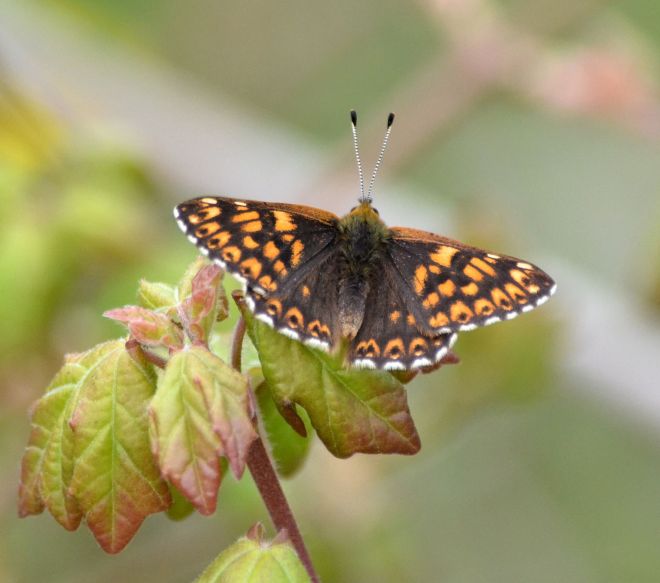
New season Duke of Burgundy at Noar Hill
I had not recorded this species in Great Britain since compiling entries in my 2015 British butterflies series (see here and here). Arriving at around 11:30 I headed for the spot that had been the most reliable for sightings earlier in this decade. There another observer spotted a Duke keeping fairly low in the vegetation, before going to ground altogether. So I wandered on to try to re-locate another hotspot recalled from three years ago.
Conditions had become lightly overcast, and on my way back a group of four observers were gathered in one of the many former chalk pits on this hill top. That could only mean one thing and I went across to join them. I do not favour the situation of being amongst several people all pointing camera lenses at one butterfly, but in the circumstances this was the best option. Things were cooler and cloudier than the morning’s BBC forecast had suggested, and there was a lot of habitat in which to seek out more butterflies.
Those conditions did ensure this individual Duke of Burgundy was keeping stock still on its chosen perch. I was able to capture some rather different images than in previous seasons, first of all from below. I then asked and was granted my field colleagues’ permission to climb the bank above the butterfly that was resting with wings flat to absorb what warmth it could. As one man remarked it wouldn’t be going anywhere and the greatest risk was my sliding down the slope taking the Duke with me.


English Duke of Burgundy are found mostly on southern chalk and limestone grassland such as this. They require a delicate balance of site management to cater for their needs, which are sheltered habitat with patches of scrub and well distributed Cowslip and Primrose. Those larval food plants must not become too shaded by surrounding shrubs and grasses. In the past DoB was known as a woodland species using managed coppice where the plants abound. But due to the general reduction of coppicing a relocation of around 80% of the population has occurred in modern times. Most sightings are of territorial males perching on prominent leaves at the edge of scrub. The females are more elusive, spending much of their time resting or flying low to the ground.
Now a digression. Throughout a short time on Noar Hill I remained aware that it wasn’t exactly ideal reptile conditions. But after indulging my liking for home-made village shop pasties in nearby Selborne I still moved on the short distance to the Smooth Snake site of my intention. There, strangely for this observer in the field, the sun came out on my arrival and there was a good window of opportunity but all I found was one Slow Worm. This is not expected to be easy though and the quest goes on.
On Saturday (5th) I began the day at my “new spiritual home” in Surrey. Arriving at 8:45am I staked out the spot for the next 90 minutes or so where in mid-April I encountered male and female Sand Lizard (see previous post), finding nothing this time. Then it was a drive south-west along the A3 to Butser Hill (SU713206) near Petersfield, Sussex to check out how early season butterflies were doing there.


This site or more specifically Rake Bottom, a deep dry valley on the hill’s western flank, also featured in my 2015 British butterflies series (see here and here). Today despite gloriously sunny conditions butterflies had clearly not got going for the year. I walked the length of the valley bottom in this stunningly beautiful location, then back again but felt little inclination to search extensively for the very sparse numbers of Green Hairstreak and Grizzled Skipper being mentioned by other people present.


I did come across two more Dukes here (pictured above) and other observers I met spoke of up to five. It was all not a patch on what I experienced three years ago but after such a cold early spring there were not a lot of wild flowers around, the exception being one of the Duke of Burgundy’s food plants, Cowslip. The valley is also now being grazed by cattle that cannot help, since such grazing is cited as one cause of DoB population declines. This location nonetheless has a wilder and more remote feel to it than Noar Hill, where I was told there were 27 parked cars later on the day of my visit after sightings were posted online.
There were certainly more people on the hill top that day than I can ever remember in past seasons. Fortunately they all came across as genuine and knowledgeable butterfly enthusiasts, rather than that irritating field underclass of butterfly tourists who seemingly have yet to add this scarcity to the small species range that attracts their destructive attentions. One person still quipped that the Dukes will probably all be trampled under foot after the forecast sunny bank holiday weekend, by the crowds they are likely to attract. I hope not. This remains a species of major conservation concern.

