False Apollo, Southern Festoon and other early spring butterflies in north-eastern Greece: 9 – 11th Apr

False Apollo is one of Europe’s rarest butterflies, occurring very locally just in the far north-east of Greece, some Aegean islands and possibly parts of southern Bulgaria. They are single brooded and on the wing only in March and April, very early in the season so this rather special item is unlikely to be observed without particular intent. Hence I joined a 12-strong group tour run by Greenwings, that operator’s first of the 2019 season.

This expedition was led by former Butterfly Conservation CEO Dr Martin Warren, with local guiding by the eminent Alexandroupolis-based conservationist Dr Michael de Courcy Williams. But no matter how excellent such direction might be butterflies will still only come out when the sun shines, and therein lies the story of this post.

false apollo.1901 potamos valley

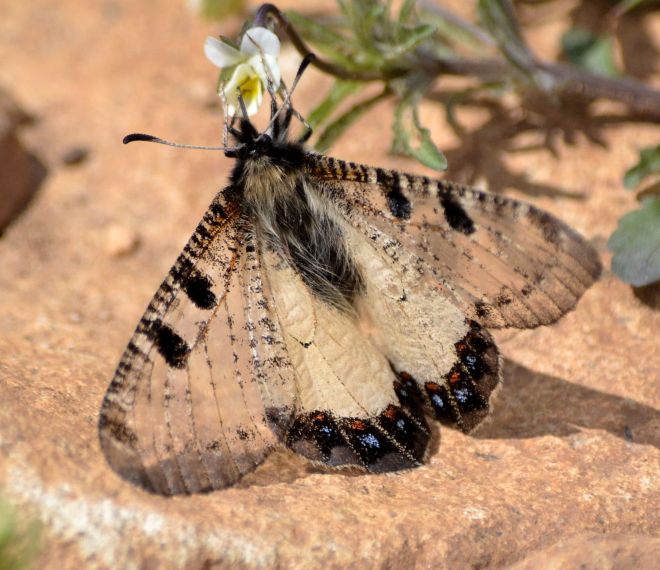
Male False Apollo

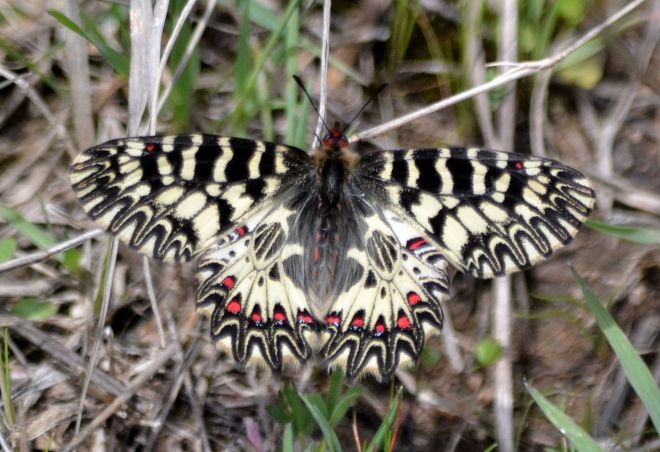
False Apollo’s stronghold in the region we visited lies in the Evros Hills near the border with Turkey and to the north of Alexandroupolis. Here many upland streams occur, along which biologically important but little studied Oak and Oriental Plane woodland has developed that supports a diverse flora and fauna. On our first visit on 10th conditions remained steadfastly overcast and no Apollos were found. But we did locate a number of roosting Southern Festoon, another regional speciality that was a very welcome and attractive lifer for me. With this trip’s sightings I have now observed three European members of that colourful genus, the others being Eastern and Spanish Festoons.

Southern Festoon occurs widely but locally across south-eastern Europe, as well as throughout Italy and in some Alpine regions, flying from late March to July. The cold and damp conditions of this tour meant the beautiful and boldly patterned butterflies were quite easy to capture pictorially, especially since my colleagues were adept at “wrangling” the near torpid specimens into photogenic positions then “gardening” around them to remove unwanted clutter.

Besides a few roosting Coppers not much else was seen on day one, other than at a lower location where the sun came out briefly. In the evening our leaders thanked the group for our forbearance and good humour, and everyone was prepared to accept one largely written off day to begin with. The various weather apps in our possession all predicted better things to come in the days ahead. But despite a brighter start on 11th at our coastal base conditions were unchanged when we arrived back on site.

On our leaving the tour minibuses this time two of the Festoons were on exactly the same perches where we had left them the previous day, indicating there could have been no sunny intervals during our absence. If anything it was now even colder here and walking around it was plain we would draw blank with the Apollos again.

Before leaving I took an opportunity to do some close up macro work with one of the Festoons (below, left), and was at once joined by more group members. Having done justice to the under-wings I next learned another field technique of warming up torpid butterflies by cupping them in the hands then breathing on them. Thus treated the Festoon obliged by opening its wings flat and another sequence of up close images was gained (below, right).

If any reader disapproves of all this I can only say it appears to be common practice amongst such highly knowledgeable company as I was in, much like netting and jarring on previous wildlife tours I had joined. Everywhere else we went on day two cloud and rain set in as soon as we reached any hitherto sunny looking spot, and by evening the group was understandably feeling a little more glum.

When day three (12th) dawned in just the same dull and drizzly way chins were mostly resting on the breakfast table. But an ex-naval man amongst us pointed out a weather front coming in off the sea with whiter cloud behind it, saying that was a good sign. Indeed it was and fairer weather followed us up into the hills. Good numbers of various butterflies were then on the wing and by mid-morning False Apollo were being located. At this time of day they are likely to be basking in any sunshine by settling on dirt, low plants or occasionally rocks.

The record shot (above, left) was my first view of a translucent fore-winged male, that was then coaxed into a more open position (above, right) before flying off. Next a much darker-toned female was located also down in the grass, before being encouraged to mount a stone where she finished warming up with the day. After the group had all taken their pictures I again went in point blank with my macro, gaining some acceptable images and a lot more burred ones as is usual (for me) with such a lens.

Mission having been accomplished the group then began to split up and go their various ways. I too wandered off alone and soon came across another male False Apollo that this time I had to myself for a while. The images below came from this third encounter, complete with those amazing see-through wings. This quality increases with age as butterflies lose wing scaling, more so in males than females, and in older specimens the fore-wings can be near completely transparent.

The situation, it’s scenery and butterfly life were all a transformation upon the previous two days. This is what I pay the money to do: wander around remote locations that nobody except wildlife enthusiasts go to; enjoying and taking pictures of the infinitely intricate, inspiring and captivating treasure trove that butterflies are (when the sun shines). The mood of the group was of course similarly uplifted and we remained on site until late in the afternoon.

The unfettered Southern Festoon were now flying freely and striking up more conventional and natural, if somewhat grassy poses (pictured below). To me this species appeared smaller than the other two European Festoons, and there was some agreement within the group over this. A few participants also found one or two of the larger, paler Eastern Festoon which I have seen once before but need better pictures of; but that will still have to wait.

southern festoon.1901 potamos valley

Southern Festoon (above and below)

Good numbers of Sooty and Grecian Copper were also on the wing here and I was able to boost my picture collection with better top-side studies of male Sooty and some under-wing treatments of both genders. I had previously observed male Sooty in the Cévennes, France (May 2016) and females in southern Greece (July 2018) where I also recorded Grecian for the first time. The very widespread Sooty is multi-brooded from April to October across much of Europe except for the Iberian peninsula and fenno-Scandia. The vivid orange Grecian is limited to the country of it’s name and the southern Balkans, with two broods flying in April and May, then July and August.

Another frequent flyer in sunlight was Eastern Dappled White, a common species of south-eastern Europe and Italy, and the third trip lifer. Had I searched carefully enough here or possessed a net and jar these locations might also have yielded the similar Eastern and Small Bath White. I previously recorded the first of those in southern Greece last summer, while the latter was on my trip wish list here; but nobody seemed very interested in this genus and so it was possibly rather overlooked.

Lastly the default butterfly for this trip was Painted Lady. 2019 is tipped as an irruption year similar to the mass migration of this species a decade ago. In Fuerteventura in January (see here) I was struck by the huge numbers that in places appeared to make the ground shimmer, as was a colleague from my southern Greece tour who was on Gran Canaria at the same time. On the day of our arrival in Alexandroupolis, despite at times torrential rain many hundreds of these very hardy butterflies were coming in off the sea and roosting on the structure of our hotel. Wherever we went in the next three days there was a constant procession of powerfully flying Painted Lady all moving relentlessly northward. The evidence seems to be that another great migration is in progress so look out in Blighty this summer, here they come.

painted lady.1905 alexandroupolis

Migrating Painted Lady

Returning to the little known though greatly prized False Apollo, these are seriously beautiful insects indeed, quite unlike any other European butterfly I have experienced. Their rarity was perhaps put into context for me by one of the most experienced tour participants, who had recorded all but six of the known European species prior to this trip. So that is now five, what an achievement! Further populations occur to the east in Turkey, Iraq, Syria, Jordan, Israel and Lebanon; and there are a number of sub-species across that range. To protect the fragile Greek population from the attentions of collectors I have not disclosed any location detail herein, by agreement with the tour operator.

Early season Maghreb butterflies around the Kasbah in Agadir, Morocco: 10 – 15th Feb

As is my custom I began this trip with a walking day, out to the Kasbah hill and back. After climbing to the top with birds mostly in mind, then walking back down again I explored a gully that runs alongside a road around the hill’s western side. This struck me at once as likely good butterfly habitat, being sheltered with wild flowers in places, and it did not disappoint. I returned here for a couple of hours on three of the next four afternoons, recording 15 common species of the region including two lifers and a north-west African sub-species.

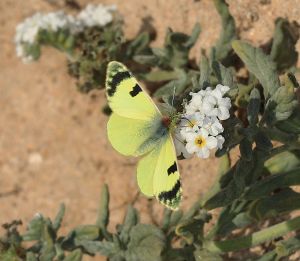
Near the top of any loose agenda I might have had for this trip was obtaining publishable pictures of Greenish Blacktip. This is a common and widespread butterfly of hot, dry, rocky places that occurs across north Africa, through the Middle East and as far as the Indian sub-continent. I had observed them during both my early year visits to Fuerteventura, but only gained pictures previously of worn individuals.

It now took all four of those above mentioned sessions to gain the open-winged picture in the above sequence (bottom, right). Interestingly this butterfly is nectaring on the same plant as the GBT captured by one of my Swedish field colleagues in Costa Calma last month (see here). Like our closely related Orange Tip at home this is a restless and fast flying species that only settles fleetingly, often on delicate, swaying perches; and they constantly relocate. But with perseverance I was able to gain some half-decent underside studies and so was largely satisfied with the outcome.

I was as pleased to find good numbers of bright yellow-toned Moroccan Orange Tip (pictured below) flying here. That welcome lifer frequents edges of cultivation, flowery places, woodland edges and scrub land as early as February in Morocco south of the Atlas Mountains but not until March further north. There are two sub-species, this one Anthocharis bella of the Maghreb region; and A b euphenoides that ranges through the Iberian peninsula into the far south of France. I had previously recorded the latter in Provence in May 2016 (see here).

All four of the species referred to so far are equally difficult to capture pictorially but now each is represented in this journal’s butterfly gallery. The African Grass Blue here were mostly well worn compared to those I observed in Fuerteventura, but the picture (below, top left) is quite pleasing. Since I am presently suffering from wear and tear in my left leg, performing the on hands and knees contortions that are required to gain acceptable pictures of such tiny butterflies was quite difficult.

I also hoped to locate African Babel Blue (above, bottom left) this week, that unbeknown to me at the time was on the wing in Costa Calma during my January visit there; but I was not successful. By way of partial compensation I did record the Maghreb sub-species of Common Blue (f celina), for which the clearest diagnostic appeared to be the broken black inner margin to the upper-side hind-wing (pictured above, right).

The week’s second lifer in the Agadir location was False Mallow Skipper (pictured below) that in the Maghreb region replaces the common and widespread Mallow Skipper of central and southern Europe. The two species are virtually impossible to tell apart in the field, being largely another male genitalia matter. FMS also ranges into the Iberian peninsula and a few Greek islands but the overlap between the two species is not fully understood. Bits job or not this was a further welcome addition of a tricky species to my life list.

Amongst more familiar butterflies Clouded Yellow (below left), Small Copper (below right), Wall Brown and Painted Lady were all well represented at this site; with smaller numbers of Cleopatra and southern Speckled Wood. Bath White (middle row, below) were looking nice and fresh, while the Small White here (bottom row) were of the pale toned first brood form.

Something a little more unusual was Spotted Fritillary (Melitaea didyma) of which a few were on the wing here at what must be the very beginning of their flight season. There are several forms of this species across its entire range and I believe those I encountered here were M d occidentalis that occurs in north-west Africa, the southern Iberian peninsula, the Balkans and Greece. I had only gained acceptable underside images of this butterfly previously, so the open-winged studies in this collage (below) were very welcome.

Through a rather hassle-prone week in Morocco I was never more content than when returning at the end of each day to this gully below the Kasbah, to prospect for butterfly pictures with nobody to bother me. That is the great benefit of an interest in insects, since wherever I might be in the world any piece of waste ground can be full of life and hence stimulating and motivating. There were also good numbers of slim, medium-sized, yellow toned dragonflies here that I suspect were immature Epaulet Skimmer, but they at no time settled. Elsewhere it was clearly the Odonata close season.

DSC_0309

The roadside gully below Agadir’s Kasbah described in this post

The butterfly list for this trip (with lifers in bold) at this site and elsewhere was: Small White, Bath White, Greenish Blacktip, Moroccan Orange Tip, Clouded Yellow, Cleopatra, Small Copper, African Grass Blue, Lang’s Short-tailed Blue, Common Blue (f celina) , Plain Tiger, Red Admiral, Painted Lady, Spotted Fritillary, Speckled Wood (P a Aegeria), Wall Brown, False Mallow Skipper – 17

A re-appointment with the Tamri / Cape Rhir Northern Bald Ibis flock in Morocco – 11th Feb

Since my first visit to Atlantic Morocco in December 2015 I have regarded a then close-up encounter with these much sought birds as possibly my best ever self-found birding moment (see here). Now following an uncannily similar experience last week (10 – 16th) I wonder if such occurrences are in fact not so unusual there. At any rate, during this repeat tripette lightning certainly chose to strike twice in more or less the same place.

bald ibis.1901 tamri

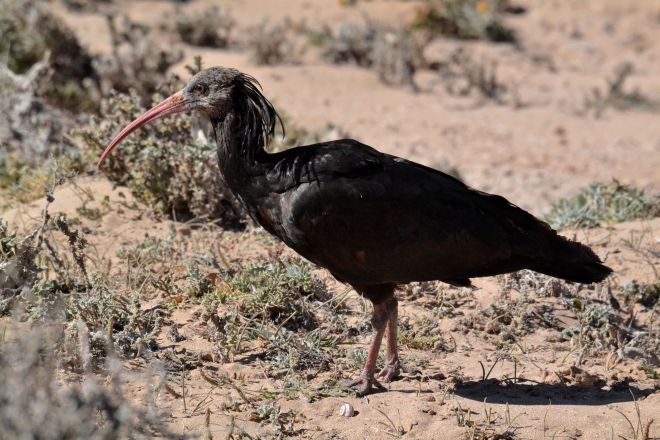
Northern Bald Ibis

The Parc National de Tamri lies 60 km north of Agadir, and just south of the coastal town of the same name. One of the region’s two historic Northern Bald Ibis flocks may be found anywhere around the large promontory of Cape Rhir and is also now expanding north of the town. All the wildlife tour operators and their clients come here to see them, and that is where I headed on my first day with a hire car (11th) this time around.

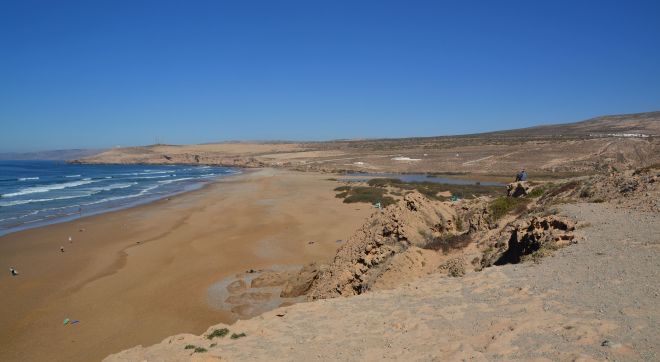
I stopped first at the location where the N1 coast road turns sharply inland towards Tamri (pictured below). Here there is a small parking area from where the Oued Tinkert estuary can be scanned. This bay can hold large concentrations of Gulls, but I could not locate Audouin’s, my favourite Gull this time. But two larger black items flying away high to the north could only have been Bald Ibis. Feeling relieved that the viewpoint was free of hustlers on this occasion, I then drove on to the town itself to take pictures in it’s Souk (market).

DSC_0471

The mouth of the Oued Tinkert at Tamri

Three years ago coming here had been my first experience of driving in Morocco but I had not taken the time then to record ordinary street scenes of daily life. Doing so was something I very much wanted to add to the trip experience this time. Nobody seemed too bothered by a foreigner walking around pointing a camera at them, though I suppose the locals must be used to it. Neither was I pestered as is the norm in Agadir, or indeed Oxford.

This slideshow requires JavaScript.

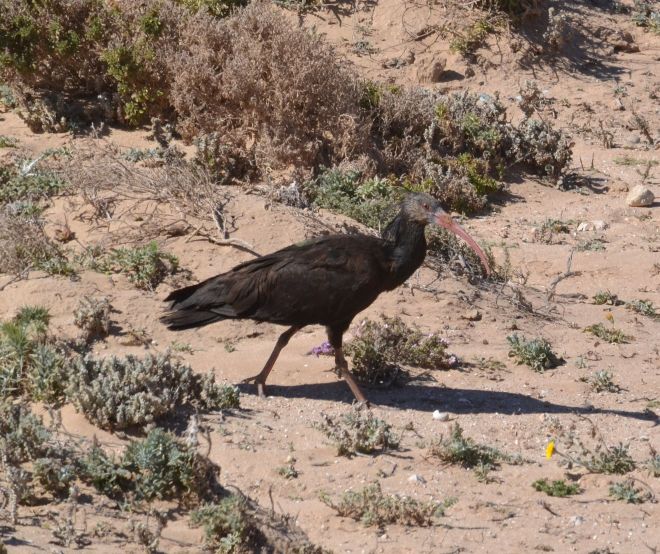
After this I headed back south along the coast road, stopping at a random place and there were the birds, 30-something of them all grazing the land that sloped away from the roadside down to the shoreline. Just as in 2015 I stayed inside the car and the Northern Bald Ibis all walked towards and then past me, the nearest birds feeding just metres from my vehicle. Their purple and green iridescence shimmered as they moved in the bright sunlight while they probed deeply into the soft ground with their long, down-curved bills. It was difficult to believe I had been this lucky not only at the first attempt now but also twice in two visits here.

bald ibis.1907 tamri

Northern Bald Ibis from my hire car window

After a while three birds actually began to walk across the metalled road. A speeding truck sent this lead group into the air, at which many more Ibis went up from the ground away to my right and most of the flock re-settled away to the other side of the road. They were now into the sun so I crossed over myself and got out of the car. A youth then approached noisily along the road towards me, shouting and waving his arms as if he was showing me the birds, and putting up even more. The locals here are all primed to take their chance with any foreign birders they might come across.

When my assailant did eventually ask for money, rather late in the proceedings by Moroccan norms, he didn’t get because I had self-found the NBI flock again, not him. After two such easy connects I must assume these birds are not difficult to locate here, and the youth told me they graze along the N1 road here all day, every day. So if observers move carefully along the coast around Cape Rhir scanning from all likely looking vantage points in turn, these most sought NBI are likely to drop in at one time or another.

When I first came here in Dec 2015, Northern Bald Ibis was still regarded as one of the world’s rarest birds. Since then they have enjoyed something of a renaissance and in 2018 the species was removed from the IUCN critically endangered list, now being classified as endangered. In that year Morocco’s two viable wild colonies (at Tamri and in the Souss-Massa National Park south of Agadir) reached a record number of 780 birds, up from 590 in 2017. Amongst those 147 breeding pairs fledged 170 chicks. At Tamri 66 breeding pairs produced 60 chicks, with a success rate of 30%. For further detail see here.

Studies also indicate that the southern Moroccan population is enjoying a breeding range expansion. In 2017 two new breeding colonies and a third roosting colony were found  between 30 and 35km north of the Tamri stronghold (see here). North-west African (or Maghreb) conservation bodies regard this recent revival as quite exceptional.

bald ibis.1913 tamri

“Who says only our mothers love us?”

I didn’t go on this trip with any well-defined wildlife agenda. The dual purpose was more to see whether re-visiting places can be motivating, and to break up the remaining time before English summer time resumes. That lack of an intensive itinerary allowed me to spend more time on some of the things I had done in Dec 2015, as well as simply experiencing daily life around Agadir, without the pressure of working through a trip wish list. Most of the birds I gained acceptable pictures of were common species of the Maghreb (NW African) region.

DSC_0529

The Kasbah from Agadir Marina

The Kasbah Hill just to the north of Agadir and its environs seemed as good a place as any to watch birds, and many of this post’s remaining pictures were taken there. Since I also devoted some effort to capturing images of tricky little butterflies, birds would also enter the mix at intervals and offer good opportunities. Moussier’s Redstart (below) was a case in point. Several times through the week they would suddenly announce themselves then appear out of nowhere, usually perching quite prominently. This stylish and classy looking item probably remains my favourite Maroc passerine.

Busy and playful, not to mention noisy Common Bulbul were plentiful everywhere. This is a widespread and successful resident breeder across much of Africa, often being encountered in pairs or small groups. The pictures below were taken from my hotel balcony.

Two more frequent urban species are House Bunting and Maghreb Magpie. The former (below, left) behaves very much like Sparrows at home, mopping up the detritus of human activity and getting around people’s feet in pavement cafés for instance. But despite their abundance in Morocco I only came across two around Agadir all week. The latter (below, right) that is characterised by it’s blue ear patches, was split as a species during 2018.

The Southern Grey Shrike (ssp algeriensis) in these pictures (below), one of what looked like a resident pair below the Kasbah, allowed a very close approach. In that location there is a complex road junction with drainage channels running through it, that I have found to be a good spot for local birding during both my Agadir-based trips. The white orbs on the bush in the lower sequence are snails not fruit.

Laughing Dove is my favourite of that genus, since I find their subtly blended tones highly attractive. This smaller, rather slim species would stand out sometimes from the far more plentiful city Collared Doves and Feral Pigeons, as in these pictures (below) also taken at the Shrike location below the Kasbah.

Lastly, Crested Lark is such a commonplace bird wherever I go abroad that I rarely pay much attention to them. But a number of times this week, whilst I was otherwise pre-occupied, they would come so close and present such photogenic opportunities that I did bother to boost my collection with a few more pictures (below) of them.

The answer to whether retro-tripettes can be motivating was “partially”, since for me a specific wildlife agenda is the main factor in avoiding feelings of loneliness or anxiety when travelling solo (in case anyone ever wonders); and the more that is new and different the better I cope. I was in no way expecting to cover the classic and mainly desert species that most usually bring foreign birders to Morocco, since those were all much too distant from my base. Indeed I at no time intended to stray very far from Agadir.

The length of time it takes to get anywhere in this country is a significant issue, and there are various pitfalls for the unwary when driving. Low speed limits, slow moving local vehicles, long stretches of road where overtaking is prohibited and police everywhere all serve to make journeys last far longer than expected. Add to that pot holes, hazardous carriageway margins, punctures and issues I had with local hire company shenanigans, and this could hardly be described as an especially relaxing trip.

DSC_0483

Greater Flamingo along the Souss estuary south of Agadir

If I go to Morocco again it will probably be on an organised group trip with one of the wildlife tour operators, if I can at length face up to the prospect of hours couped up in mini-buses with elderly convenience company over such long distances. But hey, all this beat another cold, dull and largely birdless week at home as winter moved towards its close in Blighty.

A drake Smew delivers at Kemerton Lake NR, Worcs – 27th Jan

I have been in danger of developing a preoccupation with Smew over the last two months. That could be because as new and different birds become a diminishing return as my national list grows, my attention has turned more to uncommon winter staples instead. But this is also a difficult bird to observe closely or get pictures of in my experience, and doing so can require some working at. Hence the several shorter-range outings I have undertaken at intervals to help fill some mid-winter days.

Dapper, white and black drake Smew are by any standards striking and handsome birds. Nothing else resembles them and so to my mind they are one of the most iconic local birds of midwinter. My previous experience has come mainly from different gravel pit complexes around my home county of Oxon, but this winter the species has so far given us a miss. In that absence near to home I have so far travelled to Herts twice, Leics twice and Worcs three times to seek them out; and it took until today to enjoy a truly satisfying encounter.

smew.1903 kemerton lake

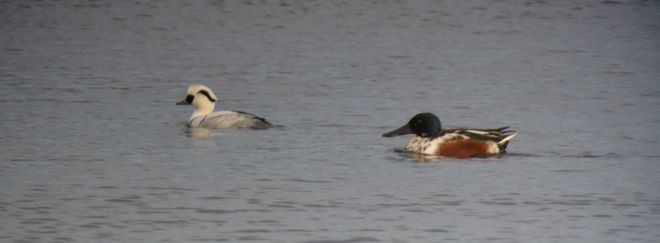
Drake Smew (left) and Shoveler at Kemerton Lake NR

This morning a bird was still present 65 miles away near a Worcs village Kemerton, between Cheltenham and Evesham, so I decided on a second attempt there. Smew are prone to moving around several sites over an area, or between different gravel pits in large complexes, and so my first visit here on 21st had been unsuccessful. Needless to say my target returned the following day and remained on most days in the interim. And so around the middle of today (27th) I arrived at Kemerton Lake NR (SO937362), a pleasing and well-kept reserve that is managed by a local conservation trust (see here).

There are hides at the north and south ends of the lake and a permissive path runs around all four sides of the site. I opted for the shorter walk to the southern hide first and soon picked out my quest closer to the northern hide. Once relocated within that facility I spent the next two hours in the Smew’s company while seeking my first ever pictorial records of them.

At first this drake remained faithful to an area away to the hide’s right and close to the shore. This was typical of how I had observed Smew in the past, since in my experience they tend when either feeding or resting to favour lake edges where they might become concealed in marginal vegetation. Today’s bird remained mostly in the open, but since it was diving constantly getting adequate records remained difficult.

After about an hour the Smew had possibly eaten it’s fill and so began to drift across the water’s surface in front of and closer to the hide. Now I was able to obtain some half decent images (above) that will have to suffice for now. By 15:30 pm the bird had moved quite some way from the hide again, and so I decided to head for home before dusk feeling largely satisfied with what had transpired.

Through my two hours here I was joined in the hide by three families, engaging with whom added greatly to an enjoyable ambience. It was a real pleasure to share the space with knowledgeable parents, quietly and lovingly teaching their young children about birds. That was also quite a contrast with the more noisy and obtrusive experience that is now the norm on RSPB reserves, for instance.

My aforementioned interest in these taiga-breeding visitors had begun before Christmas at Cheshunt GPs in Herts. This large complex is an annual wintering ground for the species, and was where I saw my first ever Smew in Feb 1985 when I lived in that area. On my first recent visit I located a drake after much searching that fairly soon dived not to appear again. Going back a few days later I was unsuccessful, since when most reports have come from one of the biggest pits where viewing could be distant.

One of this winter’s best Smew sites has been Eyebrook Reservoir in Leics, where 15 or more individuals have been sighted on some days. I visited there over the Christmas period locating a largish group, but though that was a good experience at a superb site for wildlife, my views were always distant. Moving on that day to Rutland Water I encountered three “red heads”, the immature or female form of Smew at closer quarters. I returned to Eyebrook on my way home from Holkham NNR on 28th Dec but the Smew were not in sight on that occasion.

A possible closer encounter suggested itself around that time, when two drakes were photographed on a private fishing lake at Holt, Worcs from an adjacent right of way. When I tried there and at nearby Grimley GPs on New Year’s Eve, I met local birders who recounted how the Smew in question had frequented various places in their county over the previous several weeks. But of the birds themselves that day there was no sign.

Given this propensity for moving around between sites, I suspect the Kemerton bird is one of those two drakes. And so all this has reached a satisfactory conclusion. Perhaps I have now paid sufficient attention to Smew for the time being, but still hope for one or more in God’s own county (Oxon) before winter’s end.

Hume’s Leaf Warbler nailed in Newhaven, Sussex; then those Holkham Shorelarks – 15 & 17th Jan

I feel on a roll now. After two days taken up largely by writing, picture editing and housework following my Fuerteventura trip, I was ready for the road again by Tuesday (15th). The excess energy and inner tension that arise from a preference to stay active had built up again upon my return. To relieve it there was a choice of going for a tricky little lifer, Hume’s in East Sussex or trying again for the Norfolk Shorelarks. I opted for the former since they were nearer (115 cf 150 miles) and the latter were likely to stick around for longer.

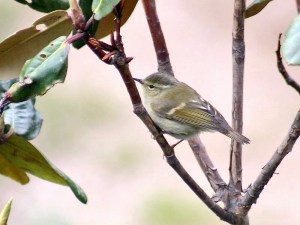
Hume’s Leaf Warbler (also known as Hume’s Yellow-browed Warbler – pictured above, left) is one of three autumn drift migrant Warblers that still occur in Britain into mid-winter. The others are the closely related Yellow-browed and Dusky, both of which are on my British and hence Westpal and life lists. I had previously dipped Hume’s twice in Dorset exactly seven years ago, an experience that entailed staring at a dense bank of vegetation for hours for no reward.

That served to put me off going for another one until now, and so Hume’s lingered amongst three other regular drift migrants – Greenish and Marsh Warblers, and Olive-backed Pipit – that I still need and really ought to have gained by now. I anticipated today might be a necessary chore, involving getting through the most perennially traffic choked section of the M25 motorway (between the M40 and A3), then another unforgiving stake-out on site. But in the event I cannot recall the south-western M25 being so un-congested, and the connect was surprisingly simple as well.

A fortunate feeling grew further when upon my arrival on the northern edge of the port of Newhaven, around nine miles east of Brighton, a parking space awaited rather invitingly in the access road to the Hume’s site (TQ 44299 02192). There I did my credentials for becoming a proper birder typical harm by polishing off a particularly delicious pasty from Pease Pottage services on the A23, rather than running for the target. Thus sated, I then “sauntered” as is my wont into Riverside Park, a former landfill site and the location quoted on RBA.

Those directions said opposite a waste incinerator (that is actually on the far side of the river) and as I approached two other birders were walking away unsuccessfully. They advised me to listen for a call not unlike Pied Wagtail. Setting up my chair I next saw off an as tasty M&S Wensleydale and carrot chutney sandwich (more food!) before at last starting to go about things more seriously.

The young tree scrub habitat here on the re-generating landfill site looked excellent for warblers, but though less dense than that previous Dorset location there was also a lot of it in which the Hume’s might be skulking. Two more birders had now arrived and we all began to search in different places. Ever incorrigible, I moved my chair to a clearing from which I could scan a good area of habitat, Googled the bird to check on it’s diagnostics, then sat and waited. That seemed preferable to walking around and risking the bird flying off ahead as I went. Five hours in that forest park in Costa Calma had clearly had some influence on my mind set.

Blue Tit, Robin and Chaffinch all moved through, before after maybe 20 minutes I indeed heard a call such as had been described to me. A small and very different passerine, the Hume’s Leaf Warbler had landed in the top of the nearest clump of saplings, rather like in the outsourced picture below. Oh that I could always enjoy such luck, but on this occasion at least my laid back approach had paid dividends. It was now 13:25pm.

hume's warbler.01

Hume’s Leaf Warbler © rights of owner reserved

Over the next 40 minutes the Hume’s came and went several more times, always announcing itself with a pronounced dsu-weet call. In this period more birders also congregated here and all got to see the Warbler well. I understand that vocalisation is the easiest way to identify Hume’s, since for non-expert observers such as myself the plumage closely resembles Yellow-browed (whilst being generally drabber). The species breeds in central Asia and the most extensive wintering area is the Indian sub-continent. Yellow-browed, from which Hume’s was separated by the BOURC in 1997, has a more northerly Siberian breeding range.

At 14:15pm it began to rain and most of the birders dispersed. Mindful of avoiding rush-hour traffic on the dreaded south-western M25 I now headed home, feeling immensely relieved at having laid this long-avoided and difficult lifer to rest. This day had been a hugely satisfying experience at the opposite end of the birding scale to those boring and frustrating 2012 sojourns in Dorset. Apparently I had made a wise choice of location as there have been six previous occurrences of HLW along the 18 mile stretch of coastline from Brighton eastward to Beachy Head since and including the first accepted British record in 1966.

========================

For a very informative guide to migrant leaf Warblers in Great Britain see here. And for a detailed, scientific paper on separating Hume’s and Yellow-browed in the field see here.

========================

Two days later on Thursday  (17th) I made a third attempt at the Holkham NNR Shorelarks on the north Norfolk coast, since missing them twice previously this winter still rather rankled. Given my current run of good form it seemed now might be the time to belatedly nail those too. Since my abandoned visit on 28th December (see here) a 20+ Shorelark flock, and up to 50+ Snow Buntings that I observed then, have been recorded regularly on RBA. Like the Buntings, the main attraction of the Larks for me was the comparatively large numbers involved, since I had only come across single figure groups in the past.

When I arrived at Lady Anne’s Drive just after 9.00 am a bitterly cold gale was blowing along the coast, which I suppose I should have anticipated. But I was wearing just about enough layers and so strode out defiantly to the roped off area at approx TF895455. There several other birders were already watching the Shorelark flock, so the connect was immediate this time and my luck was holding. At first the birds were too far away to get pictures of but then they moved quite close in … which was when I found my camera battery was flat. Oh dear! Cue a sinking feeling.

Back at the car park, having watched the Shorelarks for a while, I retrieved my camera charger and the on-site cafeteria proprietor very kindly rescued the situation while I warmed up again with a coffee and local pasty. Meanwhile a Lapland Bunting was discovered out at the sharp end, presumably amongst the Snow Bunting flock. On my walking out for the second time, the conditions had if anything deteriorated further with light snow flurries in the mix. But the Shorelarks were still present so today’s result despite my earlier faux pas was definitely meant.

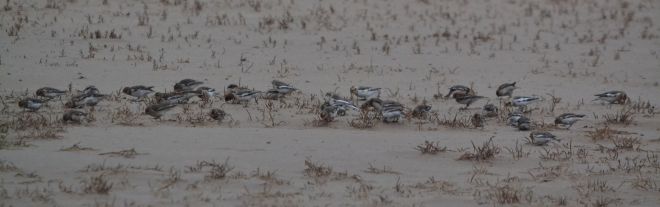
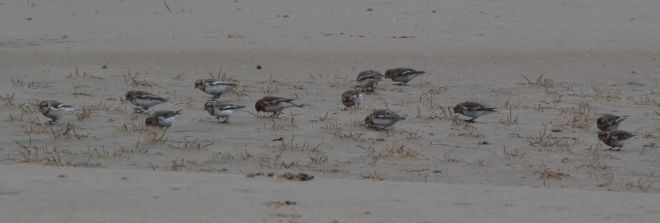
Again the flock was mobile around the roped-off area, then once more they moved closer. Given the circumstances any sort of records would suffice, and the images (above, top row) purport to be no more than that. Local birders arriving now were naturally far more concerned with locating the Lapland Bunting. I neither picked it out nor came across anyone else who had seen it since that original report, but I did speak to the finders. The today 30+ Snow Bunting flock (above, bottom row) was active throughout.

My carelessness with the camera battery had at least ensured I spent all of my four hours parking time on site, but by the end of it I was glad to head back home. I think I might have had my fill of Holkham for this winter season, but I am taking the “arduous journey” to north Norfolk in my stride now, and those aforementioned Greenish Warbler and Buff-bellied Pipit perhaps seem a little more reachable.

Fuerteventura III: the Dwarf Bittern re-visited and some island insects – 10 & 11th Jan

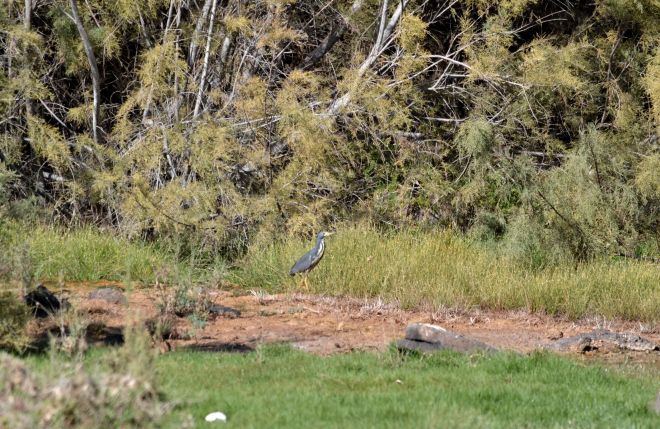
This mini-break was my third visit to Fuerteventura. I came here previously in February 2015 for five days (see trip reports), then in December 2017 just for a weekend to twitch a Dwarf Bittern, possibly the desert island’s most renowned avian resident. I was one of the earlier Brits and first Oxon birder to go for what was then the fifth Westpal record. But the urgency of that madcap adventure was not in the end necessary as this celebrity has remained faithful to it’s adopted home to the north-west of Rosario and Fvta airport ever since. Experiencing the bird again was an important aim for this new trip.

0q8a3963

Dwarf Bittern (adult male) at Barranco de Rio Cabras © and courtesy of Lars Theng

So Thursday morning (10th) found me driving out through the rugged though languid grandeur of the Fvta landscape heading for Barranco de Rio Cabras, the Bittern site. This river gorge runs close by an access road to a waste recycling plant off the FV20 main road. An approximate GPS from which to start searching for the DB is N28.4758′ W13.9030′. There I met two birders from Sweden who were unsure exactly where to look, so I took them out to the spot where I was successful those 13 months ago (see here).

As we walked across the stony plain from the road out to the Barranco the air overhead contained around nine Egyptian Vulture. This is a reliable location to find that raptor since they are attracted by the waste recycling plant. As we reached the gorge a similar number of Spoonbill flew out from it and circled around, the first I have seen here. Then we crossed the Barranco to watch for the Bittern in an area between two dams that it frequents regularly.

Barrancos such as this containing water in places act as a magnet for birds. Some of the more noticeable ones moving up and down on this occasion were Little Egret, Black-winged Stilt, Ruddy Shelduck, Little-ringed Plover and Common Snipe. A Hoopoe was active on the opposite cliff face, while Raven seemed omni-present overhead. After a while one of my companions went to search further downstream while the other remained with me.

When the call came to say the Dwarf Bittern had been located around 500 metres away the ensuing dash to connect was seriously off-piste. I could not keep up with Lars who had 20 years on me, and as I had seen the bird before it didn’t seem worth breaking an ankle or otherwise going arse over tit for. In the event I took just the one tumble, suffering no more than a bruised finger. None of this now is as easy as it used to be when I started birding abroad eight years ago.

Upon reaching the spot where the others were sitting, in a green and watery area of the barranco floor, the DB had gone back into cover. They had watched it feeding very closely and Lars had good images on his big lens HD camera. A tense wait then ensued without the bird re-emerging before my companions, being satisfied with their experience decided to move on. But as soon as they left I beheld the Dwarf Bittern striding out of cover again a little upstream from where I was sitting.

barranco de rio cabras.1901 with dwarf bittern

“Hello old friend … what have you been doing since we last met?”

Now this famous and iconic lone wanderer gave itself up to my camera for the second time. It was a rather more tranquil setting than the place upstream where I had observed the bird previously. And unlike then I was now completely alone with it and so able to enjoy especially meaningful communion. I watched and took pictures as the DB foraged along the water’s edge, practising it’s repertoire of Heron poses as it went and moving gradually upstream.

Though the habitat here clearly caters for this adult male’s sustenance I pondered upon what else might keep it in this adopted home: far from the usual range, away from his own kind and without a mate. Maybe there were similarities between us in these moments at the back of beyond. Whether or not such vagrants eventually return home is something I have thought over many times. Or do they either just settle where they have strayed, or as is more often the case die fairly soon? Might this solo Dwarf Bittern just have a low libido or could it be escaping a troubled relationship history? Perhaps I should stop there.

From close to where I was now a track led up the gorge side to the plain above, so the walk back to my car was much easier than the outward one. It now being early afternoon plenty of time remained to re-visit the lower end of Barranco de Rio Cabras where most of Fvta’s regular small passerines may be encountered. This is accessed via a dirt track from Playa Blanca, just off the FV2 road immediately south of Puerto del Rosario.

Retracing a route I first trod in 2015, the first small birds I came across were some Spectacled Warbler (pictured above, left). And in amongst them were at least two Fuerteventura Chat (above, right), an island endemic without seeing which no visit here would be complete. A little further along two Trumpeter Finch landed just ahead of me but I could not get pictures before they went on their way. What were probably Berthelot’s Pipit and Lesser Short-toed Lark were buzzing about the arid habitat, being much more frequently heard than seen. And inevitably there were Spanish Sparrows.

Once I reached the barranco’s lowest dam, the height of water behind made it impossible to walk on north-west to the Dwarf Bittern site. Things seemed far less birdy here than in 2015, and so instead I took some time to pay attention to the remote location’s insect life. Odonata comprised Blue Emperor, Red-veined Darter, Broad Scarlet and Sahara Bluetail; the last of those being Fvta’s only damselfly. And as in other locations this week there were a lot of dark brown-toned Pyrausta moths.

Butterflies were represented by the same five polyvoltine species (all-year flyers) that I encountered throughout this trip: Painted Lady, Red Admiral, Clouded Yellow, Small White and African Grass Blue; the last of those being a welcome lifer. Everywhere I went I was impressed by the significant size variation in Painted Lady. All were smaller than the migrants that regularly reach Great Britain, but I wondered if the smallest of all were an endemic form. Having read things up that is not so. There is a second Painted Lady species in the Canaries but I did not find any of them. So I must assume the size of adult butterflies depends on how much individual larvae find to eat in this arid region.

The trip lifer, African Grass Blue (pictured below) is one of the tiniest Blue species that is widespread and often common across much of north Africa and the Middle East, but extends into parts of southern Europe as well. It is discreet and very low flying, particularly favouring coastal localities in which irrigation maintains vegetation; but is also frequent in hot, dry habitats such as here. I also noticed this butterfly in the forest strip in Costa Calma while staking out the Allen’s Gallinule there.

0q8a0040

Greenish Blacktip © and courtesy of Lars Theng

On the walk back I crossed paths with a few Greenish Blacktip (pictured above), another common north African butterfly that I had seen lots of in 2015 though most then were very worn. Like Orange Tip at home this restless and fast flying species is difficult to get pictures of. Tired from my day long exertions I couldn’t summon the energy to chase them across the rocky ground this time and so publishing my own images of GBT will have to wait.

On Friday morning (11th) I couldn’t resist going again for Houbara Bustard on Tindaya Plain in Fvta’s north-east. On both my previous trips I had seen those local specialities further to the north nearer El Cotillo, but this time I opted for where most of the images published online come from. Arriving at first light I eventually observed three Houbaras in flight, and then another more distantly, but there were no roadside encounters such as I sought. That was rather annoying, especially as my Swedish associates of the previous day had photographed displaying males at 50 metres here (pictured above).

This slideshow requires JavaScript.

After two hours of frustration I decided to drive north along the dirt road to El Cotillo, but ended up circuiting the north side of Mount Tindaya back to the main road from EC to La Oliva instead. The route I intended now appears to be blocked by a private open cast mining site. Though some of the vistas here were well worth the detour the overriding sentiment was of disappointment over the lack of Houbaras, so I continued on to La Oliva to refresh my spirits. This village is rather like an oasis in the desert and unusually wild flower rich for this island, and so once again my attention turned to butterflies.

There must be trillions of Painted Lady in Fuerteventura and here it would not be an exaggeration to say the waste ground I now walked around shimmered with them. This all rather put into context the occasional spectacular irruptions that occur at home, such as one around 10 years ago. But the mind simply boggles at how many trillions of trillion there must be across the species’ entire range. The images I saved from La Oliva are all of Clouded Yellow, of which these (below) are the most pleasing.

Unfortunately on this trip my laptop charger failed and so I lost contact with Canary Islands RBA. It wasn’t until Friday evening I got a message from Eduardo saying a Desert Wheatear had been rediscovered at the reservoir site of Las Molinos that I drove past on my way back to Costa Calma. So missing what could have been my second record of that bird was also a little disappointing. It remains to present a few other and random bird images (below) from the three days featured in these two posts..

So returning to my original question, was this retro-tripette truly motivating? Where the star attractions of Allen’s Gallinule and Dwarf Bittern were concerned the answer is a most definite yes. But revisiting places for no particular reason did not grab my imagination quite so much. Possibly that is because there is only one habitat on Fuerteventura – rough, dry and very stony – in which it is always difficult to pick birds out. But despite slightly anxious doubts in the days leading up to departure, once I got off the plane all the tension slipped away and I was well and truly back into overseas wildlife travel mode. Next up will be Agadir II in February, also through lastminute.com. I might as well do all this while I can.

Allen’s Gallinule and Red-breasted Flycatcher at Costa Calma, Fuerteventura – 9 & 11th Jan

It was just a short, four-night mid-winter break for me this year with the aim of seeing whether re-visiting the locations of past wildlife adventures can still be motivating. The answer appears to be yes provided there is something new and different in the mix. The Canaries desert island of Fuerteventura is also very affordable in it’s low tourist season, as myself and other Oxon birders discovered on visiting at the time the now resident Dwarf Bittern first arrived 13 months ago. Since my week in Crete last October I have received regular mail-shots from lastminute.com and so am now aware of some good and agreeably priced packages that cater for solo travellers.

For my base this time I chose Costa Calma on the peninsula at Fvta’s far south west, as I had not reached that part of the island before and some good birds turn up there. After making the booking things became interesting when another Westpal rarity from sub-Saharan Africa, a juvenile Allen’s Gallinule turned up at Caleta de Fuste on the east coast. That bird, the island’s third remained from 13th to 24th December, then the plot took another twist. Just before my departure this week what was believed to be a second Allen’s was discovered in Costa Calma itself by birders no doubt searching for the Canaries’ ninth Red-breasted Flycatcher. This bijou tripette was by now seeming seriously meant.

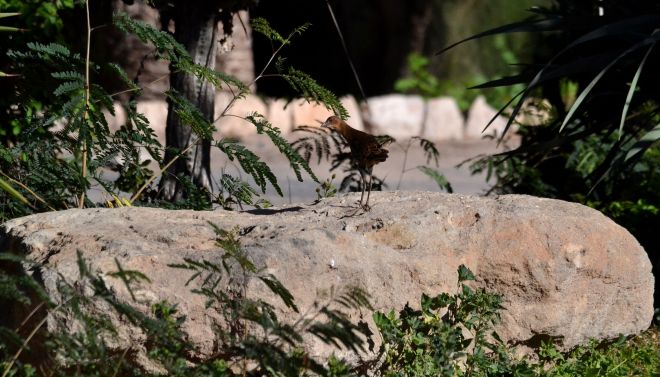
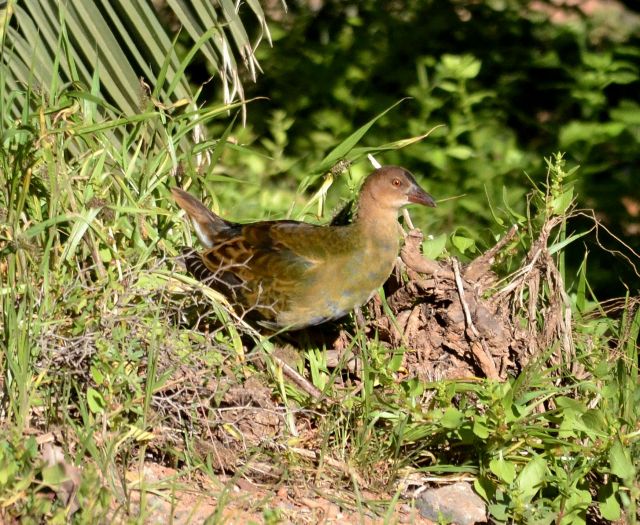
The Allen’s Gallinule (pictured above), a first winter had been frequenting a long and narrow forested strip that runs through the resort’s centre, at a spot between El Palmeral shopping centre and a communications mast opposite the Costa Calma Palace hotel. I arrived here at 11am on Wednesday (9th) armed with GPS co-ordinates provided by Dr Eduardo Garcia del Rey, president of the Sociedad Ornitologica Canaria who administers Canary Islands RBA on Facebook. And as soon as I walked in the bird flew up from one side of the path, a pattern that was to repeat itself over the next three hours.

Some other reports I had read suggested this lifer was approachable but that was not my experience. It was an easy bird to see but not to observe well. Whenever it caught sight of either myself or other people, the Allen’s would fly up into the tree cover overhead and that was what surprised me most. I have never thought of Gallinules or any other Rail or Crake as tree dwellers, but this one seemed totally at home up there (pictured below).

Stalking this bird while trying for acceptable pictures, I adopted a routine of sitting on an earth mound at the heart of it’s patch then walking a circuit at intervals. Occasionally I was joined by other birders there. Several more times the AG went up from close by always seeing me before I noticed it. From my impromptu base I also paid some attention to the small passerines that were active in the tree cover, as well as some rather more noisy and colourful characters.

The last-named were Red-vented Bulbul, (below, left) a native of the Indian sub-continent and parts of south-east Asia that has been introduced to many other countries. I knew there must be a reason for not coming across it in my pre-trip researches, and now learn this bird is regarded as one of the world’s most problematic invasive alien species. But it was still my second lifer of the morning and interesting to see here.

At one point the Red-breasted Flycatcher (above, right), also a first winter popped out and posed nicely, and I also noticed it from time to time darting about a very concentrated area in that species’ restless manner. But I did not find a Yellow-browed Warbler that had also been reported from this hot spot, seeing only Chiffchaffs and Spanish Sparrows besides the RBF. At one point I saw a Monarch butterfly, a resident species in the Canaries, but it did not settle.

At 14:00 pm I took a break, returning after an hour and in the late afternoon the Allen’s Gallinule became rather more confiding. A sequence of events next unfolded that turned my sojourn here into a very satisfying experience. First I spotted the bird right out in the open beside then atop a large mound (pictured below). And thereafter I was able to follow at a discreet distance wherever it went without it seeming concerned by my presence.

allen's gallinule.1908 costa calma

Just look at those legs … it should have been a supermodel

The Gallinule next began feeding in some longish ground cover and so I realised how I had put it up inadvertently a number of times earlier. This bird liked to keep in semi concealment in that habitat, but still seemed to allow a closer approach now than had been the case in the morning. I was all this time gaining a better understanding of its movements and habits and the end game was coming into sight.

When my quest relocated again to the spot that features at the top of this post I at last obtained pictures (below) to compare with all the others seen online. It had been a real privilege to spend five hours in this superb bird’s company and to gain such a variety of other images in the process.

allen's gallinule.1901_01 costa calma

Oh you beauty! This first winter is just beginning to acquire it’s blue adult colouring (per E G del R)

On Thursday evening (10th) I received a message from Eduardo asking if there was any further news on this rarity. I took that to mean the AG had not been reported again whilst I had been otherwise engaged with the Dwarf Bittern. So on Friday (11th) I returned to check out the same place from 15:45 to 17:20 pm, but without encountering the former again.

Instead, from my earth mound I followed the hyperactive antics of the Red-breasted Flycatcher (pictured below) through that entire interval. This tiny sprite was in exactly the same spot as two days previously, dashing about constantly, feeding in low trees and on the ground, and sitting up on a number of favoured perches. This trip’s individual was only my second record of what is a widespread central and eastern European breeder.

I wondered if I had observed the Allen’s Gallinule so well on its last day in Costa Calma, and even feared I might have spooked it, but there had been a sighting earlier on 11th and another again on Saturday (12th). Something different had indeed gone into the mix for this retro trip and my first day in Costa Calma had been a resounding success.

Note: On 18th January the Caleta de Fuste Allen’s Gallinule was re-found in it’s pre-Christmas location, confirming there were indeed two first-winter individuals on Fuerteventura through the period under discussion.

Great Northern Diver at Beale Park, Berks; and Black-throated Diver at Redditch, Worcs – 30th Dec & 2nd Jan

The opportunity to observe two wintering Divers (or Loons) within easy reach of home, both juveniles and both in public parks, has been a pleasing diversion either side of this turn of the year. I am at present finding myself going further afield to view mid-winter birds I might more usually hope to experience in Oxfordshire, but the birding scene has been unusually quiet in my home county in recent weeks. So quelling the dark season restlessness that set in after I stopped counting down to the shortest day this winter has involved more time on the road.

My previous records of both species have mostly come from Oxford’s own Farmoor Reservoir, where more recently three GND were present together in Dec 2015 but not since; and an injured BTD in full breeding plumage remained for several days in May of the same year before, sadly dying. The only exceptions were a GND in Portland Harbour (Jan 1992), and my first ever wintering BTD at a gravel pit site near Bedford (Nov 93).

The new sightings presented in this post both arrived at their respective sites on 22nd December. When I saw the GND was still just across the border with Berks last Sunday (30th), having done everything I needed to at home it filled the afternoon nicely to go and have a look. This bird was at Beale Park (SU618783), a kind of mini-zoo and visitor attraction in the Thames valley to the north-west of Reading.

I had been there previously a few times to search for Clubtail dragonflies in the adjacent riverside meadows. Unusually on-site parking appears to be free, or I have certainly yet to encounter either an attendant, ticket machine or CCTV installation; and on this occasion there was the added advantage of having the place mostly to myself. The juvenile Great Northern Diver was on view as soon as I arrived and it was certainly different to watch and enjoy one on such a small water body, a private fishing lake to one side of the car park.

I learned of the second Diver in the field whilst hoping for as iffy images of drake Smew north of Worcester on Monday (31st), by when those ducks had moved on. Then during a rather demotivated new year’s day off from birding I decided I would fill Wednesday (2nd) by making an easy trip to the end of the M40 motorway. There this bird had taken up residence at Arrow Valley Country Park (SP061673) in the town of Redditch, to the south of Birmingham.

When I arrived on-site just before midday, the juvenile Black-throated Diver was easy to pick out on the park’s main lake. It was drifting around while going through a preening routine that often involved sitting up in the water and flapping its wings. I recalled the 2015 Farmoor bird behaving in the same way. Then today’s bird began to dive again, and as with the GND two days earlier I was impressed by for how long a time it could stay under water before coming up again almost anywhere. Lastly it dozed for a while with head tucked over shoulder.

Several other birders were staking out various points around the lake’s perimeter, all hoping the bird would surface near them, just as I was. But for the most part it remained about two-thirds of the way across in water that appeared dark brown from the shadow of trees beyond the opposite bank. When it did at last pop up in the brighter-toned water near where I stood, my camera setting was then all wrong; cue a loud curse. It is at moments like that when I wish I could get my head around bird photography.

I kept 18 pictures from my two hours in the BND’s company and whilst fully appreciating how grainy and low-resolution they are, in my own way I like them well enough. Even were I a photographer I rather suspect it might become boring to always have to produce competition entries, and anyway I’m much better at insects.

So what was it like birding on the general public’s turf? I have to say things were rather more agreeable than the reverse situation of the previous post. As an often lone male of a certain age I seldom go to public parks for obvious reasons. But despite the constant procession of parents and children around Arrow Valley Lake, my motivation in standing around looking through optics was not queried at all. And I was only accosted once by someone who just had to talk at me about a Goldeneye when I was trying to get pictures of the Diver. Eventually he got the message and “left me to it”.

Enjoying prolonged encounters with the 2015 summer plumaged adult (pictured above, left) locally, and now this wintering juvenile leaves me feeling pretty well versed in things Black-throated Diver. This had been a pleasant enough and far from arduous day out.

A Snow Bunting flock at Holkham NNR, Norfolk – 28th Dec

This day was more about burning off pent-up energy on the road rather than any specific birding agenda. The period immediately following the winter solstice, when daylight hours seem barely to lengthen before the final week of January, is a tedious time for an outdoor person such as myself. So the as arduous seven hour round trip to the north Norfolk coast seemed not unattractive on this occasion, so long as it was undertaken in darkness.

In the interval since my last visit on 5th November (see here) there had been frequent reports of both Snow Bunting and Shorelark flocks in the dune area behind Holkham Bay (TF895455) that is a regular wintering ground for both species. I now arrived at the Holkham NNR car park along Lady Anne’s Drive shortly after dawn to seek them out, making my way to an area that has been cordoned off for these birds protection.

snow bunting.1810 holkham

There were just several other birders and a few dog walkers present and all was pleasant and tranquil as the morning brightened. I soon noticed a ground feeding group of birds within the impromptu enclosure that indeed was the 50-plus Snow Bunting flock (pictured above), and at once became captivated by them. Their collective charm seemed to be augmented by the plumage variation amongst individuals; the warm, rusty tones of winter plumaged females contrasting attractively with the whiter colouration of males. Juveniles contributed in their more understated way to what somehow resembled an undulating patchwork quilt as the entire ensemble buzzed about feeding restlessly all the while and moving from place to place.

Snow Bunting is an annual winter visitor to Great Britain from Arctic and trans-polar breeding grounds, though a small number are resident in the Scottish Cairngorms. A fairly large and long-winged, ground dwelling Bunting, its breeding colouration evolves from a gradual wearing and abrasion of the feathers rather than a conventional spring moult. Having encountered this bird only in very small numbers previously this now was a very worthwhile experience to come across so many together and hence note the degree of plumage variation that exists.

I continued to enjoy the mini spectacle being played out before me for the next two hours while wandering about Holkham’s vegetated dune habitat and chatting to the other birders. There was also a larger flock of Twite here, another of Norfolk’s speciality winter passerines. Offshore there were Divers, Grebes and what looked like a raft of Scoter, though I am not a great one for identifying dark specks on the sea at distance. But of the reported Shorelark flock there was resolutely no sign.

The reason for that soon became clear. By 11am this SSSI began to heave with general public and their dogs. Though people kept out of the roped off area as requested the identical adjacent habitat, that it is not rocket science to realise is equally sensitive, was being roundly trampled. Even had any Shorelark been concealed in there somewhere they would hardly be sticking around now. Meaningful birding was over for the day.

That was merely a foretaste. By the time I reached the boardwalk leading back to the car park, the human and canine tide flowing in the outward direction was assuming near biblical proportions. Since I was in this place for a purpose, namely to observe wildlife, to my mind it seemed these crowds were mostly just walking about doing very little other than being out and about together. So why go to a national nature reserve that is meant to exist for the benefit of wildlife then do just what they would in a public park? I must confess to not actually getting it.

In retrospect I should perhaps not have been so taken aback. Holkham is Englands’ largest NNR and a significant contributor to the local economy, and whilst the Holkham Estate and Natural England take measures to protect habitats from visitor pressure they likewise have jobs and the regional tourism infrastructure to support. Everywhere now, though birders are a well represented group in the visitor total, conservation charities have long since decided that green clad optics carriers are a less ready resource than the general public when it comes to hands being put in pockets.

Whether we are less likely to go to forward slash gizyerdosh when we get back home, as appears to be reserve managers’ perception, I cannot say. But we travel long distances and so accrue that cost before arriving, we like to avoid paying to park if possible, we bring packed lunches, we spend our time in the field rather than in cafeterias or on-site shops, etc, etc. But might I ask quietly herein once again: “What about the wildlife, and is there not a better way than what just seems like a self defeating cycle where conservation is concerned?” These views are not intended as a rant but needless to say I headed out of there pretty sharpish.

Some other birders were still arriving as I left, and as throughout the morning all were asking one another if anyone had seen any Shorelarks. But during what must also have been two previous days of pressure and disturbance the prime reason for actual wildlife enthusiasts to visit this site must simply have gone elsewhere, just like before my previous visit. By contrast the Snow Buntings (below) seemed unconcerned by all the company and continued in their own busy and alluring way throughout.

snow bunting.1808 holkham

I had planned to spend the rest of daylight at nearby Wells Wood to try for two Coues’s Arctic Redpoll, but now thought better of even attempting to negotiate the car park there. Instead I moved part way home to a reservoir site in Leicestershire, finding nothing of note but re-attaining some peace and tranquilly while quietly watching birds until dusk.

December has been unusually uneventful nationally for notable birds. I have not been inactive in this mid-winter, having enjoyed good experiences locally of four seasonal finches – Common Crossbill, Siskin, Redpoll and Brambling – and gone a bit further afield to cover that most charismatic of winter wildfowl, Smew. But I do not assume people will wish to consult this journal if I am not presenting something of national or European interest. And though not a photographer I prefer to include pictures of some kind. Gaining my best ever experience of Snow Bunting, with pictures today seemed worth including here albeit with a certain degree of frustration over not observing more.

White-tailed Eagle in the New Forest, Hants – 16th Dec

The opportunity to experience my second British White-tailed Eagle at the far end of the A34 / M3 / M27 run from Oxford provided welcome respite from birding doldrums that have set in since my last entry in this journal. That 5½ week interval has been very quiet both nationally and so far in December locally too. Hence reading of this raptor on RBA upon rising this morning made it a fairly easy decision to get straight out of the door.

The site in question was quoted as Milkham Inclosure (SZ210100) lying to the north of the A31 trunk road between Cadnam and Ringwood in the New Forest National Park. But RBA had yet to give more directions. OS Explorer map OL22 shows a number of parking areas along a road skirting the forestry plantation’s northern side that I checked on arrival for assemblages of birders. But finding no signs of activity I returned to the first car park where two locals fed me information from a Hampshire source that I suspect was Going Birding.

The WTE, a juvenile had first been reported on RBA two days previously, but I now learned some reports were saying it had been in the area for up to 10 days. Also the bird was being encouraged to stick around by carcasses being put out in the area between the A31 and the plantation. The best viewpoint was cited as a lay-by on the A31. Though some birders were visible on foot between there and where I was, with the skies looking threatening I opted to follow that advice and drove on.

The right place had to be on the north-east bound carriageway, judging by the numbers of cars parked there. This meant turning back at the Picket Post Services junction, after which it was the second lay-by heading the other way. Once there I beheld a twitch line a short distance to one side of the road. Another birder then pointed out the White-tailed Eagle flying over the tree-line to the north, before going down into Roe Inclosure, just west of the first cited plantation. So priority one: “see the bird” was achieved immediately.

This was indeed an excellent spot from which to view the plantations to the north. After getting all my kit together I went over to join the other birders, though some were already walking away being satisfied with their views just gained. I soon wondered if they should have stayed a little longer since the Eagle re-emerged then perched in the top of a tall Pine tree. Priority two: “see the bird well” was quickly followed by priority three: “get any kind of picture”. But at that range in overcast conditions the distant records (above) were all I was going to gain. It was now about 11:35am.

When the WTE next flew further back and out of sight, more birders also moved on. But the location of the carcass in Buckherd Bottom having been pointed out I decided to stay and see if the bird might come closer to feed. I remained on-site for some time during which the twitch line built up again as RBA was now directing people to the lay-by. After a while our quest was relocated, perched very distantly in two more locations. Most of the later arriving birders had to make do with those views. At around 1:10pm, having noticed a squall approaching from the west I headed back to my car, reaching safety just before the weather turned foul. Priority four: “get a better picture” would have to wait for another day.

The New Forest has some past form where Eagles are concerned, with both White-tailed and Short-toed being recorded in this decade. English WTE records remain uncommon away from the east coast, and especially this far south. Though today’s bird appears to be ringed it is not yet known where it hails from, but across the North Sea the species now breeds as far south as Holland. My only previous record of White-tailed Eagle in Great Britain was in Suffolk in January 1989, much closer to when they began to be re-introduced into parts of Scotland. I have also observed this impressive raptor in Estonia but have yet to bird in Scotland where WTE is now a popular tourist attraction. Not a bad Sunday out then, all things considered.