My first Aurantiaca Damselfy is tracked down in the New Forest, Hants – 1st June

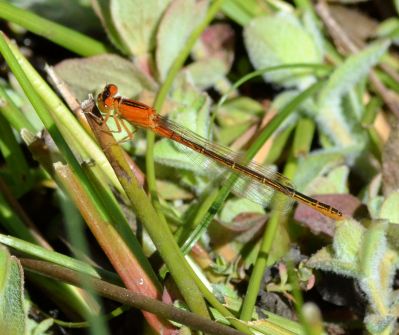
Having gone into 2020 with a specific wildlife agenda the spring part of which is now on hold for another year, on the first day of summer I was able to get out and convert one item of it. This is the earliest date on which the mystical and fabled aurantiaca, the teneral female Scarce Blue-tailed Damselfly was recorded in 2019 by one of the leading British odo bloggers.

Today was my own third attempt at experiencing the quite beautiful, orange and black-toned colour form in what is a brief window of opportunity. A year ago I had to abandon my search in overcast conditions, and in 2018 I just didn’t see any. Thus it was that at around 11am I came back to one of my favourite New Forest odo sites, Latchmore Brook (SU182124). The parking area was by necessity closed and walking in from a discreet distance to respect appeals from local residents I felt pleased there would be rather less general public than usual here.

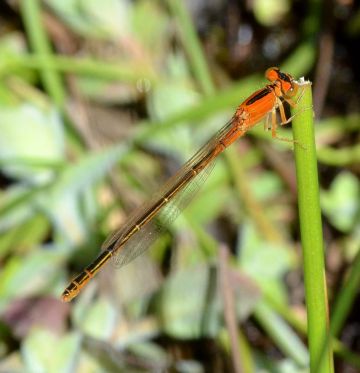
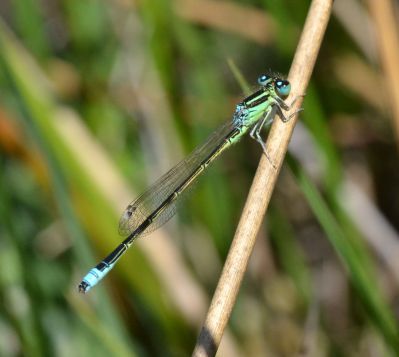
scarce blue-tailed.2010 imm fem latchford brook

Scarce Blue-tailed Damselfly, imm fem aurantiaca phase

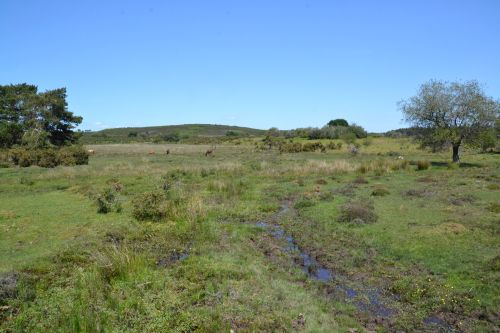
Scarce Blue-tailed Damselfy (SBT) has a marked preference for shallow water conditions with little vegetation, that occur in heathland valley mires such as one to the immediate north of Latchmore Brook. I was concerned that after such an exceptionally hot and dry May the bog here might have dried out, but on arrival found plenty of surface water (pictured below). After walking about at random for a while I waded into what seemed from past experience of the site a promising looking piece of mire. Then on turning around to keep my footing, there right behind me was an aurantiaca in all her bright finery. What a moment!

DSC_0114

Lowland valley mire habitat at Latchmore Brook

Normally I am perhaps too sensitive over going into odo sites and possibly damaging habitat. But here the mire was already greatly pitted and trampled by grazing cattle and ponies, so I did not feel my usual compunction at doing more of the same. Indeed a degree of such habitat disturbance creates favourable conditions for SBT (per Brooks and Lewington). I was surprised by how still my quest kept for much of the time as I captured the images herein, so she was not bothered by my presence. She really is a rather special damsel, is she not?

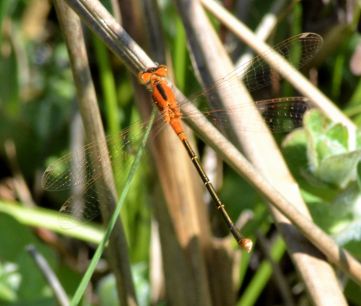
scarce blue-tailed.2014 imm fem latchford brook

Scarce Blue-tailed Damselfly, imm fem aurantiaca phase

The same degree of tolerance was not evident from the human company today. Another odo hunter on site ignored me studiously through an hour before the blogger himself arrived and blanked me too, not for the first time in the field. But I had already self-found my quest, and not one for being rabbited at myself never attempt to make others engage if they do not wish to. I sought out more aurantiacae through a further hour or so here but without success. Mission had been accomplished early on this visit.

SBT’s emergence period typically begins in late May, peaks in June and continues through to July. Emergence occurs throughout the morning under favourable conditions, so my own timing seemed to be appropriate. But when delayed by cooler, overcast conditions a sudden sunny spell will trigger activity at other times of day. Freshly emerged adults, of which I noticed some here are dull brown but develop brighter colours by the following day. Females progress from this initial bright orange phase to greenish brown as they mature. The flight season lasts until early September.

I possibly owed success today to the relative shallowness of the mire in the present prolonged dry weather period. On past visits here I can recall misplaced steps causing me to sink in to knee level and so would have been far more cautious, but today there were no such mishaps. I doubt whether odo royalty secures its images by always staying on the perimeter. Having gained these pictures so early I wondered what to do next and the best answer seemed to be secure an acceptable one of a male. I located several moving low down in the mire vegetation, of which only this study (below) adequately shows the diagnostics.

scarce blue-tailed.2001 latchford brook

Male Scarce Blue-tailed Damselfly

First impressions are of a smaller, weaker flying blue damselfly than regular Blue-tailed. The “blue tail” itself extends over the lower part of segment 8 and there are two black dots on segment 9 that are just about discernible in the above image. Markings on the thorax develop through green and turquoise to deep blue as males mature. They spend their time lying in wait for passing females, being quick to investigate then pursue any likely mate.

scarce blue-tailed.2011 imm fem latchford brook

Scarce Blue-tailed Damselfly, imm fem aurantiaca phase

But today was all about the female Scarce Blue-tailed Dameslfly. There is very little for me still to experience where English odonata are concerned. To have now successfully searched out this highly attractive colour form after two years of trying was immensely satisfying.

The first precious jewels of summer 2020: a further celebration of the Black Hairstreak – 31st May

Observing oft-recorded British butterflies in new places has been one theme of this most unusual spring of 2020, but on its final day my going back to where it all began for one very special species proved to be even more satisfying. Overnight I had learned that Black Hairstreak were now flying in a particular place to the north of Oxford. So I contacted Ewan who had already checked our own recent location of choice twice this season where none had yet emerged, and we met at the second site just before 9:30am.

When I joined Butterfly Conservation in 2010 and participated in various field trips, today’s location was an acknowledged hot spot for a butterfly that is one of Great Britain’s most threatened and hence sought after in equal measure. The group leader explained how an issue had arisen there with egg collection and that if participants were to return in the autumn we might likely come across a degree of trimming of the Blackthorn food plant hedges.

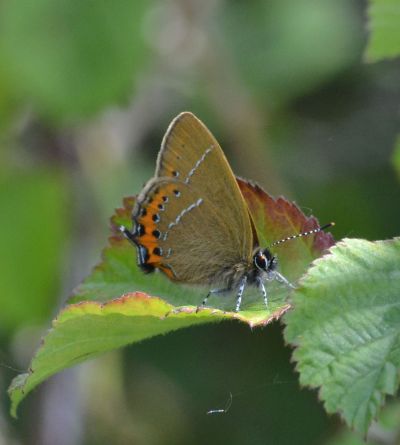
black hairstreak.2002

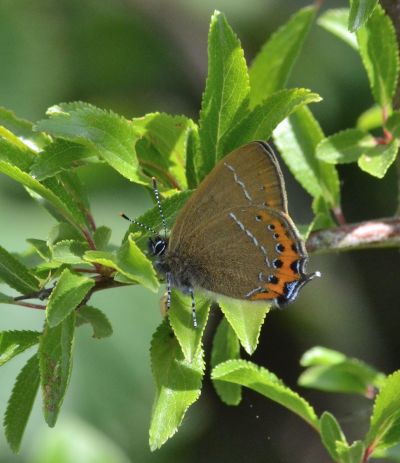
Black Hairstreak

This particular colony indeed declined over the ensuing years, during which the centre of attention for Black Hairstreak and its attendant, social media-inspired circus moved first to the M40 Compensation Area of Bernwood Forest, then Whitecross Green Wood in Oxfordshire. Most recently another population, close to a long-standing stronghold that had been put off limits to genuine butterfly enthusiasts by HS2 construction works, came under the same visitor pressure with habitat being roundly trashed once again. But no matter where else I went for this particular record, I made a point of still checking today’s site, mostly finding no more than a few individuals and in some years none at all.

black hairstreak.2003

Black Hairstreak

All this harassment of an endangered species and habitat pressurisation progressed with the apparent blessing of conservation charities, as they persisted with the folly of prioritising hands in new members’ pockets over servicing their core interest groups and support, as all now seem to do. So perhaps no wildlife species symbolises that ongoing misplacement of loyalties better than the Black Hairstreak butterfly.

black hairstreak.2004

Black Hairstreak

Today we found a cluster of up to a dozen Black Hairstreak at the same spot I had first visited on a BC field outing 10 years previously. These were mostly keeping near the tops of the Blackthorn hedges since there were no flowering wild plants such as Bramble or Privet to bring them lower and so offer the kind of point blank communion we had enjoyed at other sites in recent years. But every so often an individual would indeed pose agreeably enough for acceptable pictures to be obtained.

black hairstreak.2001

Black Hairstreak

I do not really need more images of any previously recorded British butterfly in this current season, having an extensive collection already. But being unable like everyone else at present to travel abroad and widen my butterfly experience I must be content with repeat exercises such as this. My policy is to get in and out early where Black Hairstreak is concerned, before the circus arrives back in town.

Having recorded the species for 2020 and gained the studies presented in this post, some of which do seem a little evolved from those of other years, I now feel less need to visit other sites. That things have turned full circle for Black Hairstreak in a former stronghold where it appears to be thriving once more is especially gladdening. And so I intend to leave this most beleaguered of our butterflies in peace to see out it’s brief June flight season free from my own further attentions.

Wyre Forest, Worcs re-visited for Small Pearl-bordered Fritillary – 27th May

My present national butterfly agenda includes one site visit for each of the early season Fritillaries, so today I returned to the ancient Oak woodland of Wyre Forest at Bewdley that I first visited in this same week 12 months ago (see here). Meeting Ewan at the usual start time of 10am in that site’s Dry Mill Lane car park (SO771762), our quest was Small Pearl-bordered Fritillary of which this NNR hosts a healthy population.

small pearl-bordered fritillary.2005 wyre forest

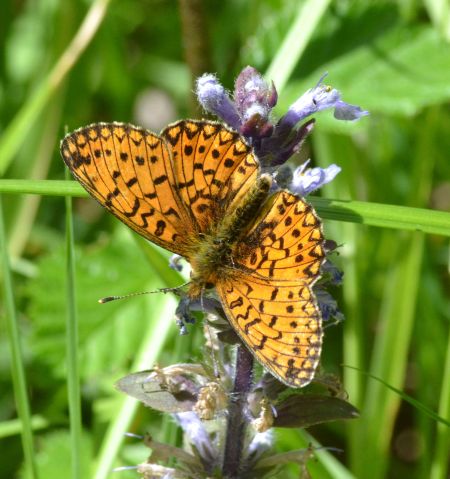
Small Pearl-bordered Fritillary

We first walked westward along the hard-surfaced access route of a former railway line. This was being very well used by family groups, dog walkers and cyclists, and every day in the countryside seems like a Sunday at the moment in the still surreal post lock-down climate. In track-side areas that must be managed for them we soon began to notice Pearl-bordered Fritillary, amongst which some individuals (pictured below) were still quite fresh. But how aware of this local treasure the human footfall all around us may have been I cannot say.

Those butterflies are now nearing the end of their flight season, but that of Small PBF is just beginning. So we turned off this busy thoroughfare and took a path steeply down into the valley of Dowles Brook that adjoins the northern edge of the reserve. In the rather idyllic setting of stream-side meadows at our trek’s end we encountered much richer brown and faster flying Fritillaries that at once stood out from the still present Pearls, and that was what we had come here to find.

The easiest way to separate Small Pearl-bordered Fritillary through binoculars on first encountering them is to pick out the black chevrons surrounding both underside wing edge pearls, a prominent black dot near the centre of the hind-wing, and markings along the top-side edge of the fore-wing that appear to spell the letters 730. The two sequences above illustrate those diagnostics quite clearly.

The two butterflies are also quite different on jizz once the observer has their eye in. On this sunny morning the presumably male Small Pearls we found here were all very hyperactive, patrolling endlessly in search of mates. On settling they would most usually keep tumbling around their flower heads of choice which made gaining acceptable images of them quite difficult to achieve. But I persevered and there were quite a few more butterflies to choose from here today than during my previous 2019 visits.

A year ago I did rather better for top-side than underside studies, but today that situation was reversed. The above collage presents my better results. We remained at this place for around an hour and for much of that time had it to ourselves. I would fear for the lush habitat here if this tranquil spot ever acquired the popularity for SPBF of Bentley Wood in Hants, hence my vagueness as to the precise location. My better top side studies are presented below.

After moving on in the early afternoon we birded the woods on the valley sides, encountering two Pied Flycatcher and finding a Great Spotted Woodpecker nest. Common Redstart and Wood Warbler also breed on this reserve but we did not find any today. Lastly we walked back along the main access track, and some Small Pearls were now also active amongst the Pearls in the managed areas viewed in the morning. The under-wing images herein featuring Horseshoe Vetch were all captured in that second location.

I dealt with SPBF in detail in the two posts published in this journal in 2019, so this account of a follow up visit is a briefer, picture-based treatment. Much of the specific wildlife agenda I went into this present remarkable year with has had to be abandoned, but re-experiencing these two little treasures of any British spring was always going to be part of the plan.

Bucknell Wood, Northants re-visited for 2020 Wood White – 23rd May

I had not visited this classic Wood White site for five years since the previous, brief post in this journal as part of my 2015 British butterflies series (see here). Indeed I have not recorded the species nationally during that interval, so given my current re-working of the British list, when Ewan asked me to accompany him there today I opted to join him.

wood white.2006 bucknell wood

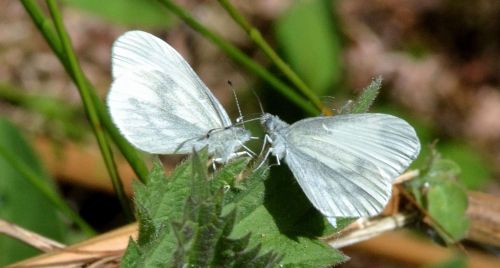
The courting dance of springtime Wood White today

My own access point to Bucknell Wood outside the village of Silverstone has been along a track at its southern end (SP 65882 44750), from where I have usually found this butterfly immediately. But on arriving there at around 10am my colleague was in the main Forestry Commission car park a little to the north, and neither of us knew of the alternative locations. So through the course of this exercise we both became aware of a second option, which was perhaps apt at the present time with many times the usual numbers of people visiting the countryside and parking areas being under pressure.

At first I set out along my usual past route, but as it was overcast and windy it was plain I would not find any butterflies yet. So I went up to the other access point and belatedly our paths crossed. The conditions remained distinctly butterfly unfriendly for the next hour, and then we had to shelter as best we could from a minor soaking. But as that weather front drifted eastward across the wood, extensive clear blue sky followed behind it. Such a scenario seemed perfect for accomplishing our mission as butterflies would emerge again as the late morning warmed up, and so things transpired.

Though the site was now sunlit strong wind was still afflicting the main rides, but along a more grassy and sheltered track I eventually came across a first roosting Wood White on an exposed perch. This was presumably a female since a second butterfly arrived on the scene and proceeded to dance around the first (pictured above, right). But the latter appeared to be getting the old cold shoulder and so presumably “he” flew off. Before too much longer we were encountering several of these ghostly waifs (pictured above) and two maturing Broad-bodied Chaser dragonflies (below) across the same area.

The Wood White displays a noticeably dainty jizz compared to Small or Green-veined Whites, having one of the slowest and most delicate flights of any British butterfly. The smallest of those three, they indeed flap their oval wings so under-statedly as they glide about that the distinctive faint patterning is readily visible, and always rest with wings closed. Unlike other whites these live in self-contained colonies of a few dozen and largely remain faithful to their breeding area in English woodlands.

Adults in southern sites typically begin to emerge in late April, peaking in May and lasting into June before dwindling through that month. The average life-span is eight days, though some individuals can last for up to three weeks. There is usually then a second brood in which males display smaller, darker wing tips. Numbers can then be as high again after a warm spring such as the present one, flying from mid-July to late August.

Males spend their time patrolling up to a metre above the ground in their search for mates, checking out any white object they come across. If that turns out to be a newly emerged female they begin the distinctive head-to-head courtship dance captured in this post’s lead image. Our first sighting today must have been less fresh as she appeared to reject the suitor concerned. Females fly only half as much as males and when observed are usually nectaring on plants such as Bugle, Ragged Robin or Birds-foot Trefoil. Males may nectar less on flowers and supplement their diet by mud-puddling for mineral salts if the conditions are right.

Wood White was one of the fastest declining native butterflies over the last 30 years of the 20th century, and in 2007 became a priority species in the UK National Biodiversity Action Plan. Mounting concern over its plight led to the development of a recovery project led by Butterfly Conservation. By 2010 only 50 extant sites were identified, of which 13 were thought to have already lost their colonies.

Bucknell Wood is one of a complex of six forest sites in Northamptonshire and north Bucks that hold 20% of the species’ national total. The others are Hazelborough Forest, Whitefield Wood, Sywell and Hardwick Woods, and part of Yardley Chase. Five of those are managed by the Forestry Commission which has worked with BC staff and volunteers to create the sunny rides and clearings that Wood White requires to survive.

After leaving here we paid a brief visit to nearby Hazelborough Forest (SP659431) where in the area we accessed the difference in habitat to that required by Wood White was quite apparent. The next heavy rain belt was also approaching and so we did not linger. But I returned here two days later and indeed found more butterflies in suitable habitat along the main ride and a side track from it. The second brood of the enigmatic Wood White is one I have yet to experience in Great Britain, so a further visit to this area seems quite likely.

The Marsh Fritillaries of Strawberry Banks SSSI, Glos – 21st May

The reserve of Strawberry Banks is one I have wanted to experience for some years now, so doing so today gave me an evolved way of recording Marsh Fritillary for the 2020 season. An “unimproved” limestone grassland in the Cotswold AONB, it is privately owned and managed in a traditional way, until recently by the Gloucestershire Wildlife Trust. The most well-known butterfly here each year was my quest for this visit. Famously in May 2011 there was an explosion of 15,000 at the site, though in most years numbers are far more modest.

marsh fritillary.2001_01 strawberry banks

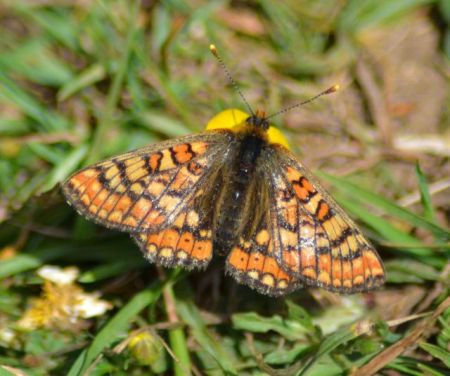
Marsh Fritillary

The reserve (see here) is accessed from a minor road between Oakridge Lynch and Chalford in the highly picturesque Frome Valley to the east of Stroud, Glos. From there (SO 91164 02938) rights of way lead uphill through the ancient Cotswold Beech woodlands of Three Groves Wood on the right and Oldhills Wood on the left. The SSSI itself comprises two steep and wildflower rich pastures on the eastern side of the minor valley of a Frome tributary that flows between those two woodlands.

Once I arrived on site at around 10am it wasn’t long before a first Marsh Fritillary crossed my path, before doing what this species invariably does by posing nicely on a raised stem. All the butterflies I observed today were along the lowest edges of both meadows, and often displayed a preference for nectaring on Buttercups. But the main food plant is Devil’s-bit Scabious. Over the years I have noted some size variation between different populations observed in Great Britain and continental Europe, and today was struck by the relative smallness of this particular cluster.

Though once widespread in the British Isles the Marsh Fritillary declined severely through the 20th century. Having acquired threatened status the species has been the subject of much conservation effort over the past two decades and more recently has enjoyed something of a revival. This Gloucestershire breeding colony is a long established one but populations in general are highly volatile and long term survival will depend upon the maintenance of suitable low-intensity grazed habitats.

There are three main habitat types: damp grasslands dominated by tussock forming grasses, ancient calcareous grasslands usually on west or south-facing slopes in England, and shorter coastal grasslands in other parts of the British Isles. Temporary colonies can also occur either in larger woodland clearings or other grasslands. Smaller isolated clusters are easily impacted by sudden changes to habitat.

Having become extinct here in Oxfordshire during the 1990s, small numbers of MF have in the last two years been recorded on the South Oxon Downs and at Cholsey Marsh in the Thames Valley, though whether this is due to releases remains unclear. The species has also returned to its last known BC UTB location of Seven Barrows on the Berkshire Downs in the current flight season. And a project is now underway to restore Marsh Fritillary to the damp grassland fields of RSPB Otmoor just to the north-east of Oxford (see here).

I feel pleased to have got around to visiting one of the most constant MF populations in southern England in this scenic and uplifting location of Stroud’s “Golden Valley” (see here). Recording scarcer butterflies in new locations is always satisfying as the ongoing pattern of this most unusual of years continues to confirm.


For new visitors to this blog who might have been directed via a specific species search, the different posts presented herein on British Butterflies are regularly referred to. The most consulted items to date are:

Glanville Fritillary @ Hutchinson’s Bank, Surrey – 1066 views

Marsh Fritillary et al @ Cotley Hill, Wilts – 621 views

Large Heath @ Whixall Moss, Shropshire – 408 views

Wood White @ Bucknell Wood, Northants – 254 views

Marsh Fritillary et al @ Battlesbury Hill, Wilts – 228 views

Duke of Burgundy @ Noar Hill, Hants – 225 views

Large Blue @ Daneway Banks, Glos – 222 views

Black Hairstreak @ Whitecross Green Wood, Oxon – 214 views

Heath Fritillary @ East Blean Wood, Kent – 193 views

Pearl-bordered Fritillary @ Bentley Wood, Hants – 186 views

Pearl-bordered Fritillary @ Rewell Wood, Sussex – 178 views

Purple Emperor et al @ Bernwood Forest, Bucks – 168 views

Duke of Burgundy at Noar and Butser Hills – 132 views

Adonis Blue @ Aston Rowant NNR, Oxon – 127 views

2020 Pearl-bordered Fritillary in the New Forest, Hants + British spring butterflies at Oxon sites: 14 – 18th May

The present exceptional circumstances have ruled out any butterflying abroad this spring, so I have found myself working through the British list once again. And that has proved to be more motivating than I could have imagined pre-Covid 19. Indeed prior to today I had managed to record almost everything that could be expected in a more normal season. The exceptions were Duke of Burgundy and Pearl-bordered Fritillary, that do not occur here in Oxfordshire.

pearl-bordered fritillary.2001 new forest

Pearl-bordered Fritillary

So having left the first weekend since lock-down was eased in the British countryside to the general public, whilst myself opting to keep a lower profile, I now hit the road on a bijou day trip to Hampshire. Of the five PBF sites described herein in 2019, the one I enjoyed most was the “East Inclosures” of the New Forest national park, since it was the quietest. This area is accessed from the Standing Hat car park (SU314036) just outside Brockenhurst. My arrival there at around 10am this morning was timed to coincide with these delightful butterflies warming up with the day, before they become too hyperactive to record pictorially.

As soon as I walked into the forest here a first Pearl-bordered Fritillary crossed my path, then along the initial stretch of track out to the inclosures I counted four more. Soon after heading off that hard track towards the hot spot of a year ago (see here), I came upon a cluster of 10 all nectaring on Bugle and the first part of my dual mission for this day was soon accomplished.

Places I walked where Bugle was in flower were always the most productive in terms of observing Pearls today. That is one of a number of low-growing, forest clearing plants such as Violet, Primrose and Wild Hyacinth these butterflies depend upon in the ephemeral habitat they require of coppiced woodland where the undergrowth has been cut down for two or three years. When not nectaring males spend their time energetically flitting and gliding up to a metre above ground level in an endless search for newly emerged females. On finding one they will hover around the potential mate until either being accepted or rejected, and this was behaviour I witnessed several times today.

I was fortunate to have found this concentration so early in my visit, as the most productive spot of last year was far less so when I reached it this time. I then explored more rides coming across Pearls mostly in ones or twos in different places. The seven silver pearl markings that edge the underside hind-wings, and so account for this rather special butterfly’s name are visible in this sequence (below).

When I arrived here the forest seemed gloriously empty after the weekend, and for much of my three hours on site I had things largely to myself, save for the intermittent company of a Hants BC transect walker. But by 1.00 pm the location had inevitably filled up with general public. I moved on to a Duke of Burgundy site at Farley Mount near Winchester, but in contrast to a year ago found neither those or Pearls this time. So the former remains a butterfly I may not record for this 2020 British season.

Oxon spring butterflies, 2020

Over the preceding four days since the government lifted restrictions on internal travel I managed to add several spring speciality Oxfordshire butterflies for this year to the commoner species observed in my local countryside over the seven weeks of lock-down. At the weekend everyone I heard from or spoke to who had gone anywhere with a car park used words such as bedlam or pandemonium, as the British public poured en masse into the countryside. In an attempt to keep reasonably remote I chose to walk the South Oxon Downs above Aston Upthorpe, a classic butterfly area.

At Lowbury Hill (SU539825) I gained personal first site records of Green Hairstreak and Dingy Skipper, while Small Copper and plentiful Small Heath were also active. By late morning I was competing for space with motocross riders, and at one point was accosted by the loud occupants of an off road vehicle who just had to disturb me. Those activities are ongoing issues in the locality and the tracks leading to the Ridgeway area were badly rutted during the wet months of January and February this year.

Walking back to my own car through the open access land of Juniper Valley I found more Dingy and Grizzled Skipper, both of which are site specialities. Small Heath and Common Blue were each flying in numbers. A nearby motocross track is closed at present so people must be taking their bikes up onto the sensitive wildlife habitat of the high Downs. Vans and multi-occupied cars passed in the opposite direction once I had left the relative peace of the SSSI.

On 14th I visited another classic Oxon butterfly site Watlington Hill NT (SU702932) on the Chilterns escarpment, to seek out its speciality Blues. Common Blue and Brown Argus were both duly encountered, the latter mostly around some enclosures that have been created to protect Horseshoe Vetch from grazing rabbits. That is the food plant of Adonis Blue and I was delighted to secure a personal first site record of that iconic spring butterfly there.

Lastly, the second sequence of Orange Tip pictures (below) was recorded on a local footpath during a walk from home since my recent post on that butterfly (see here). During a somewhat surreal interval one encounter and picture opportunity such as this would often make the day’s outing seem worthwhile, which of course every local walk was.

The seven weeks of lock-down seem like no time at all to look back on, more like a hole in my memory, and filling each day successfully was motivating in itself. But anything I did prior to this unprecedented experience now seems a very long time ago.

A selection of anecdotes concerning the English Cuckoo Pint (Arum maculatum) – April 2020

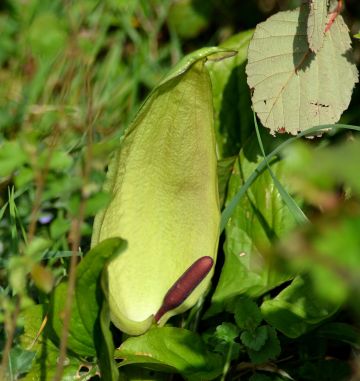
The only English Aroid enjoys a place in national folklore like few other native wild plants. Having been unable to resist the little irony at the close of my previous post, I soon began to notice imminent Cuckoo Pint blooms in those unkempt corners of my garden that I retain at least partly for their benefit. Everywhere I have walked in the local countryside so far this year there has been a profusion of Arum maculatum foliage. Now these rampant, quintessentially English plants of shady places everywhere are revealing their very particular character.

DSC_0008

“Lords and Ladies” in Toot Baldon, Oxon

Thus having searched on-line for whatever mildly entertaining trivia might be forthcoming, I now present it herein. Folk-tales and herbal remedies a-plenty have been associated with the Cuckoo Pint over the centuries. Estimates of the number of other colloquial names for it range from 90 to upwards of 150, more than any other native English plant. Many of them and especially the gender-related ones arise from the brief April bloom’s suggestive quality. Consider: Lords and Ladies, Cows and Bulls, Stallions and Mares, Devils and Angels, Adam and Eve, Soldiers Diddies, or most to the point the Willy Lily.
cuckoo pint.01

So what’s in a name? I was possibly slow to realise, until researching this piece, that if all but the first two and last two letters of “Cuckoo Pint” are removed … I’ll stop there. So perhaps the term is a quaint folklore equivalent of rhyming slang, or similar play on words, but I have yet to find anything else on-line which is so impolite as to confirm that. Moving swiftly on, if not merely a euphemism the “Cuckoo” half of the name may refer to the time of year when both those birds and the Arum blooms first appear in the countryside. “Pint” is widely agreed to be a shortening of the old-English word “Pintle” meaning … well, can you guess? “Priest’s Pintle” is yet another of the vernacular names

But the wild Arum known as “Cuckoo Pint” possessed an ability to stir the rustic English imagination in more diverse ways. Beholders of the inflorescence who might prefer religious interpretations may choose from Friar’s Cowl, Jack in the Pulpit, or Parson and Clerk. Other non-smutty alternatives might be Soldier in a Sentry Box, Bloody Man’s Finger, Wake Robin, Tender Ear, Cheese and Toast, and many more besides. Two of the longer winded ones are “Sonsie Give Us Your Hand” or even “Kitty Come Down the Lane, Jump Up and Kiss Me”; or so my researches suggest.

Cuckoo Pints around Toot and Marsh Baldon, Oxon

Given it’s more obvious amorous associations it is hardly surprising that historically the Cuckoo Pint has enjoyed a reputation for possessing aphrodisiac powers. Any country names with “Cuckoo” in them tend to have such meanings. A PDF published by Fareham Borough Council in 2019 (see here) states that in some areas it was believed girls could get pregnant simply by looking at this plant, yes really! Well there’s an excuse for frolicsome wenches of the day. I wonder if anyone believed them?

More credibly, this plant has been put to an astonishing range of uses over the centuries. In folk medicine the leaves of A maculatum were squeezed to extract the juice that was then used to burn off warts and other growths on the skin. This practice was particularly popular during the mid-17th century. The roots of the plant were also dried and made into a powder, used to alleviate rheumatism or paralysis. In the 18th century, the leaf juice was distilled and applied to the face as an anti-ageing treatment; while that of the root was applied to treating asthma, ruptures, scurvy and wind. Herbalists largely stopped using it at the start of the 20th century.

starchmakers

17th century starch makers

Away from “medicine”, it was noted that root tubers contained starch that during the Elizabethan period was used to stiffen linen, especially the then fashionable long ruffs (collars). The 15th century nuns of Syon Abbey used the roots to make starch for altar cloths and other church linens. Hence “Starchwort” was then yet another colloquial name. But due to the high corrosive properties of the juice, these practices didn’t last as people tasked with laundering the clothing could suffer painful effects.

Flemish ruffs c1585

“The most pure and white starch is made of the rootes of the Cuckoo-pint, but most hurtful for the hands of the laundresse that have the handling of it, for it chappeth, blistereth, and maketh the hands rough and rugged and withall smarting”.
Gerard’s Herbal, 1633

All parts of the plant may produce allergic skin reactions. But there are nonetheless reports in past published herbals of Arum starch being used in skin cosmetics in 19th century Paris, and also for removing freckles in Italy at that time. An ointment made by stewing the juice of fresh sliced tubers with lard was in places cited as an efficient cure for the fungal skin infection Ringworm, despite causing blistering when applied.

Cuckoo-pint root if washed and roasted well is edible, and when ground was once traded under the name of “Portland Sago”. This flour was used to make “Saloop”, a hot drink popular amongst the lower orders of 18th and 19th century society as a lower-cost alternative to tea or coffee. It was said to be very refreshing, and was served in the same way with milk and sugar, but if prepared incorrectly could be highly toxic. The beverage was also considered a remedy for various ailments as well as hangovers. But its popularity is said to have declined on becoming associated with treating venereal disease, after which drinking it in public was deemed shameful. Saloop street vendors in London then became replaced by coffee stalls.
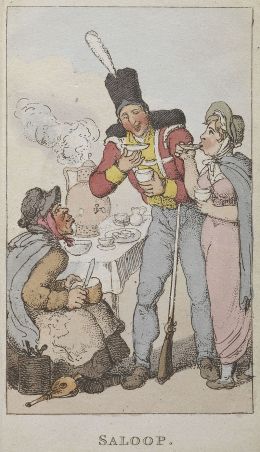
Saloop

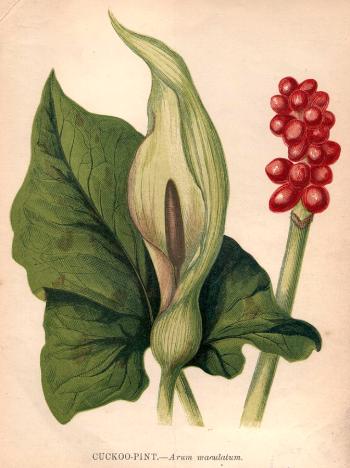
Moving on to botanic matters the glossy, spear-shaped leaves appear very early in the year, followed by the blooms at this time of writing. Pollinators are attracted by an odour and raised temperature generated in the early evening. Minute flies visiting the plant enter the floral trap of the spathe through a zone of bristles, then fall into a smooth-walled floral chamber from which they cannot escape. Gorging themselves on a secretion produced by the female flowers at the base of the spadix, the trapped flies effect cross-pollination if they have previously visited another Cuckoo Pint. All the while the male flowers, situated much higher on the spadix, rain pollen down onto their guests. The next day, when smell, heat, and food are gone, those pollen-laden insects are allowed to escape by a wilting of the bristles. Thus released they are then as often as not recaptured by other inflorescences still in the smelly receptive stage, and so things continue.

As with many Aroids the blooms last for little more than a day, then the whole plant quickly wilts. Later in the season the stems turn into erect spikes of bright orange berries that are a highly attractive and long lasting feature wherever Cuckoo Pints occur. But as always in nature such a colouration indicates that the fruit is toxic if eaten. Doing so causes irritation in the mouth and throat, leading to swelling and pain and can affect breathing. Though that is not strictly poisonous, places where this post’s pictures were taken are best avoided by dog walkers, and children should be warned against touching the fruits.
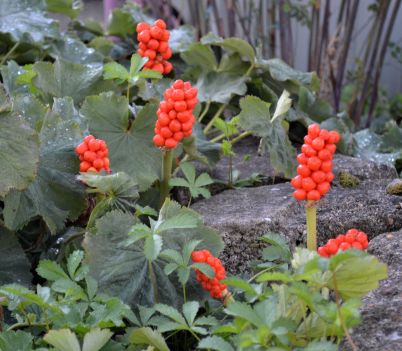
cuckoo pint fruit.01

Arum maculatum fruit in my garden (undated)

There is some variation in form between different wild Arums I am encountering around the Baldons on my Oxon green belt patch walks. The cream-coloured spadices of these ghostly, quasi-religious looking plants (below, top row), captured at dusk suggest a degree of hybridisation, being more like those of the continental Arum italicum than our own A maculatum. The former is grown in gardens such as my own, so maybe those aforementioned pollinators are ranging more widely. Some leaves also display a brown-blotched appearance, and in one case even the spathe (below, bottom).
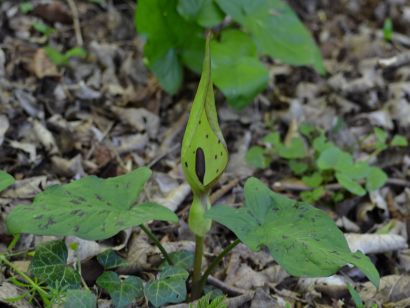
cuckoo pint.2026 the baldons

Cuckoo Pints are always invasive. It is one of the wild plants that persist in my garden – like Bluebells, Euphorbia, Lily of the Valley and the ubiquitous Celandines – that however much I might try to reduce them are always back in force the following spring. Wild Arums are not robust, so if growth is removed after flowering there will be no visible trace through summer, autumn and early winter. Then new glossy green foliage will issue from the soil again as the end of winter beckons a new spring season and the renewed life then forthcoming.
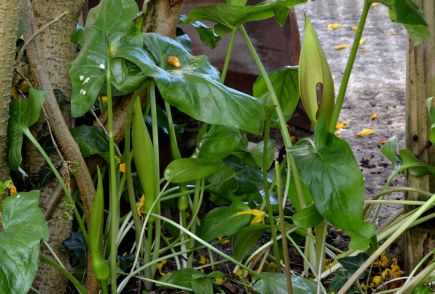
arum maculatum or cuckoo pint.2001

Cuckoo Pints in a neglected corner of my garden

Now is the time to see and enjoy the sole English Aroid in bloom in our countryside, and if sought out there are plenty of them to be found. But these suggestive, evocative, even haunting symbols of simpler past ages and pleasures, that have been held in popular fascination for so long are in themselves far more transient. What thing of such strange, alluring beauty does not have the right to be so? Such is the mystery of Aroids and such, perhaps is life.
A celebration of the Orange Tip and other early season British butterflies – 12th Apr

It is an oft-repeated mantra among wildlife enthusiasts at present that whatever the plight of the human populace, the endless rhythm of life in the natural world continues. In this period of national lock-down to counter Covid-19 I have on most days been walking the local right of way network between my own and nearby villages. Despite living here for 20 years I had only done that in part previously. The past three weeks since emergency measures were announced have seen me explore it all. Now, having identified the better looking wildlife corridors, I may attempt to patch watch them for as long as current restrictions continue.

As of this Easter Sunday I have recorded all 10 of the common butterfly species that can be expected by this time of the new season. Upon coming across my first Orange Tips four days ago my priority at once became to acquire better portraits of a very difficult subject to capture well. Surely this exquisite symbol of annual renewal in nature is one of our most delicately beautiful butterflies. But they are typically very restless, and fly a long way between settling if doing so at all, especially in the full heat of the day.
j preview2

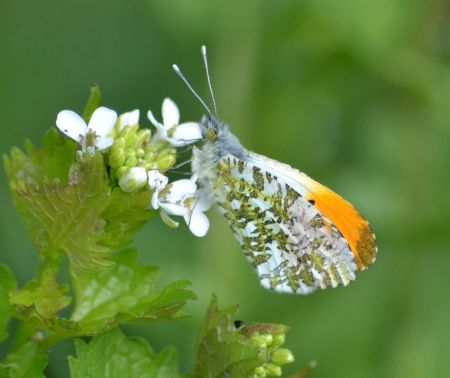
Resting male Orange Tip on Garlic Mustard

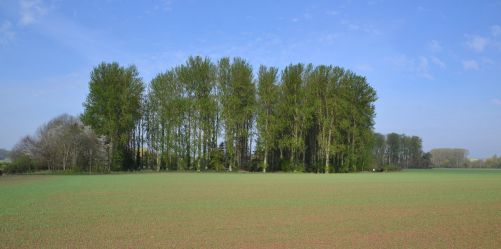
On this once again sunny morning I set out to walk the Thame valley north of the next village of Chiselhampton. On reaching a wooded feature known as The Jenet (SP606004) at some time before 10am I noticed a resting Orange Tip on vegetation by the track side, and more soon appeared. Perhaps this is a roost site. In any case the wild plant-rich margin of the tree belt, carpeted with flowering Nettles and Garlic Mustard, looked very butterfly friendly. The day was just beginning to warm up and my quest were perching on flower heads while keeping quite still. This is in my experience a not too frequent opportunity to achieve what I was seeking, and I was clearly in a good place at the right time.

little milton.2002 the jenet

The Jenet, near Little Milton, Oxon

I have already referred to the constantly on the move character of male Orange Tips, that are a familiar springtime sight across much of the British Isles along hedgerows and woodland edges, as well as in parks and gardens. Thomas and Lewington describes them as “a patroller par excellence“, wandering the countryside through much of the day searching every shrub and tussock for mates. The less conspicuous females are more elusive, concealing themselves in bushes for hours on end.

That reference book also cites males as being “fine examples both of warning colouration and camouflage”. The distinctive wing tips in flight alert predators that this butterfly is distasteful, their bodies containing quantities of bitter oil accumulated during the larval stage from Garlic Mustard, the principal food plant. Birds will rarely take them more than once. When at rest the upper wings are lowered and blending in becomes the best form of self protection.

The Orange Tip’s wandering lifestyle takes it into a great variety of habitats and they are widespread in gardens from April onward. There they are attracted by cultivated plants such as Honesty, Sweet Rocket and Lady’s Smock. But these consummate nomads rarely linger in any place for long. Numbers peak during May and flight continues into June, with a second brood occurring in the earliest flight seasons.

Females have grey rather than orange wing tips but share the attractive underside patterning of males, the hind-wings being mottled delicately with lichen-like green. Old fashioned, colloquial names for them included “Lady of the Woods” or simply “Wood Lady”, those being possibly a little more evocative than the modern day equivalent. I found one (pictured below, right) in another small woodland along my Easter Sunday morning route at SP608007.

The other butterflies seen so far on my new patch are the early season staples Peacock, Small Tortoiseshell, Comma, Small, Large and Green-veined Whites; Brimstone, Speckled Wood and Holly Blue. I have been especially impressed by the numbers of Peacock everywhere I tread, the newly emerged hibernators seeming quite widespread after the mild winter just past. As Orange Tip is perhaps one of our most delicate, surely the Peacock (below, top row) is one of our boldest butterflies. The other two new season’s hibernators are in the bottom row.

My own lock-down routine is mostly to exercise in the mornings then spend the rest of the day in the garden at home. The local footpath network may be accessed from selected points on my way back from visiting local convenience stores, or else I walk from home. I prefer to go out early as the only people I need to distance from then (as they do me) are just a few joggers, dog walkers or other hikers. Almost everyone I pass is pleasant and friendly, being out for the same reasons as myself, though for much of the time I barely see a soul.

The present situation is altering my outlook in different ways. Not least when I recall the tranquillity I sought and found butterflying in the south of France last July, I now realise I can achieve that within a short distance of my doorstep. I was wondering how to motivate myself in the coming local wildlife season, so if needs must patch working could be the answer. Importantly, my near three-stone (19 kg) weight loss in just over 12 months and continued high protein diet appear to be giving me boundless energy.

A year ago I was experiencing joint pain from walking just short distances. Now I enjoy the local countryside for up to six or seven miles at a stretch, drawing on seemingly re-found reserves. On that note I’ll end with an image of my season’s first blooming Cuckoo Pint (below) also from this morning’s walk – perhaps another symbol of spring-time renewal in nature.

rtdactw

“Rise today and change this world” *

* (Lyric © Alter Bridge, 2007)  Were I a photographer, as I often stress I’m not, I might perhaps find all kinds of fault with the half decent Orange Tip images this post contains. Likewise I might not have made too much effort to capture them pictorially in more usual butterfly seasons, and so have just a small number of previous studies in my collection. But the opportunity to witness and record the re-emergence of the precious jewel that is Orange Tip has never seemed more uplifting, refreshing and welcome than now.

Filling the day: A Laughing Gull at roost in Avon after a dawn Dipper in Bucks – 14th Mar

Today was mostly about its early morning and late afternoon, less about the time in between, and also about recording my career 500th bird for the Western Palearctic region. That personal landmark was reached courtesy of a Laughing Gull that over the previous four days (since Tuesday 10th) had been logged coming in to roost at Chew Valley Lake (ST565606) just south of Bristol, then flying out again at up to 10 o’clock in the mornings.

I find this common and widespread Nearctic Gull attractive, having experienced many in various plumages two years ago in Florida. In the British Isles it is a rare vagrant. The two mainland opportunities I recall prior to that 2018 life’s great adventure – at Dungeness (Jun 2016) and on Merseyside (Apr 2015) – were both in what I considered unappealing locations and rather too far to drive. So when this latest individual, a first winter bird turned up at just over 90 miles from home I immediately felt interested.

laughing gull.1814 1w sanibel island

First winter Laughing Gull in Florida (Jan 2018)

But picking one Gull out of a possibly distant roost is not a birding activity I have ever relished. So I waited to see whether any pattern might emerge that could ease my task. Now, given the absence of the usual Saturday afternoon filler of live football on TV and radio, I considered my motivational options at around midday then hit the road.

I arrived on-site mid-afternoon and pulled into a shore-side lay-by alongside CVL’s Heron’s Green Bay. There I engaged with two friendly local birders who said it was as good a spot as any to seek my quest. Though I at once thought any sighting from there would be distant, it became apparent they were in contact with colleagues stationed at the various locations where the Gull had been viewed thus far, so I stuck with them.

By 4:20pm nature’s necessities prompted my relocation to Woodford Lodge, the visitor centre and cafeteria where the required facilities might be found. That had also been the most oft-cited spot from which to scan the Gull roost over the preceding days, and on getting there I found rather more developed twitch lines. Now it was a matter of tagging along, letting other birders do the harder work as is my preference, and seeing what transpired.

chew valley lake

The outlook across Chew Valley Lake from Woodford Bank © rights of owner reserved

At some time after 5pm a ripple and murmur enveloped the gathering as various people simultaneously called: “It’s there, with the Common Gulls”. The safest option was to ask a nearby birder to put me on the Laughing Gull in my own scope, which bird then stood out at once by it’s dark tone, black bill and relatively slim build. Having been thus assisted it was quite easy to re-find a number of times. I was impressed by the youth of more than a few of my companions and just how knowledgeable they were, and so might keep trying myself. One Cornish 20-something had also reached and passed 500 WestPal today, or so he said.

The Gull thereafter seemed unlikely to move in any closer, drifting ever sideways out in the mid-to-far distance. But I had ticked it for Blighty and thus satisfied opted to head for home with the warm glow of a successful twitch within me. As I drove away most of the other birders had also departed or else were doing so. It would have been impossible to gain pictures today. For what has been posted on RBA so far see here.

My day had begun with a short drive the other side of Oxford to a public park, The Rye (SU 875921) in High Wycombe, Bucks. There a Black-bellied Dipper had been reported on RBA early on Friday morning on a rocky water feature at the outfall from a long ornamental lake known as “The Dyke”. Amongst sub-species of Eurasian Dipper the one resident to the British Isles has a chestnut coloured band on the darker brown / black belly. The more widely distributed continental European Ssp does not, the underparts being uniformly darker, hence the citation “black-bellied”. Small numbers of these are reported nationally each winter but I had yet to observe one here.

dipper.1701 black-bellied corsica

Black-bellied Dipper in Corsica, Sep 2017

When one turned up in another public park outside Northampton for a few days at the beginning of March I looked back through my picture archives and found I had recorded a BBD in Corsica in September 2017 (pictured above). On the day I planned to go for the Northants bird it moved on, so now I was interested to try for this latest, even closer one to home. On 13th I had arrived mid-morning to find several people standing right at the waters edge and yapping dogs on the path above the waterfall, which hardly looked promising.

I then heard a tale of how a dog walker had allowed his pet to scare off the Dipper, then two birders “had a go” at him, he “got the hump” and sent the dog into the water again. Such are the pitfalls of trying to bird in a public park. It was not rocket science to surmise the Dipper was hardly likely to come back with a posse of optics toters now in such close attendance. Hence I searched the water course that flows through the park for as far as I could walk, downstream then up but without success and so gave things up for the day.

In the afternoon I was contacted by a local birding friend who said colleagues would be looking for the Dipper again both at dusk and first light today (14th), so I would be kept informed. It was not seen again on Friday but the dawn tripette still seemed worth making. As I turned off the M40 a message came in to say the Dipper was back, which sort of tip-off is always helpful. So all I had to do was arrive on site in confident mood and walk over to where people were gathered. Things this time were as easy as that.

dipper.2001 black-bellied high wycombe

Black-bellied Dipper in High Wycombe

Now eight birders were standing at a sensible distance and the Black-bellied Dipper (pictured above) was moving around the water feature. The aforementioned colouration was quite obvious, and I watched it going about it’s business for around 15 minutes. At just after 6:50am if flew off towards the long lake of it’s own volition, then after hanging around myself for another 20 minutes or so I decided to go on my way. The bird did return, and was reported on and off right through Saturday, but I suspect a bit of a circus might have developed later.

As the country is now in the grips of worldwide hysteria concerning the Covid-19 outbreak I feel glad to have both birding and gardening as interests should normal life be suspended. With many people stockpiling supplies and stripping out supermarkets, on my way home from Wycombe I took advantage of the still early hour to acquire a small stash of my own before pandemonium broke. So now I need not go out too much in public for a few weeks if that is what we are all instructed to do. There could be more days like this to fill in the time ahead. Today I did that quite successfully.


Blue-winged Teal at Man Sands Wetland, Devon – 12th Feb

As February lurches back towards the mundane I opted to try for a British and WestPal bird list addition that I had recorded previously only in Florida two years ago. A first-winter drake Blue-winged Teal, of genuine cited provenance has been over-wintering on these shores in the southern part  of the “English Riviera” in south Devon through much of the current season.

Though at 180 miles this vagrant Nearctic duck was beyond my past preferred range, I had been considering taking another step on that slippery slope for a while now. Earlier in the winter it (the BWT) could perhaps have been described as rather nondescript, but more recently a few recognisable pictures had begun to appear online. And some other Oxon birders had hence made the same journey as spring approaches, ahead of myself.

DSC_0063

Today’s best effort … Blue-winged Teal (imm male)

I arrived on site at the tiny and highly picturesque NT Man Sands Wetland to the south of Brixham just before 9:00am, feeling a little flat perhaps a week on from GGOslo, though that is something about which I should not complain. From a car park at SX 91311 53068 an unmade road leads steeply down to the shoreline behind which lie some man made lagoons. In the cold, clear morning light it was at once plain I had gotten somewhere above averagely pleasant, and with bird sounds filling the air and their sources active in the hedgerows my dulled spirits began to revive.

The wildlife habitat here has been created by the National Trust (see here) since 2005, by removing old sea defences and field drainage to create a series of pools of standing water and marshland. A well established reed bed has now developed and the whole complex attracts common wildfowl and other water birds, wintering waders such as Snipe, and more. Today Cettis Warbler announced themselves here and there, while Stonechat were prominent in the surrounding fields. A Black Redstart has also over-wintered around a redundant lime kiln at the site though I wasn’t able to locate it.

man sands wetland.2001

Man Sands Wetland looking towards the sea

On the landward side of the wetland is a small, elevated bird hide. My quest had been absent from RBA over the previous three days, though having been resident in the locality for quite some time it has become less newsworthy. Would it still be here? I scoped around the scene before me picking out small numbers of Gadwall, Mallard, Tufted Duck, Moorhen and Coot … and then the unmistakable form of the Blue-winged Teal. It was now 9:30 am and mission had already been accomplished.

The most noticeable features at that range of a BWT drake are possibly the broad white facial crescent and a bill that is much larger than those of Eurasian and other Teal species. This maturing individual was certainly an attractive sight as it dabbled continuously in the marshy vegetation of its adopted abode. The home range is north America where they occur almost throughout the continent, and British records average around four a year.

man sands wetland.2003 map

Man Sands Wetland and environs (site plan)

From the hide I noticed occasional walkers on the South West Coast Path between the lagoons and the beach here. Gaining any recognisable pictures from where I was seemed unlikely and so I walked down to the shoreline to try my luck closer in. Indeed better results were then attainable though nothing of any quality. At all times this otherwise delightful duck seemed intent on keeping to semi-cover and making acceptable pictures of itself as difficult as possible to acquire. These records (below) are all digiscoped.

I hadn’t especially wanted to come here today but the longer I lingered in this remote, even idyllic location the more I was drawn in by its natural beauty and tranquillity. And so as on many occasions in even more off the beaten track parts of the world I came to evaluate the seclusion of my situation. It was just me again in communion with this other lone wanderer, not unlike that with the Dwarf Bittern on Fuerteventura a year ago. This is what I know and it would be churlish not to appreciate that I can do these things.

man sands wetland.2002

Man Sands Wetland looking inland

After two hours on site hunger pangs prompted my departure, then I drove into Brixham to seek a pasty shop. Earlier in the hide I had taken an opportunity to take pictures of several Bullfinch that were attracted to feeders placed just outside. The pictures (below) are impacted by having been captured through a none too clean, non-lift-able window.

Cirl Bunting has become something of a staple during my more recent travels in southern Europe, but in the British Isles is present only in south Devon that represents a kind of outpost in the species’ European range. My first career record was in November 1988 at Lannacombe Bay, south of where I was today, at which I believe Cirls are now rather more occasional. 16 miles north of Man Sands lies RSPB Labrador Bay (SX 930703), a small coastal reserve that is managed for the species and is now cited as the best site to observe them nationally.

cirl bunting.2001 labrador bay

Cirl Bunting

It seemed a pity not to take such an opportunity when I was nearby, so that is where I headed in the afternoon. It didn’t take long to locate some Cirls (pictured above) and I found just three. An information board quoted 34 pairs on territory, but there was a lot of very steep habitat to search and by now I was feeling quite tired. So contenting myself with a reconnoitre of the site I spent just an hour there, filed it away for future reference then headed home.

The bottom line today was I gained a career 355th British and 499th WestPal bird. 180 miles indeed seems to be the new 150 where travelling is concerned, and time on the road passed easily enough. But it’s not all about numbers as a very wise Oxon birding colleague once chided me. The snap decision upon waking too early to plug a little gap in the field guide had produced an interesting and worthwhile outing.